WASHINGTON – The Navy has completed shakedown trials on the USS Massachusetts (SSN 798) and the submarine is ready for Fleet tasking. As a result of the superb material condition and combat readiness, the Navy waived the post-shakedown availability of USS Massachusetts (SSN 798). This decision was made possible by the operational quality of the ship during trials and the urgency to deliver warfighting capability to the Fleet.
MECHANICSBURG, Pa. – Thirteen students selected for employment at Naval Supply Systems Command (NAVSUP) Business Systems Center (BSC) through the Department of War (DOW) Cyber Service Academy (CSA) completed a 10-week summer internship session onboard Naval Support Activity Mechanicsburg, Aug. 14.
The Office of Naval Research (ONR) today announces the first class of 12 winners in its inaugural Chief of Naval Research (CNR) Fellows program.
Launched earlier this year, the fellowship is designed to foster a constant infusion of state-of-the-art knowledge, while simultaneously creating a growing network of researchers who can translate the Navy and Marine Corps’ most pressing challenges into science and technology (S&T) research that will provide critical benefits to Sailors and Marines.
The CNR Fellows program brings the dozen academic research professors to ONR for a one-year fellowship in support of critical naval focus areas, with a stipend of $150,000 per Fellow.
FREEPORT, Bahamas — The Freedom-variant littoral combat ship USS Cooperstown (LCS 23) arrived in Freeport, Bahamas, for a scheduled port visit on Aug. 13. This visit highlights the strong, enduring partnership between the United States and The Bahamas and underscores a shared commitment to maritime security and regional stability.
U.S. Navy forces are deployed under U.S. Northern Command’s (USNORTHCOM) maritime homeland defense authorities in support of maritime homeland defense. USNORTHCOM is working together with the Department of Homeland Security to provide additional military forces and capabilities to protect the territorial integrity of the U.S. southern border.
During the multi-day visit, the crew of Cooperstown expects to participate in a series of engagements designed to foster goodwill and strengthen bilateral ties. U.S. Navy Sailors will volunteer their time for a Community Relations (COMREL) project at the Beacon School, giving back to the local Freeport community.
The ship’s crew will also conduct scheduled ship tours for members of the Royal Bahamian Defense Force and the Royal Bahamian Police Force to share best practices and enhance interoperability between the partnering maritime forces.
“Our port visits reflect the enduring partnership between the United States and The Bahamas and underscores our shared commitment to strengthening maritime security throughout the region,” said Commander Jesse DuParc, Commanding Officer of Cooperstown. “Through meaningful engagement with the Royal Bahamas Defense Force, lasting community outreach, and amazing professional exchanges, we thoroughly enjoy the genuine trust, interoperability, and enduring relationships that enhance maritime domain awareness and strengthen our collective ability to promote lasting security and stability across the Caribbean.”
Cooperstown’s visit to Freeport demonstrates the U.S. Navy’s continued presence in the region and its dedication to working alongside partner nations to ensure a secure and prosperous Caribbean.
U.S. 2nd Fleet, reestablished in 2018 in response to the changing global security environment, develops and employs maritime ready forces to fight across multiple domains in the Atlantic and Arctic in order to ensure access, deter aggression and defend U.S., allied, and partner interests.
For more U.S. 2nd Fleet news and photos, visit facebook.com/US2ndFleet, https://www.c2f.usff.navy.mil/, X – @US2ndFleet, and https://www.linkedin.com/company/commander-u-s-2nd-fleet.
U.S. Naval Forces Southern Command/U.S. 4th Fleet completed the Combined Force Maritime Component Command (CFMCC) portion of the annual exercise PANAMAX, Aug. 3-12. This portion of the exercise helped provide maritime-focused interoperability training for the U.S. and participating multinational staffs, and build participating nation capability to plan and execute operations.
Participants in the CFMCC portion of the exercise were challenged with various maritime scenarios to help hone their skills, forge strong cooperative partnerships, and demonstrate their collective capacity to respond to and deter threats to maritime regions and critical waterways. Working together promoted a shared understanding of threats and goals, while furthering the commitment to ensure lasting regional peace by leveraging combined strengths.
“The two weeks have been intensive,” said Rear Adm. Carlos Sardiello, Commander, U.S. Fourth Fleet. “The high tempo required a total team effort; we came here as individuals, and we leave here as a team, forged together.”
Under the exercise scenario, participants from air, land, special forces and maritime components formed a multinational force to defend the Panama Canal under a United Nations Security Council resolution. The scenario played out with complex simulated operations in the canal and its regional waters in both the Eastern Pacific Ocean and the Caribbean Sea.
“This exercise is essential because it’s a crucible on which we forge our own individual strengths, and we address our weaknesses and our self-doubt,” said Sardiello. “We worked outside our comfort zones to develop as leaders and as officers.”
The CFMCC portion of the exercise was conducted at locations in the U.S. to include Joint Staff Exercise Directorate at Suffolk, Va., U.S. Southern Command, Doral, Fla., Fort Sam Houston, San Antonio, Texas, Homestead Air Reserve Base, Homestead, Fla., Davis-Monthan Air Force Base, Tucson, Ariz., and Naval Station Mayport, Fla. More than 150 U.S. and partner nation personnel worked at these locations and brought the knowledge of their individual skillsets to contribute to the team effort.
“It is important, the friendships we built these two weeks of hard working,” said Chilean Navy Capt. Juan Pablo Villanueva, Deputy Commander of the Maritime Component at PANAMAX 2026, “I am certain that each of us will cherish the personal and professional qualities we shared. Memories will endure, and whenever we cross paths at an international event, we will remember that we were Panamax 2026.”
Nations who participated include Panama, Argentina, Belize, Brazil, Chile, Colombia, Costa Rica, Dominican Republic, Ecuador, El Salvador, Guatemala, Honduras, Jamaica, Mexico, Netherlands, Paraguay, Peru, UK and the United States.
PANAMAX 2026 is a Republic of Panama-hosted, U.S. Southern Command-sponsored training exercise that seeks to improve interoperability and strengthen collective capacity to conduct complex multinational and all-domain operations to ensure free flow of commerce through the Panama Canal and maintain security and stability in the region.
WASHINGTON — Acting Secretary of the Navy Hung Cao has appointed Kahlil “KD” Warner as the Senior Advisor to the Secretary of the Navy for Legislative Affairs serving within the Office of Legislative Affairs (OLA). In this role, he serves as the principal civilian advisor responsible for reviewing and coordinating timely, accurate responses to official correspondence, resolving constituent issues, and clarifying Department of the Navy policy on items of congressional interest.
“For the safety and security of our Nation, Congress must fully understand what our Sailors, Marines, and civilians need to accomplish their mission today—and tomorrow,” said Secretary Cao. “Just as we rely on congressional support, we must remain strictly accountable for every dollar appropriated to us. Mr. Warner is the ideal advisor to continue to strengthen this vital partnership, ensuring our communication is transparent, precise, and directly aligned with our strategic goals.”
On April 21, 2026, the Department of the Navy released the Fiscal Year 2027 President’s Budget request focused on restoring American maritime dominance with a total Navy topline of $377.5 billion. By strengthening the Department’s relationship with Congress, Mr. Warner will play a vital role in articulating the necessity of these investments and securing the resources required to modernize our Fleet. His strategic engagement will directly support our warfighters, ensuring the Navy-Marine Corps team maintains the advantage necessary to deter adversaries and decisively win conflicts in any contested maritime environment.
“It is my profound honor to serve the Navy-Marine Corps team in this capacity,” said Warner. “I look forward to working closely with Secretary Cao, Department of the Navy leaders, the industrial base, and our partners in Congress to bring a one team, one fight mentality, ensuring our Sailors and Marines have the unwavering legislative support and resources they need to maintain our maritime superiority.”
Prior to his appointment, Warner served in the Office of the Assistant Secretary of War for Legislative Affairs as the Senior Legislative Advisor to both the Under Secretary of War for Policy and the Under Secretary of War for Personnel & Readiness. In that role, he delivered critical legislative counsel to Department of War senior officials regarding congressional intent on high-priority matters.
The USS Abraham Lincoln crushed their deployment and will return home soon as part of a planned rotation. Details will come but let me be clear: the safety and security of our Sailors and Marines always comes first.
Mission accomplishment. Troop Welfare. This is how we lead.
The Lincoln was extended because the mission demanded it. Deployments are hard. Combat operations make them harder. War is hell and normal routines are disrupted. One of the hardest aspects about warfighting beyond knowingly placing our service members in harm’s way is that even with the best planning and communication, change and uncertainty will always be in play. Our success depends on how we adapt.
Sailors and Marines are expected to dig deep—and they always do. A leader’s responsibility is to take care of their people the best they can while balancing mission requirements. During this deployment we have seen both: the job is getting done and our leaders are taking care of their people.
Unfortunately, the media are trying to paint our warriors as victims. Not only is that dishonest but it takes away the focus on the enemy and the threat it poses against our nation, people, and way of life.
Here is the truth—
266 days deployed.
200 days in a combat zone.
10,000+ sorties.
1.5M lbs. of ordnance dropped.
And retention rates on the ABE are amongst the highest of all carriers.
It is also true—
A small number of mental health cases were treated with no loss of life.
Meal plans were adjusted when fresh resupply was unavailable, without a single meal being missed.
Calls home were limited when the operational threat was too high.
There is no question our young men and women have been pushed to their limits—but they have never broken. They are rightly tired—but have never been out of the fight. However, it is clear, knowing the whole story, our force and their families are not victims. They are the epitome of American strength and resilience.
So, when the USS Abraham Lincoln pulls into the pier, join me and stand proudly with a grateful heart and give our Sailors and Marines the Hero’s Welcome they deserve. Semper Fi and Hooyah.
Nimitz-class aircraft carrier USS George Washington (CVN 73), flagship of Carrier Strike Group (CSG) 5, Carrier Air Wing (CVW) 5, Ticonderoga-class guided-missile cruiser USS Robert Smalls (CG 62), and Arleigh Burke-class guided-missile destroyer USS Shoup (DDG 86) departed Da Nang, Aug. 5, 2026, concluding a scheduled port visit that reinforced the enduring partnership between the U.S. and Vietnam.
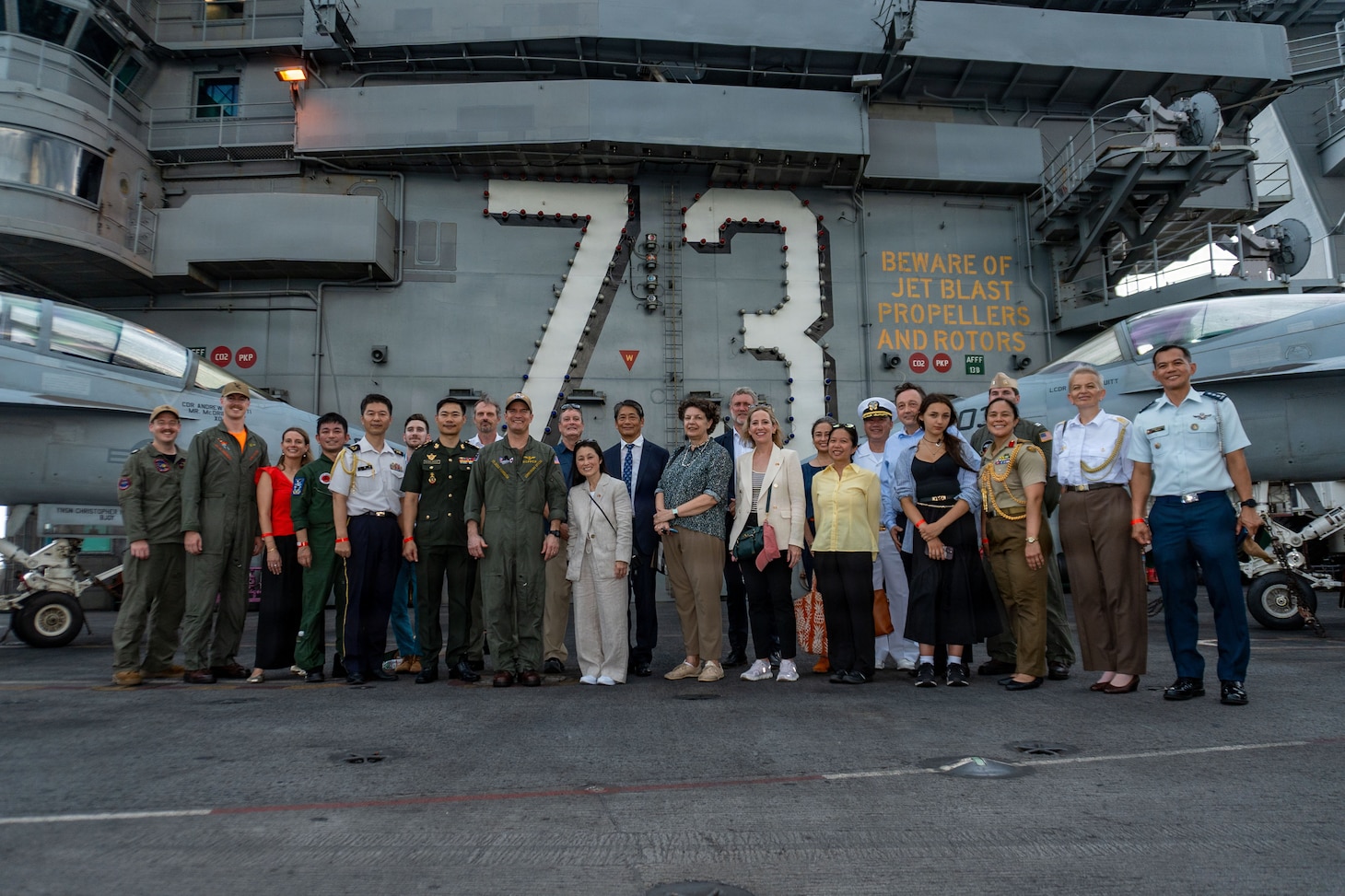
Capt. Nicholas DeLeo, commanding officer of Nimitz-class aircraft carrier USS George Washington (CVN 73), center, poses for a group photo with distinguished visitors on the flight deck during a scheduled port visit to Da Nang, Vietnam, Aug. 3, 2026. George Washington is the U.S. Navy’s premier forward-deployed aircraft carrier, a long-standing symbol of the United States’ commitment to maintaining a free and open Indo-Pacific, while operating alongside allies and partners across the U.S. Navy’s largest numbered fleet. (U.S. Navy photo by Mass Communication Specialist 2nd Class Tyler Crowley)
Upon departure, the George Washington Carrier Strike Group (GWA CSG) and forces from the Vietnamese People’s Navy conducted a bilateral search-and-rescue (SAR) exercise at sea. This cooperative maritime exercise allowed both nations to build upon relationships formed ashore and practice coordinated communication, emergency response, and life-saving procedures in the maritime domain. The U.S. and Vietnamese maritime services work together to improve Vietnam’s ability to maintain bilateral maritime domain awareness.
During the port visit, the leadership and crew of George Washington engaged in a robust schedule of key leader engagements with military counterparts to include a reception with 400 guests from Vietnam, a friendly soccer game between US and Vietnam Sailors, U.S. Seventh Fleet Band concerts, and ship tours for over 450 guests aimed at building trust and highlighting the strengthening U.S.-Vietnam partnership. Each iteration serves to further deepen the network of cooperation that represents the critical importance of maritime partnership.
“Whether we are navigating the complexities of an at-sea rescue exercise or playing a spirited game of soccer on a local field, the goal is the same: building human connections,” said Capt. Nicholas DeLeo, commanding officer of George Washington. “The hospitality shown to our Sailors by the people of Da Nang was world-class. Through these cultural exchanges and cooperative training events, we strengthen the bonds that help maintain peace and stability throughout the region.” The U.S. Navy looks forward to the continued work with the Vietnam People’s Navy and across the Vietnamese Ministry of Defense to advance a free, open, secure, and prosperous region.
The GWA CSG is operating in the U.S. 7th Fleet area of operations. George Washington is the U.S. Navy’s premier forward-deployed aircraft carrier, a long-standing symbol of the United States’ commitment to maintaining a free and open Indo-Pacific, while operating alongside allies and partners across the U.S. Navy’s largest numbered fleet. U.S. 7th Fleet, the Navy’s largest forward-deployed numbered fleet, routinely interacts and operates with allies and partners in preserving a free and open Indo-Pacific.
A multidisciplinary team of recent NPS graduates from the space systems, physics and electrical engineering programs developed a Terahertz Imaging Camera, combining their individual thesis research efforts into a functioning payload set for launch to the International Space Station in 2027. (U.S. Navy photo by Mass Communications Specialist Second Class Abreen Padeken)
At the Naval Postgraduate School (NPS), a team of students and faculty is demonstrating how space innovation is not the product of a single discipline, but the result of tightly coordinated teamwork across time and academic disciplines. Their project, the Terahertz Imaging Camera (TIC), set to launch to the International Space Station (ISS) in 2027, stands as a powerful example of how NPS transforms defense-focused education and applied research into real-world operational capability.
From its earliest stages, the TIC effort has been defined by integration, not just of hardware and software, but of people, expertise and ideas. Several students from NPS’ space systems, physics and electrical engineering programs each took ownership of a piece of the system, working collectively to build a complex payload designed to operate in the harsh environment of space.
“Space systems are inherently multidisciplinary,” said NPS Space Systems Academic Group (SSAG) chair Dr. Wenschel Lan, co-principal investigator (co-PI) for the TIC. “This project gives our students the opportunity to work together with subject matter experts to design, build, test and operate real spaceflight hardware. That collaborative experience is critical to solving real-world problems.”
The project is a low-cost, space-based terahertz (THz) imaging system for remote sensing of atomic oxygen emissions in Earth’s upper atmosphere. These emissions are critical for understanding upper atmospheric dynamics and winds, which impact satellite communications.
They can also be used for identification of human-induced sources of THz radiation, such as spacecraft launch and reentry, as well as other phenomena of interest to the defense and intelligence communities.
The THz band that the TIC surveils lies between microwave (radar) and infrared (thermal imaging) wavelengths and is generally very difficult to detect, according to Dr. Fabio Alves, professor of physics and co-PI for the TIC project.
“We are building a sensor based on metamaterial films that can absorb terahertz waves of specific frequencies with high efficiency,” Alves explained. “The terahertz sensor, designed with the help of physics professor Dragoslav Grbovic and 2025 graduate U.S. Air Force Lt. Col. Jennifer Nolta, is a matrix of more than 3,000 pixels that heat up on terahertz absorption. The heat of individual pixels is probed by an infrared camera on the backside, constructing an image of the terahertz scene.”
Additionally, Alves adds, the focalization optics for the terahertz and infrared portions was designed by U.S. Air Force Maj. Daniel Nelson, also a 2025 graduate.
The TIC was one of seven projects selected through NPS’ inaugural Digital Trident AI Challenge in 2025, with partial funding and in-kind support provided by the NPS Foundation and Alumni Association. Chosen from 38 entries, each of the seven projects takes on key operational problems critical to U.S. national security.
In addition, Alves notes, TIC was selected by NPS’ Consortium for Robotics and Unmanned Systems Education and Research (CRUSER) for seed project funding focused on the study of autonomous surveillance to be implemented in future terahertz sensors.
“The Digital Trident AI Challenge is part of NPS’ effort to explore, experiment with, and operationalize emerging technologies that will have an immediate and advantageous impact on national security challenges,” said Kaitie Penry, director of the NPS Emerging Technology and Innovation Office (ETIO).
Putting that vision into practice, the TIC payload reflects the combined expertise of the interdisciplinary team behind it.
It incorporates a novel microelectromechanical (MEMS)-based sensor, an intricate optics assembly, custom electronics, and a structure engineered to survive launch and on-orbit conditions. Each component represents a specialized challenge, but the true difficulty lies in bringing them all together into a single, functioning system.
Members of the Terahertz Imaging Camera (TIC) team — U.S. Navy Ensign Yvonne Fu and Lt. Joshua McCowan and Marine Corps Lt. Col. Brian Neri, from left — review the technology’s concept of operations in the space systems lab. The TIC is a low-cost, space-based terahertz (THz) imaging system for remote sensing of atomic oxygen emissions and other human-induced sources of THz radiation. (U.S. Navy photo by Mass Communications Specialist Second Class Abreen Padeken)
“The optics assembly, the sensor, the structural design, the electronics … They’re all individual problems,” Lan explained. “But integrating everything into a functional instrument is where the team effort really comes in.”
For the students, that integration began in the classroom and quickly evolved into a shared mission. Many joined the project through coursework before continuing into thesis research, creating a pipeline of contributors who built on each other’s work.
“When I came onto the project, there was a gap in how we interfaced the camera with the onboard systems,” said U.S. Navy Lt. Joshua McCowan, a June 2026 graduate in space systems operations. “That became my role, and from there it grew into my thesis. Everyone kind of found their niche and contributed where they were needed.”
U.S. Marine Corps Lt. Col. Brian Neri, a dual degree graduate in space systems operations and applied physics, said the collaborative nature of the project was one of its biggest draws.
“You’re not just working on your own piece in isolation,” Neri said. “You’re constantly working with others to make sure everything fits together and meets the overall objectives.”
Neri was among a select group of students who had the chance to brief NASA Artemis II pilot and NPS alumnus U.S. Navy Capt. Victor Glover, when he returned to campus in June after his historic lunar mission. Glover picked up on the camera’s potential naval applications, including its ability to detect objects leaving or entering space, and was keen to learn more as the system is finalized and prepared for launch early next year.
Each student’s contribution to the TIC was distinct, but none stood alone.
McCowan focused on camera calibration, ensuring the imaging system could maintain accuracy despite thermal fluctuations in orbit. Neri developed the concept of operations, bringing together NASA requirements, hardware capabilities, and software constraints into a cohesive plan for how the payload will function on the ISS.
Neri’s thesis, entitled “Concept of Operations and Functional Testing of Terahertz Imaging Camera 2.1,” earned an NPS Outstanding Thesis award upon his graduation in June 2026.
“The concept of operations really pulls everything together,” Neri said. “It takes everyone’s work and defines how we actually use the system to achieve the mission.”
Meanwhile, following the steps of 2025 graduate Nolta’s sensor design, Ensign Yvonne Fu worked in the cleanroom fabricating the focal plane array, a delicate sensor built layer by layer from silicon and metals, designed to detect terahertz radiation. Her work required precision and patience, with each step building on the last.
“It’s a long process with a lot of opportunities for things to go wrong,” she said. “But knowing that what you’re building will be part of the final system makes it worth it.”
Ensign Justin Williams approached the project from a modeling perspective, simulating the terahertz signatures the sensor is designed to detect. His work provided critical insight into how the payload will perform once in orbit.
Ensign Andrew Oleson, meanwhile, ensured the entire system could survive launch and operation in space, conducting structural analyses that tied together the physical integrity of all components.
“My work depends on everyone else’s,” Oleson said. “And their work depends on mine. It really shows how interconnected everything is.”
The TIC team didn’t just divide and conquer individual tasks; rather, the team worked continuously to integrate their efforts. Weekly meetings with faculty advisors and other SSAG faculty and staff, provided a forum to share progress, troubleshoot challenges, and refine designs.
“We were constantly presenting what we had done and getting feedback,” McCowan said. “That helped us stay aligned and build off each other’s work.”
This iterative process mirrored real-world engineering environments, where collaboration and communication are essential to success. For Neri, one of the most important lessons came from navigating trade-offs as a team.
“We had to balance complexity, risk and timeline,” he said. “Those decisions weren’t made in a vacuum. They involved discussions across the team, and understanding how one choice would impact everyone else.”
The complexity of the TIC project inevitably brought challenges, many of which required collective problem-solving.
Ensign Justin Williams and Lt. Joshua McCowan demonstrate the Terahertz Imaging Camera (TIC) system’s casing in the space systems lab in NPS’ Bullard Hall. The TIC was one of seven projects focused on key operational problems selected for funding through NPS’ inaugural Digital Trident AI Challenge in 2025, supported by the NPS Foundation and Alumni Association. (U.S. Navy photo by Mass Communications Specialist Second Class Abreen Padeken)
McCowan encountered discrepancies between the camera’s documentation and its actual capabilities, requiring coordination with manufacturers and adjustments to the team’s approach. Williams faced the challenge of learning specialized software with little existing expertise on campus, reaching out to external researchers for guidance while sharing his knowledge with the team. And Fu dealt with the realities of fabrication, where a single mistake could undo hours of work, all while Oleson reconciled simulation data with real-world testing, ensuring the payload’s structural integrity.
Through it all, the team relied on each other.
“Everybody was working toward the same goal,” Neri said. “That made it easier to push through the tough parts.”
Students consistently pointed to the NPS environment as a key enabler of collaboration. Access to specialized labs, equipment and computing resources allowed them to tackle complex problems, while faculty mentorship ensured they had the guidance needed to succeed.
“Everyone here is willing to help,” Neri said. “Whether it’s faculty, staff or other students, there’s always someone you can go to.”
The structure of the program also supports teamwork. Dedicated time for thesis work, combined with regular interactions with advisors and peers, creates a battle rhythm that encourages collaboration rather than competition.
“There’s a shared sense of purpose,” Fu said. “Seeing how hard everyone else is working motivates you to do the same.”
For SSAG leadership at NPS, learning by doing is a hallmark of their approach, exemplified by the group’s active CubeSat program where students conceive, design, build, test, launch, and operate satellites for real missions in orbit. The TIC project builds on this philosophy where the result is more than a technical achievement — it also develops the technical talent of graduates destined to be leaders in the space domain.
“Our goal is to educate our students to understand space fundamentals, apply this knowledge to real-world problems, and inform the fleet on how space affects the users of these assets,” Lan said. “Regardless of where our graduates go for their next tour, they hit the ground running and are able to contribute meaningfully.”
Graduates from the TIC team are already transitioning into their new roles across operational commands and advanced training pipelines, bringing with them the collaborative skills they developed at NPS. Meanwhile, the TIC payload moves closer to deployment on the ISS, representing more than just a technological milestone, but also a collective accomplishment.
For the students, the most memorable aspect of the project wasn’t any single component or breakthrough. It was the experience of working together. “Seeing all the pieces come together into a single system was incredible,” Fu said.
Neri echoed that sentiment.
“We had a phenomenal team,” he said. “Everyone was dedicated, everyone cared, and we were all working toward something bigger than ourselves.”
That spirit of collaboration, built in classrooms, labs and meeting rooms across campus, is what ultimately made the TIC project possible. And as it prepares for launch, the payload carries with it a clear message … At NPS, teamwork isn’t just part of the process — it’s the driving force behind innovation.
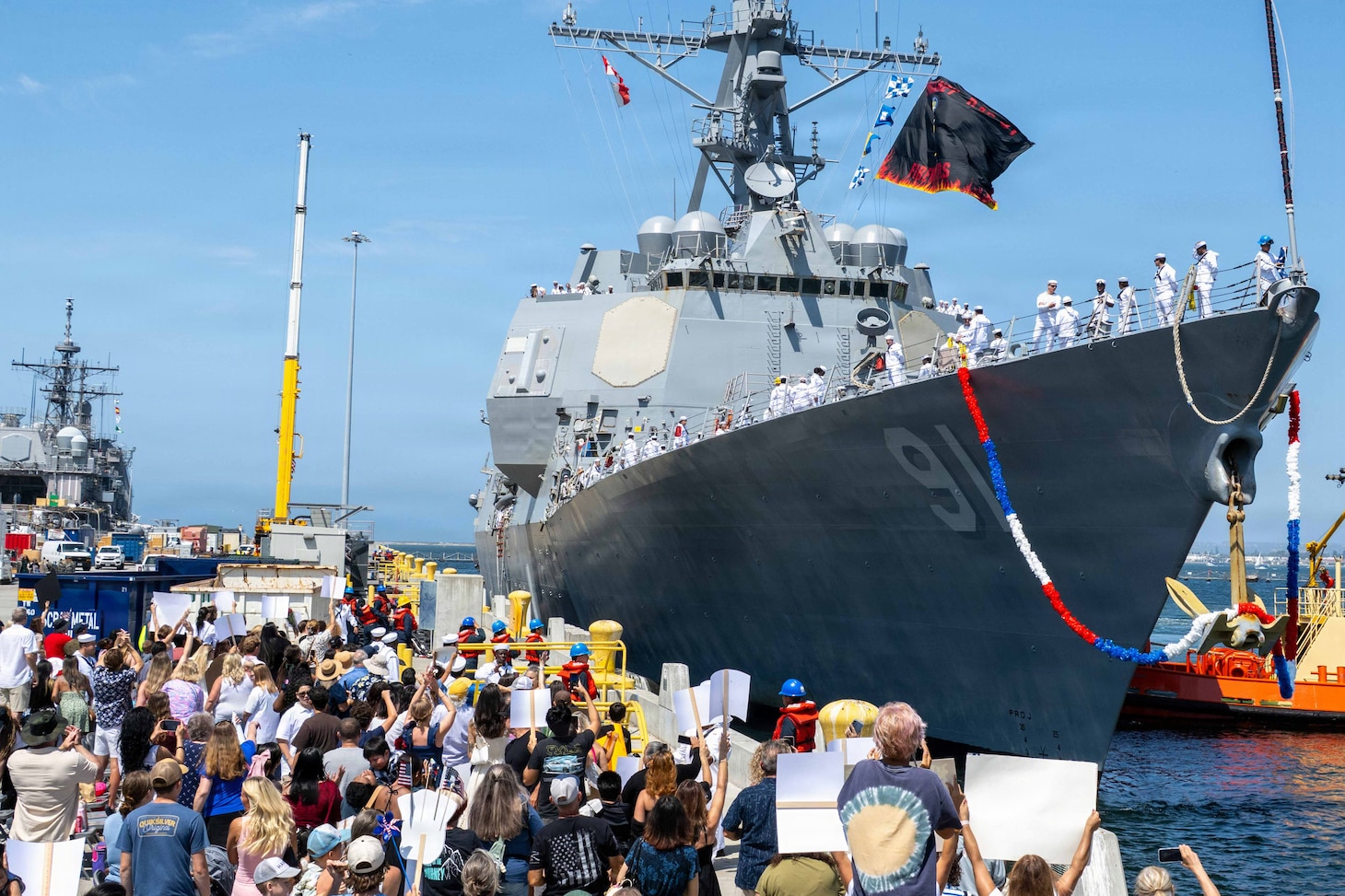
SAN DIEGO – Arleigh Burke-class guided-missile destroyer USS Pinckney (DDG 91) returned to its homeport of Naval Base San Diego, following nine months of operations supporting regional security and combat operations in the Indo-Pacific and Middle East, Aug. 9, 2026.
Arleigh Burke-class guided-missile destroyer USS Pinckney (DDG 91) returns to its homeport of Naval Base San Diego, Aug. 9, 2026. An integral part of the U.S. Pacific Fleet, U.S. 3rd Fleet leads naval forces in the Indo-Pacific and provides the realistic, relevant training necessary to execute the U.S. Navy’s role across the full spectrum of military operations. U.S. 3rd Fleet works together with allies and partners to advance freedom of navigation and overflight, the rule of law and other principles that underpin security for the Indo-Pacific region. (U.S. Navy photo by Aviation Boatswain’s Mate (Launching and Recovery Equipment) Airman Aprentice Ethan Oase)
After departing San Diego on Nov. 25, 2025, Pinckney, along with an air wing detachment from Helicopter Maritime Strike Squadron (HSM) 37, conducted operations to strengthen regional partnerships and demonstrate the U.S. Navy’s commitment to achieving peace through strength in the U.S. 7th Fleet.
During a scheduled port visit to Singapore, the crew successfully completed a ship repair and maintenance exercise, showcasing the crew’s ability to conduct maintenance and repair in forward locations. Pinckney’s operations were highlighted by key leader engagements with the U.S. Ambassador to Singapore; Republic of Singapore Navy Commander, First Flotilla; and U.S. Navy Commander, Task Force 76.
As operational requirements evolved, Pinckney’s mission shifted to support operations in the U.S. 5th Fleet. The crew worked alongside other U.S. Central Command (CENTCOM) joint forces in successfully carrying out strikes in support of Operation Epic Fury. During the U.S. naval blockade of Iranian ports, Pinckney and HSM-37 conducted precision maritime interdictions, compelling 11 commercial vessels to comply with CENTCOM directives.
“Pinckney’s Firewalkers answered every mission with professionalism, resilience, and unwavering commitment,” said Cmdr. Timothy DeVall, commanding officer of Pinckney. “Whether operating in the Indo-Pacific or supporting combat operations in the Middle East, our Sailors consistently demonstrated the readiness and adaptability required to execute our mission. I couldn’t be prouder of what this team accomplished.”
Pinckney steamed more than 48,000 nautical miles across U.S. 3rd, U.S. 7th, and U.S. 5th Fleets; completed 534 flight hours; executed 24 replenishments-at-sea; and transited through five strategic waterways.
An integral part of the U.S. Pacific Fleet, U.S. 3rd Fleet leads naval forces in the region and provides the realistic, relevant training necessary to execute our Navy’s role across the full spectrum of military operations – from combat operations to humanitarian assistance and disaster response. U.S. 3rd Fleet works together with allies and partners to advance freedom of navigation and overflight, the rule of law, and other principles that underpin security for the region.
For more news from U.S. 3rd Fleet, visit https://www.dvidshub.net/unit/COM-US3rdFleet. For more news from CSG-3 and Pinckney, visit https://www.dvidshub.net/unit/CSG3.
 Download