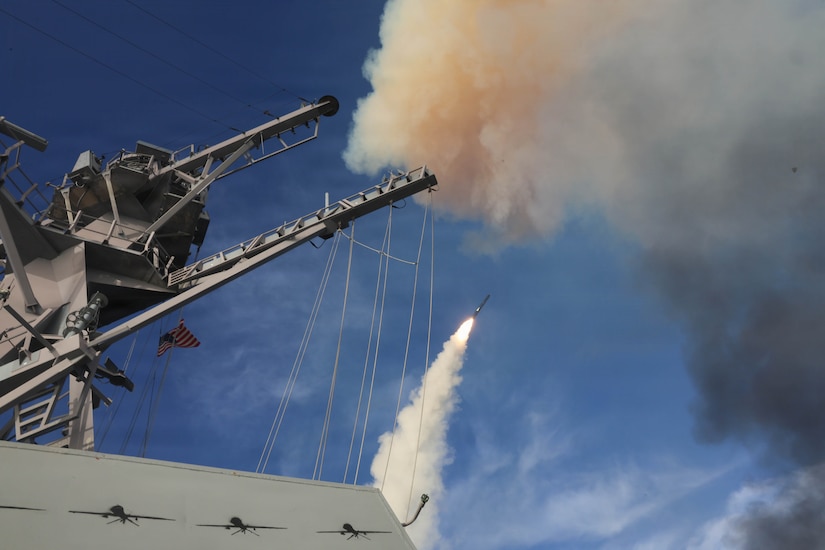
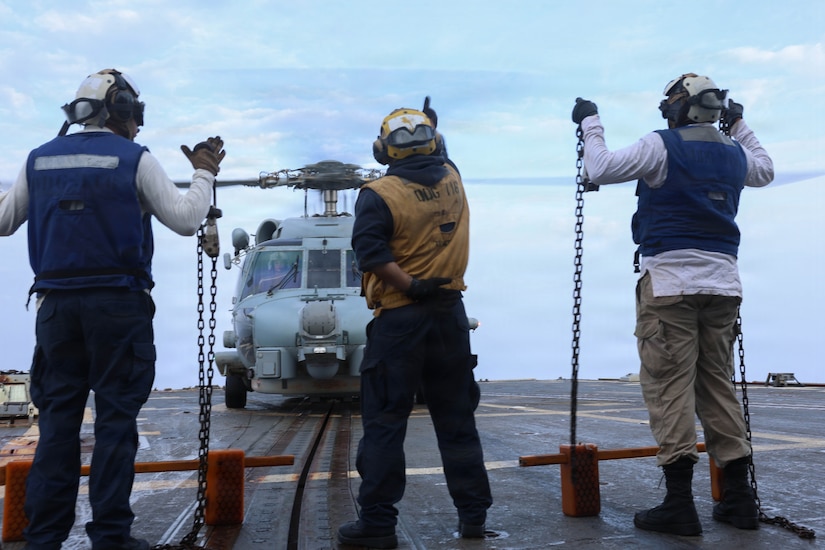
Nimitz-class aircraft carrier USS George Washington (CVN 73), flagship of Carrier Strike Group (CSG) 5, Carrier Air Wing (CVW) 5, Ticonderoga-class guided-missile cruiser USS Robert Smalls (CG 62), and Arleigh Burke-class guided-missile destroyer USS Shoup (DDG 86) departed Da Nang, Aug. 5, 2026, concluding a scheduled port visit that reinforced the enduring partnership between the U.S. and Vietnam.
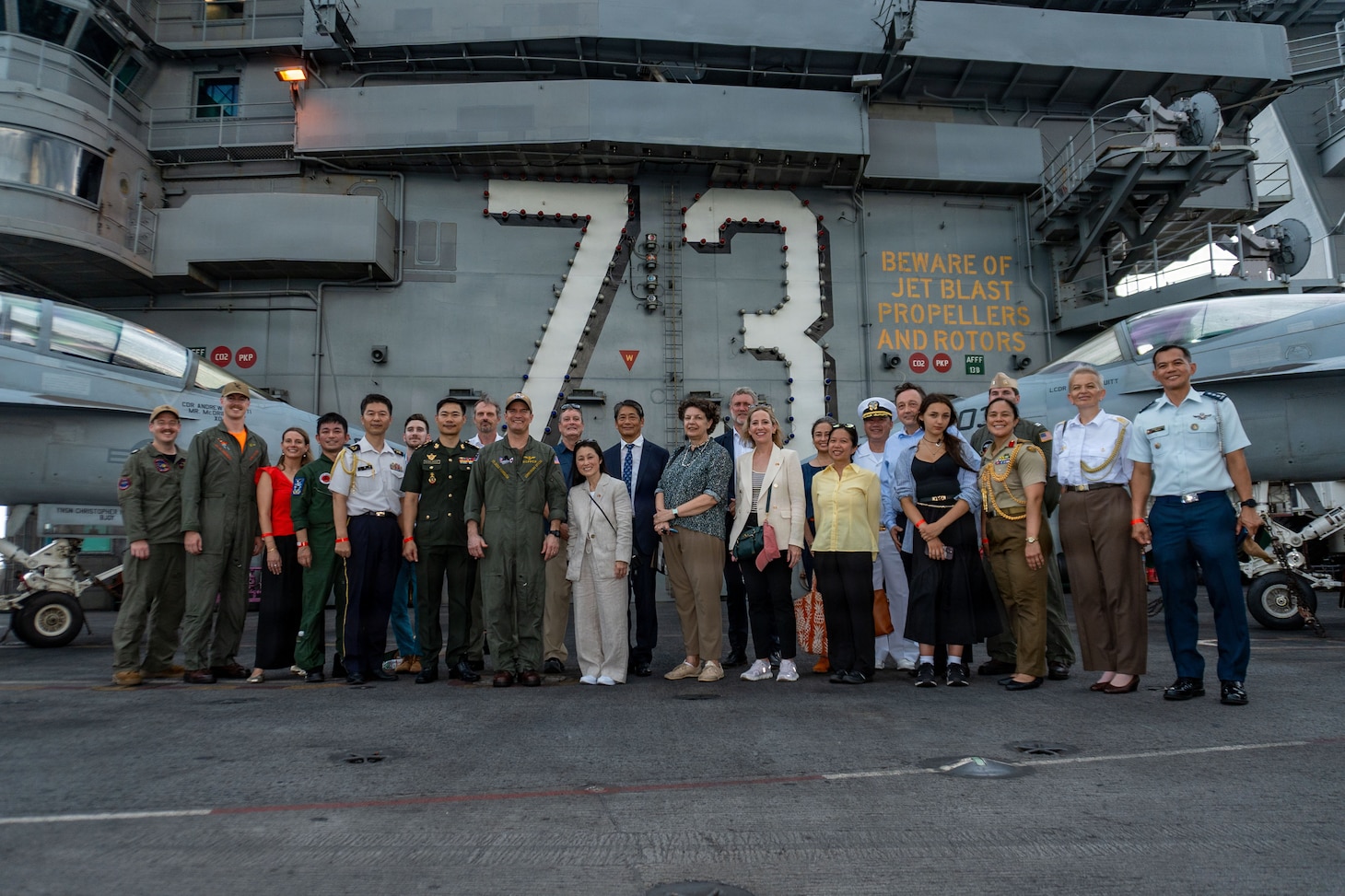
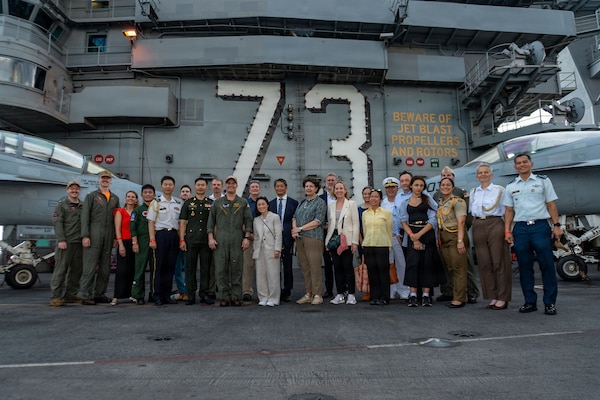
Capt. Nicholas DeLeo, commanding officer of Nimitz-class aircraft carrier USS George Washington (CVN 73), center, poses for a group photo with distinguished visitors on the flight deck during a scheduled port visit to Da Nang, Vietnam, Aug. 3, 2026. George Washington is the U.S. Navy’s premier forward-deployed aircraft carrier, a long-standing symbol of the United States’ commitment to maintaining a free and open Indo-Pacific, while operating alongside allies and partners across the U.S. Navy’s largest numbered fleet. (U.S. Navy photo by Mass Communication Specialist 2nd Class Tyler Crowley)
Upon departure, the George Washington Carrier Strike Group (GWA CSG) and forces from the Vietnamese People’s Navy conducted a bilateral search-and-rescue (SAR) exercise at sea. This cooperative maritime exercise allowed both nations to build upon relationships formed ashore and practice coordinated communication, emergency response, and life-saving procedures in the maritime domain. The U.S. and Vietnamese maritime services work together to improve Vietnam’s ability to maintain bilateral maritime domain awareness.
During the port visit, the leadership and crew of George Washington engaged in a robust schedule of key leader engagements with military counterparts to include a reception with 400 guests from Vietnam, a friendly soccer game between US and Vietnam Sailors, U.S. Seventh Fleet Band concerts, and ship tours for over 450 guests aimed at building trust and highlighting the strengthening U.S.-Vietnam partnership. Each iteration serves to further deepen the network of cooperation that represents the critical importance of maritime partnership.
“Whether we are navigating the complexities of an at-sea rescue exercise or playing a spirited game of soccer on a local field, the goal is the same: building human connections,” said Capt. Nicholas DeLeo, commanding officer of George Washington. “The hospitality shown to our Sailors by the people of Da Nang was world-class. Through these cultural exchanges and cooperative training events, we strengthen the bonds that help maintain peace and stability throughout the region.” The U.S. Navy looks forward to the continued work with the Vietnam People’s Navy and across the Vietnamese Ministry of Defense to advance a free, open, secure, and prosperous region.
The GWA CSG is operating in the U.S. 7th Fleet area of operations. George Washington is the U.S. Navy’s premier forward-deployed aircraft carrier, a long-standing symbol of the United States’ commitment to maintaining a free and open Indo-Pacific, while operating alongside allies and partners across the U.S. Navy’s largest numbered fleet. U.S. 7th Fleet, the Navy’s largest forward-deployed numbered fleet, routinely interacts and operates with allies and partners in preserving a free and open Indo-Pacific.
Through the Point Defense Task Force, Air Combat Command is conducting the experimentation and data analysis required to inform Headquarters Air Force decisions on Point Defense, a rapidly expanding mission designed to safeguard air bases against a full spectrum of airborne threats, ranging from small unmanned aircraft systems to cruise missiles.
“Two years ago, we started as a tiny, agile battle lab with only six people. The threat landscape evolved, so we evolved too,” said Lt. Col. Cody Moore, ACC Directorate of Operations A35 division chief. “Together we adapted and established the very foundation of how the Air Force will protect our installations from airborne threats for years to come. Because of our hard work, the heavy lifting of the initial charter, the foundational concept development is complete, and the playbook has been written.”
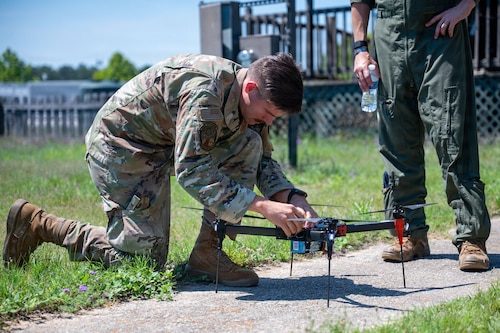
Senior Airman Luke Wilson, assigned to the 9th Air Force (Air Forces Central) Battle Lab, prepares a small Unmanned Aerial System (sUAS) to be targeted by counter-sUAS systems during a base defense demonstration at Shaw Air Force Base, South Carolina, June 5, 2026. The purpose of the demonstration was to showcase the capabilities of sUAS-based aerial defenses to locate, identify and neutralize unauthorized sUASs near military installations. (U.S. Air Force photo by Airman Will Sherwood)
Within this mission, ACC’s PDTF develops innovative solutions, integrates advanced technologies, and addresses operational challenges to ensure installation security across the Air Force.
“The [Point Defense] Task Force is responsible for the analysis behind how we organize, train, and equip our forces for this mission and we have been working hard to provide recommendations and answers to senior leaders as soon as possible,” said Moore.
To drive this continuous innovation, the task force expanded its program by establishing dedicated battle labs to put testing directly into the hands of tactical total force Airmen.
As a subordinate unit formed under the PDTF, the Point Defense Battle Lab, located at the 319th Reconnaissance Wing in Grand Forks Air Force Base, North Dakota, executes operational rehearsals, and rapid testing and evaluation to validate capabilities such as electronic warfare, and active and passive defenses.
“We drive the priorities for the battle lab and tell them what our top concern is, and they go and develop tactics, techniques and procedures for it,” said Moore. “They are very adaptable when looking at the next big threat and working with industry on what is already out there so we don’t have to reinvent the wheel.”
With support from the 184th Wing, Kansas Air National Guard, the PDBL serves as a hub for collaboration and the primary engine behind ACC’s tactical experimentation and rapid prototyping for counter-sUAS.
Through these ongoing experiments, Moore and his team test their theories to develop the foundations of the future point defense blueprint.
As the Air Force builds a formal training pipeline, ACC is fielding a specialized Mobile Training Team to bridge the immediate readiness and training needs for current point defense operations.
These expert teams are actively deploying to ACC installations across the country, delivering an intensive two-week course to train local Airmen on the newly validated technology and tactics.
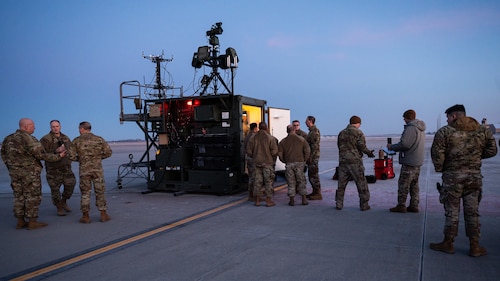
Airmen assigned to the 319th Reconnaissance Wing, prepare to execute a Point Defense Battle Lab exercise on the flightline at Grand Forks Air Force Base, North Dakota, Feb. 13, 2026. The PDBL serves as a hub for collaboration, pushing boundaries in Couter-small Unmanned Aircraft System capabilities, ensuring the Air Force maintains tactical superiority against evolving threats, and is a key part of the service’s effort to develop and evaluate advanced technologies to defend installations from sUAS threats. (U.S. Air Force photo by Airman 1st Class Emma Teel)
“This organization has developed a curriculum and have already sent out their first team of NCO instructors to teach Airmen. They started here at Langley and are now on the road to coach other installations.” said Col. James Price, special assistant to the Director of Operations for Headquarters ACC.
Point Defense capabilities require a closely integrated team of specialists, including base defense personnel, command and control operators, airspace managers, and radar maintenance and sustainment experts.
“You need all of those pieces of the puzzle to provide effective defense and to deconflict the airspace around our bases,” said Moore. “It’s not just the Air Force; it’s a whole-of-government problem. We are working with local air traffic control, local law enforcement, and joint partners to build those relationships.”
With the PDTF established, ACC continues driving the innovative tactics and joint-force integration necessary to protect against evolving airborne threats.
The Department of the Air Force has selected Joint Base Andrews, Maryland, as the preferred location to replace the existing 26 UH-1N “Huey” helicopters with 26 HH-60W helicopters. Andrews will stand up the 5th Helicopter Squadron, the first unit on base to receive the HH-60W.
A multidisciplinary team of recent NPS graduates from the space systems, physics and electrical engineering programs developed a Terahertz Imaging Camera, combining their individual thesis research efforts into a functioning payload set for launch to the International Space Station in 2027. (U.S. Navy photo by Mass Communications Specialist Second Class Abreen Padeken)
At the Naval Postgraduate School (NPS), a team of students and faculty is demonstrating how space innovation is not the product of a single discipline, but the result of tightly coordinated teamwork across time and academic disciplines. Their project, the Terahertz Imaging Camera (TIC), set to launch to the International Space Station (ISS) in 2027, stands as a powerful example of how NPS transforms defense-focused education and applied research into real-world operational capability.
From its earliest stages, the TIC effort has been defined by integration, not just of hardware and software, but of people, expertise and ideas. Several students from NPS’ space systems, physics and electrical engineering programs each took ownership of a piece of the system, working collectively to build a complex payload designed to operate in the harsh environment of space.
“Space systems are inherently multidisciplinary,” said NPS Space Systems Academic Group (SSAG) chair Dr. Wenschel Lan, co-principal investigator (co-PI) for the TIC. “This project gives our students the opportunity to work together with subject matter experts to design, build, test and operate real spaceflight hardware. That collaborative experience is critical to solving real-world problems.”
The project is a low-cost, space-based terahertz (THz) imaging system for remote sensing of atomic oxygen emissions in Earth’s upper atmosphere. These emissions are critical for understanding upper atmospheric dynamics and winds, which impact satellite communications.
They can also be used for identification of human-induced sources of THz radiation, such as spacecraft launch and reentry, as well as other phenomena of interest to the defense and intelligence communities.
The THz band that the TIC surveils lies between microwave (radar) and infrared (thermal imaging) wavelengths and is generally very difficult to detect, according to Dr. Fabio Alves, professor of physics and co-PI for the TIC project.
“We are building a sensor based on metamaterial films that can absorb terahertz waves of specific frequencies with high efficiency,” Alves explained. “The terahertz sensor, designed with the help of physics professor Dragoslav Grbovic and 2025 graduate U.S. Air Force Lt. Col. Jennifer Nolta, is a matrix of more than 3,000 pixels that heat up on terahertz absorption. The heat of individual pixels is probed by an infrared camera on the backside, constructing an image of the terahertz scene.”
Additionally, Alves adds, the focalization optics for the terahertz and infrared portions was designed by U.S. Air Force Maj. Daniel Nelson, also a 2025 graduate.
The TIC was one of seven projects selected through NPS’ inaugural Digital Trident AI Challenge in 2025, with partial funding and in-kind support provided by the NPS Foundation and Alumni Association. Chosen from 38 entries, each of the seven projects takes on key operational problems critical to U.S. national security.
In addition, Alves notes, TIC was selected by NPS’ Consortium for Robotics and Unmanned Systems Education and Research (CRUSER) for seed project funding focused on the study of autonomous surveillance to be implemented in future terahertz sensors.
“The Digital Trident AI Challenge is part of NPS’ effort to explore, experiment with, and operationalize emerging technologies that will have an immediate and advantageous impact on national security challenges,” said Kaitie Penry, director of the NPS Emerging Technology and Innovation Office (ETIO).
Putting that vision into practice, the TIC payload reflects the combined expertise of the interdisciplinary team behind it.
It incorporates a novel microelectromechanical (MEMS)-based sensor, an intricate optics assembly, custom electronics, and a structure engineered to survive launch and on-orbit conditions. Each component represents a specialized challenge, but the true difficulty lies in bringing them all together into a single, functioning system.
Members of the Terahertz Imaging Camera (TIC) team — U.S. Navy Ensign Yvonne Fu and Lt. Joshua McCowan and Marine Corps Lt. Col. Brian Neri, from left — review the technology’s concept of operations in the space systems lab. The TIC is a low-cost, space-based terahertz (THz) imaging system for remote sensing of atomic oxygen emissions and other human-induced sources of THz radiation. (U.S. Navy photo by Mass Communications Specialist Second Class Abreen Padeken)
“The optics assembly, the sensor, the structural design, the electronics … They’re all individual problems,” Lan explained. “But integrating everything into a functional instrument is where the team effort really comes in.”
For the students, that integration began in the classroom and quickly evolved into a shared mission. Many joined the project through coursework before continuing into thesis research, creating a pipeline of contributors who built on each other’s work.
“When I came onto the project, there was a gap in how we interfaced the camera with the onboard systems,” said U.S. Navy Lt. Joshua McCowan, a June 2026 graduate in space systems operations. “That became my role, and from there it grew into my thesis. Everyone kind of found their niche and contributed where they were needed.”
U.S. Marine Corps Lt. Col. Brian Neri, a dual degree graduate in space systems operations and applied physics, said the collaborative nature of the project was one of its biggest draws.
“You’re not just working on your own piece in isolation,” Neri said. “You’re constantly working with others to make sure everything fits together and meets the overall objectives.”
Neri was among a select group of students who had the chance to brief NASA Artemis II pilot and NPS alumnus U.S. Navy Capt. Victor Glover, when he returned to campus in June after his historic lunar mission. Glover picked up on the camera’s potential naval applications, including its ability to detect objects leaving or entering space, and was keen to learn more as the system is finalized and prepared for launch early next year.
Each student’s contribution to the TIC was distinct, but none stood alone.
McCowan focused on camera calibration, ensuring the imaging system could maintain accuracy despite thermal fluctuations in orbit. Neri developed the concept of operations, bringing together NASA requirements, hardware capabilities, and software constraints into a cohesive plan for how the payload will function on the ISS.
Neri’s thesis, entitled “Concept of Operations and Functional Testing of Terahertz Imaging Camera 2.1,” earned an NPS Outstanding Thesis award upon his graduation in June 2026.
“The concept of operations really pulls everything together,” Neri said. “It takes everyone’s work and defines how we actually use the system to achieve the mission.”
Meanwhile, following the steps of 2025 graduate Nolta’s sensor design, Ensign Yvonne Fu worked in the cleanroom fabricating the focal plane array, a delicate sensor built layer by layer from silicon and metals, designed to detect terahertz radiation. Her work required precision and patience, with each step building on the last.
“It’s a long process with a lot of opportunities for things to go wrong,” she said. “But knowing that what you’re building will be part of the final system makes it worth it.”
Ensign Justin Williams approached the project from a modeling perspective, simulating the terahertz signatures the sensor is designed to detect. His work provided critical insight into how the payload will perform once in orbit.
Ensign Andrew Oleson, meanwhile, ensured the entire system could survive launch and operation in space, conducting structural analyses that tied together the physical integrity of all components.
“My work depends on everyone else’s,” Oleson said. “And their work depends on mine. It really shows how interconnected everything is.”
The TIC team didn’t just divide and conquer individual tasks; rather, the team worked continuously to integrate their efforts. Weekly meetings with faculty advisors and other SSAG faculty and staff, provided a forum to share progress, troubleshoot challenges, and refine designs.
“We were constantly presenting what we had done and getting feedback,” McCowan said. “That helped us stay aligned and build off each other’s work.”
This iterative process mirrored real-world engineering environments, where collaboration and communication are essential to success. For Neri, one of the most important lessons came from navigating trade-offs as a team.
“We had to balance complexity, risk and timeline,” he said. “Those decisions weren’t made in a vacuum. They involved discussions across the team, and understanding how one choice would impact everyone else.”
The complexity of the TIC project inevitably brought challenges, many of which required collective problem-solving.
Ensign Justin Williams and Lt. Joshua McCowan demonstrate the Terahertz Imaging Camera (TIC) system’s casing in the space systems lab in NPS’ Bullard Hall. The TIC was one of seven projects focused on key operational problems selected for funding through NPS’ inaugural Digital Trident AI Challenge in 2025, supported by the NPS Foundation and Alumni Association. (U.S. Navy photo by Mass Communications Specialist Second Class Abreen Padeken)
McCowan encountered discrepancies between the camera’s documentation and its actual capabilities, requiring coordination with manufacturers and adjustments to the team’s approach. Williams faced the challenge of learning specialized software with little existing expertise on campus, reaching out to external researchers for guidance while sharing his knowledge with the team. And Fu dealt with the realities of fabrication, where a single mistake could undo hours of work, all while Oleson reconciled simulation data with real-world testing, ensuring the payload’s structural integrity.
Through it all, the team relied on each other.
“Everybody was working toward the same goal,” Neri said. “That made it easier to push through the tough parts.”
Students consistently pointed to the NPS environment as a key enabler of collaboration. Access to specialized labs, equipment and computing resources allowed them to tackle complex problems, while faculty mentorship ensured they had the guidance needed to succeed.
“Everyone here is willing to help,” Neri said. “Whether it’s faculty, staff or other students, there’s always someone you can go to.”
The structure of the program also supports teamwork. Dedicated time for thesis work, combined with regular interactions with advisors and peers, creates a battle rhythm that encourages collaboration rather than competition.
“There’s a shared sense of purpose,” Fu said. “Seeing how hard everyone else is working motivates you to do the same.”
For SSAG leadership at NPS, learning by doing is a hallmark of their approach, exemplified by the group’s active CubeSat program where students conceive, design, build, test, launch, and operate satellites for real missions in orbit. The TIC project builds on this philosophy where the result is more than a technical achievement — it also develops the technical talent of graduates destined to be leaders in the space domain.
“Our goal is to educate our students to understand space fundamentals, apply this knowledge to real-world problems, and inform the fleet on how space affects the users of these assets,” Lan said. “Regardless of where our graduates go for their next tour, they hit the ground running and are able to contribute meaningfully.”
Graduates from the TIC team are already transitioning into their new roles across operational commands and advanced training pipelines, bringing with them the collaborative skills they developed at NPS. Meanwhile, the TIC payload moves closer to deployment on the ISS, representing more than just a technological milestone, but also a collective accomplishment.
For the students, the most memorable aspect of the project wasn’t any single component or breakthrough. It was the experience of working together. “Seeing all the pieces come together into a single system was incredible,” Fu said.
Neri echoed that sentiment.
“We had a phenomenal team,” he said. “Everyone was dedicated, everyone cared, and we were all working toward something bigger than ourselves.”
That spirit of collaboration, built in classrooms, labs and meeting rooms across campus, is what ultimately made the TIC project possible. And as it prepares for launch, the payload carries with it a clear message … At NPS, teamwork isn’t just part of the process — it’s the driving force behind innovation.
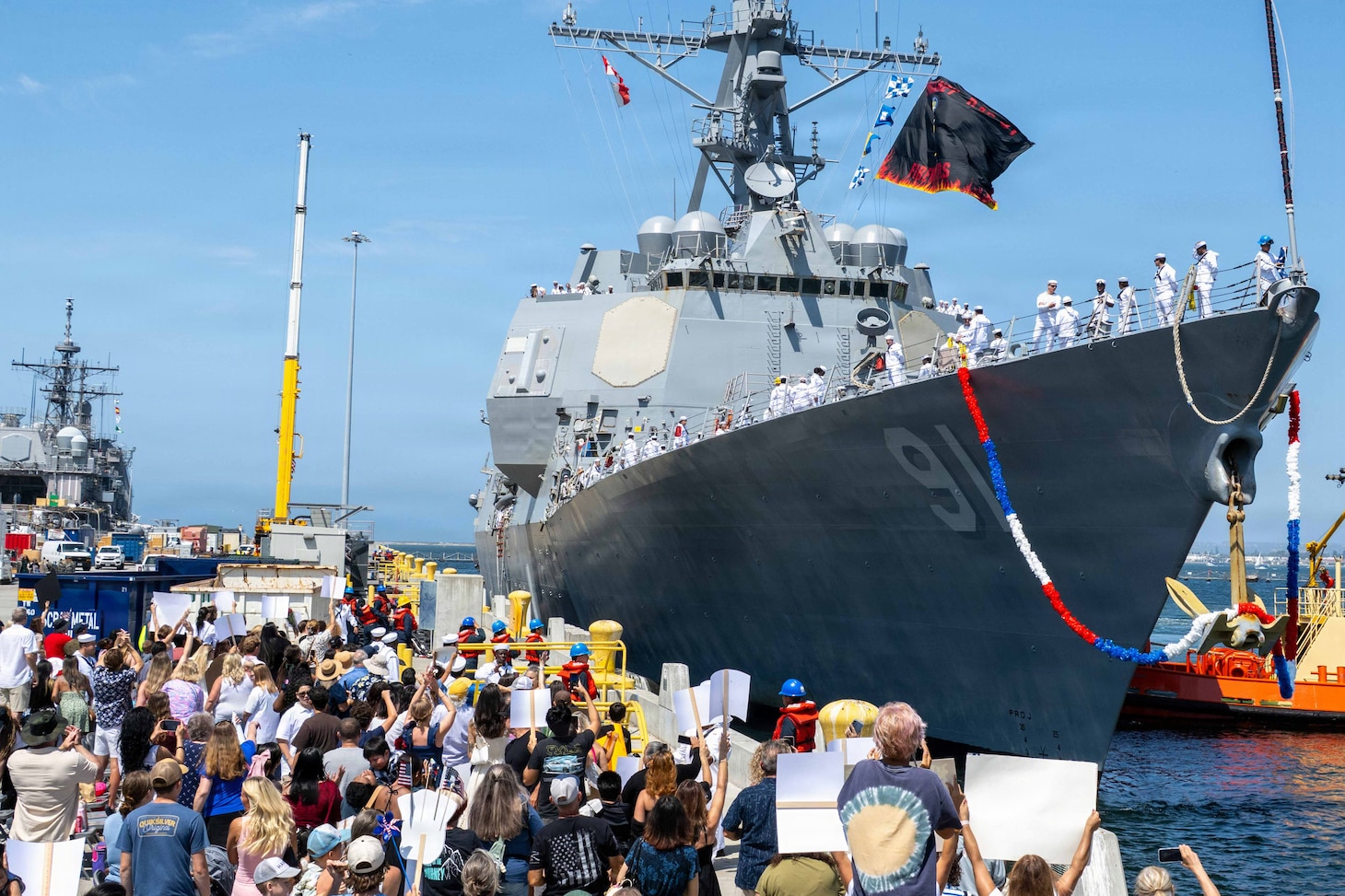
SAN DIEGO – Arleigh Burke-class guided-missile destroyer USS Pinckney (DDG 91) returned to its homeport of Naval Base San Diego, following nine months of operations supporting regional security and combat operations in the Indo-Pacific and Middle East, Aug. 9, 2026.
Arleigh Burke-class guided-missile destroyer USS Pinckney (DDG 91) returns to its homeport of Naval Base San Diego, Aug. 9, 2026. An integral part of the U.S. Pacific Fleet, U.S. 3rd Fleet leads naval forces in the Indo-Pacific and provides the realistic, relevant training necessary to execute the U.S. Navy’s role across the full spectrum of military operations. U.S. 3rd Fleet works together with allies and partners to advance freedom of navigation and overflight, the rule of law and other principles that underpin security for the Indo-Pacific region. (U.S. Navy photo by Aviation Boatswain’s Mate (Launching and Recovery Equipment) Airman Aprentice Ethan Oase)
After departing San Diego on Nov. 25, 2025, Pinckney, along with an air wing detachment from Helicopter Maritime Strike Squadron (HSM) 37, conducted operations to strengthen regional partnerships and demonstrate the U.S. Navy’s commitment to achieving peace through strength in the U.S. 7th Fleet.
During a scheduled port visit to Singapore, the crew successfully completed a ship repair and maintenance exercise, showcasing the crew’s ability to conduct maintenance and repair in forward locations. Pinckney’s operations were highlighted by key leader engagements with the U.S. Ambassador to Singapore; Republic of Singapore Navy Commander, First Flotilla; and U.S. Navy Commander, Task Force 76.
As operational requirements evolved, Pinckney’s mission shifted to support operations in the U.S. 5th Fleet. The crew worked alongside other U.S. Central Command (CENTCOM) joint forces in successfully carrying out strikes in support of Operation Epic Fury. During the U.S. naval blockade of Iranian ports, Pinckney and HSM-37 conducted precision maritime interdictions, compelling 11 commercial vessels to comply with CENTCOM directives.
“Pinckney’s Firewalkers answered every mission with professionalism, resilience, and unwavering commitment,” said Cmdr. Timothy DeVall, commanding officer of Pinckney. “Whether operating in the Indo-Pacific or supporting combat operations in the Middle East, our Sailors consistently demonstrated the readiness and adaptability required to execute our mission. I couldn’t be prouder of what this team accomplished.”
Pinckney steamed more than 48,000 nautical miles across U.S. 3rd, U.S. 7th, and U.S. 5th Fleets; completed 534 flight hours; executed 24 replenishments-at-sea; and transited through five strategic waterways.
An integral part of the U.S. Pacific Fleet, U.S. 3rd Fleet leads naval forces in the region and provides the realistic, relevant training necessary to execute our Navy’s role across the full spectrum of military operations – from combat operations to humanitarian assistance and disaster response. U.S. 3rd Fleet works together with allies and partners to advance freedom of navigation and overflight, the rule of law, and other principles that underpin security for the region.
For more news from U.S. 3rd Fleet, visit https://www.dvidshub.net/unit/COM-US3rdFleet. For more news from CSG-3 and Pinckney, visit https://www.dvidshub.net/unit/CSG3.
U.S. 4th Fleet Hosts Multinational Forces for PANAMAX 2026
By L.t.j.g. Paul Archer
MAYPORT, Fla. – “Securing the Western Hemisphere requires seamless cooperation and a unified effort between partner nations,” said Sardiello. “PANAMAX strengthens effective hemispheric command and control so that our combined forces can effectively secure strategic key terrain like the Panama Canal. Safeguarding this maritime crossroads is not just a regional defense priority, but a cornerstone of global economic stability.”
More than 150 Sailors, Marines, and public security forces from 19 separate nations will serve on the CFMCC staff under the leadership of U.S. Navy Rear Admiral Carlos Sardiello, Commander USNAVSOUTH.
This year’s exercise is designed to conduct stability operations in support of a fictitious United Nations Security Council resolution. It provides intensive interoperability training for participating multinational staff and builds partner nation capacity to plan and execute complex operations.
“PANAMAX 2026 is an unparalleled opportunity for partner nations to sharpen their tactical edge and deepen interoperability,” said Mr. Patrick Cooper, Lead Planner for PANAMAX 2026. “This exercise rigorously tests our integration, ensuring our combined forces are fully prepared for any future shared endeavors. In addition to the operational gains, the personal connections made among our partners in the AOR will pay dividends for a generation.”
PANAMAX delivers unique, simulated training opportunities incorporating scripted, event-driven scenarios to maximize interoperability. These scenarios address key aspects of combined operations, such as technology standardization and shared operating procedures.
PANAMAX began in 2003 with three countries—Chile, Panama, and the United States—focusing solely on the maritime security of the Panama Canal. Since that time, it has grown to become the region’s largest coalition command post exercise, ensuring the defense of one of the most strategically and economically crucial pieces of infrastructure in the world.
As the exercise host for the Joint Force Maritime Component Command, USNAVSOUTH/4th Fleet supports SOUTHCOM’s joint and combined military operations. By employing maritime forces in cooperative security operations, the command maintains access, enhances interoperability, and builds enduring partnerships to promote peace, stability, and prosperity throughout the Caribbean, Central, and South American regions.
“The Department of the Air Force has a resolute commitment to rapidly return affected service members to the ranks,” said Assistant Secretary of the Air Force for Manpower and Reserve Affairs Honorable Richard L. Anderson. “By running medical certifications and record-correction board actions in parallel rather than sequentially, and establishing dedicated reinstatement case managers as single, proactive points of contact for applicants, we aim to increase the speed and ease of returning former members to service under the DAF COVID-19 reinstatement program.”
The changes align with the SECWAR’s May 7, 2026, establishment of the Department of War COVID-19 Reinstatement and Reconciliation Task Force, which charged the services with identifying and removing impediments to reinstatement, standardizing procedures, and proactively communicating with affected members through individualized contact.
Previously, medical certifications and board-correction actions were processed sequentially, creating an average 30-day bottleneck associated with medical clearances. The department has restructured the workflow so the two now proceed at the same time.
Dedicated reinstatement case managers now serve as single, proactive points of contact for applicants. Case managers aim to eliminate delays caused by missing documents, guide and assist members through each step, connect them with the right agencies, drive handoffs between the organizations that touch a case, resolve administrative roadblocks, provide updates, and answer questions to ensure rapid and accurate reintegration.
Case managers will help members correctly fill out all necessary forms to ensure a smooth application process, which in turn will help members avoid resubmitting forms and accelerate the reinstatement process.
Additionally, because case managers handle direct communication and preparation with members, the Air Force Review Board Agency COVID-19 Reinstatement Team is freed up to focus solely on adjudicating and finalizing cases, accelerating decisions for everyone.
The changes apply to former Airmen and Guardians pursuing a return to service under Executive Order 14184, “Reinstating Service Members Discharged Under the Military’s COVID-19 Vaccination Mandate,” signed Jan. 27, 2025. The expedited reinstatement program is operating under a one-year extension directed by the Secretary of War and remains open until April 1, 2027.
Former Airmen and Guardians who were unjustly discharged for declining the vaccine, voluntarily separated or allowed service to lapse rather than comply, transferred to the Individual Ready Reserve, or received a “General (Under Honorable Conditions)” discharge for refusing the COVID-19 vaccine can find eligibility criteria, checklists, forms, and frequently asked questions at the Air Force’s COVID reinstatement page, www.af.mil/COVID-Reinstatement, or contact:
Chief Master Sgt. of the Air Force David R. Wolfe announced a series of changes to the enlisted professional military education Aug. 11 during his keynote address at the Air Force Sergeants Association’s Summit 26, outlining an effort to make professional development more continuous, accessible and connected throughout an Airman’s career.
The changes, known as the Enlisted Professional Military Education Modernization, standardizes installation professional development centers into a three-tier structure and consolidates installation enlisted development, including the Airman Leadership School and Noncommissioned Officer Academy schoolhouses, under them.
“We are taking the pieces that already exist, organizing them into a more coherent system, clarifying who is responsible for that system, and filling the developmental gaps between formal EPME experiences,” Wolfe said.
During the initial phase of the EMPE Modernization, what Airmen learn does not change, and neither does who sets and certifies it. All EPME and Foundations Course curriculum development and accreditation remains with Air University’s Barnes Center for Enlisted Education. The Barnes Center continues to schedule Noncommissioned Officer Academy classes, and the Air Force Personnel Center continues to schedule students.
ALS and NCO Academy in-residence education continues.
“Over time, [EPME Modernization] will allow us to build a more agile, adaptive and dynamic delivery model for the development and education opportunities…,” Wolfe said.
Wolfe knows the schoolhouses firsthand, having taught at ALS and the NCO Academy at the Elmendorf Professional Military Education Center from 2004 to 2007 and serving as that center’s commandant from 2014 to 2016.
What changes is the role of the professional development center, which is identified as Professional Military Education Centers under the new reorganization. The PME Center becomes the single point of oversight for enlisted development on an installation, with the ALS and NCO Academy schoolhouses aligned under it.
Three tiers
The structure scales to installation size and existing infrastructure.
Eight installations will operate large PME centers with a development advisor, ALS and NCO Academy. Fifty-seven will operate medium centers with a development advisor and ALS, while 15 smaller centers will be built around development advisors at installations without a resident ALS or NCO Academy.
Development advisors will serve as connective tissue across all three PME center models and continue overseeing programs such as Foundations Courses, the First Term Enlisted Course and Informed Decision Seminar.
They will also continue providing career counseling and retraining advice for more complicated cases requiring deeper analysis. Wolfe announced the Air Force is developing an artificial intelligence agent intended to help Airmen more readily understand applicable policies and career opportunities, allowing development advisors to focus their expertise on cases requiring greater analysis.
Reporting and oversight
PME Centers will align under the wing command chief and command team for staff supervision, integration and administrative oversight. The wing commander retains command authority. The wing command chief exercises functional oversight for enlisted development and serves as the principal enlisted adviser for PME Center priorities, curriculum integration and developmental outcomes.
Command chiefs already carry the responsibility to develop their wing’s Airmen; the EMPE Modernization gives them the corresponding oversight of the organization that delivers that development.
Installation command chiefs will also track and report a Status of Professional Development covering a range of data across EPME, submitted through a dashboard now in development. The dashboard will provide information to the Enlisted Force Development Panel to inform strategy, policy and senior leader decisions. Specific reporting requirements will be published in forthcoming guidance.
Adjunct Faculty
The Air Force plans to build on the existing Foundations Courses through an adjunct faculty model that draws on qualified Airmen with specialized experience and instructor backgrounds to teach subjects in which they have expertise.
“We have more than 10,000 former 8Ts in our Air Force—I’m talking to you,” Wolfe told the audience. “You have something to offer, and we are going to establish a method for you to be able to deliver your expertise to our Airmen on demand.”
Air University will develop and deploy a virtual Foundations Course capability in two phases: Phase I, synchronous instruction delivered by video teleconference through a centralized integration hub, and Phase II, asynchronous, self-paced courses available on demand.
Implementation work is under way across the Air Staff, major commands, Air Education and Training Command and Air University, spanning organization, management, resourcing, policy, the virtual Foundations Course and messaging.
Additional Updates
Wolfe also used the keynote to announce changes to enlisted promotion processes and a new initiative supporting military spouses.
Beginning with the current cycle, the Stripes for Exceptional Performers nomination windows for promotion to staff sergeant and technical sergeant will align with their respective static closeout dates, giving commanders additional time to evaluate eligible Airmen after promotion results are released.
“Timing should not unnecessarily narrow opportunity,” Wolfe said. “Extending the window gives commanders more time to evaluate performance and recognize Airmen who have demonstrated exceptional potential.”
Wolfe also announced a change intended to prevent promotion vacancies from going unfilled when selected members decline promotion.
Over the past four years, 59 senior master sergeants selected for chief master sergeant declined promotion. Under the new approach, the Air Force will use the board-established order of merit to identify the next qualified Airman when a promotion vacancy is created by a declination.
The process begins with the 2026 chief master sergeant promotion cycle and is planned to continue with senior master sergeant and master sergeant boards in 2027.
Wolfe informed the Airmen in attendance of the Global Military Spouse Connection, a new Air Force Personnel Center initiative designed to better connect qualified military spouses with civilian employment opportunities across the Department of the Air Force.
The initiative uses a pre-vetted résumé repository to help connect hiring managers with qualified military spouses. The pilot is underway at Travis Air Force Base, California; Patrick Space Force Base, Florida; and Ramstein Air Base, Germany.
Wolfe said the initiative is not a mandatory hiring directive but intended to create a more direct connection between military spouse talent and Department of the Air Force civilian workforce requirements.
The full keynote address can be found on the official Chief Master Sergeant of the Air Force Facebook page.
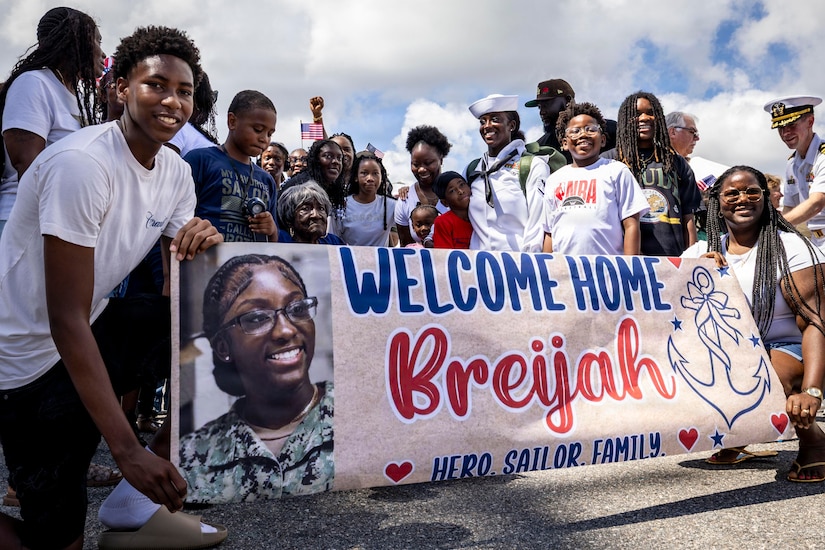
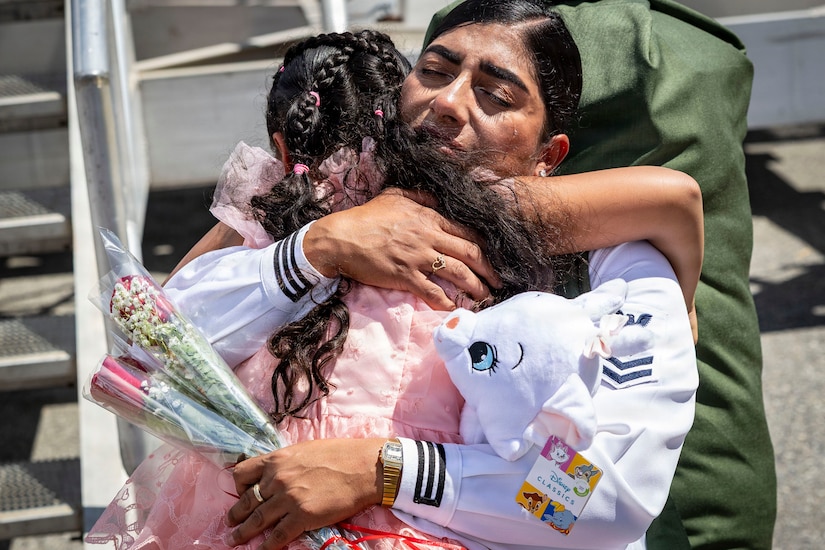
The guided-missile destroyer USS Thomas Hudner returned to Naval Station Mayport, Florida, Aug. 9, concluding an almost nine-month deployment across multiple geographic theaters, including the U.S. 4th, 5th and 6th Fleet areas of operations.
During the deployment, the crew demonstrated exceptional resilience and tactical proficiency across three different fleets, said Navy Cmdr. David Cook, the USS Thomas Hudner commander.
“Their dedication is unmatched, and we are absolutely thrilled to be back in Mayport to reunite with the families and loved ones whose unwavering support made our success possible,” Cook said.
The USS Thomas Hudner is a multimission guided-missile destroyer capable of air warfare, antisubmarine warfare, naval surface fire support and surface warfare. The ship carries approximately 300 sailors.
The ship bears the name of Navy Capt. Thomas J. Hudner Jr., a Medal of Honor recipient who received the nation’s top military honor for his heroic and selfless actions while attempting to save the life of his wingman, Navy Ensign Jesse L. Brown, during the Korean War.
The U.S. 2nd Fleet, reestablished in 2018 in response to the changing global security environment, develops and employs maritime-ready forces to fight across multiple domains in the Atlantic and Arctic to ensure access, deter aggression and defend U.S., allied and partner interests.
Two moves, made in the right order, will break portfolios — and eventually the acquisition system as a whole — out of the compliance trap, writes Timothy Cooke in this op-ed.
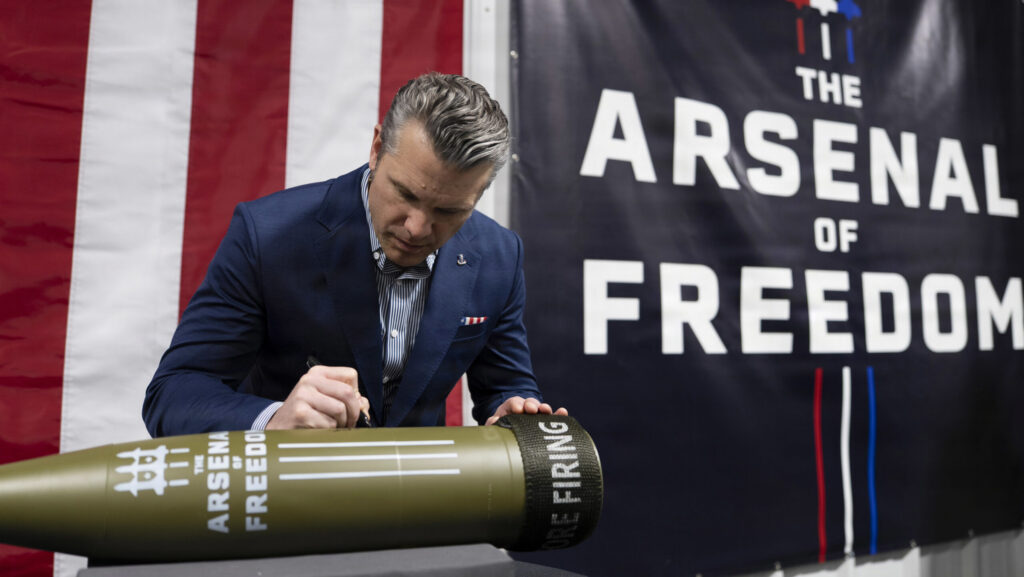
Sec. Pete Hegseth signs a 155 mm howitzer shell during his “Arsenal of Freedom” speaking tour of American defense industry. (DoD photo by US Navy Petty Officer 1st Class Alexander Kubitza)
What will it take for acquisition reform to finally succeed? New org charts aren’t enough: The people in the organization need new incentives.
Since last fall, in a sweeping organizational overhaul, all three military departments have replaced program executive officers with Portfolio Acquisition Executives (PAEs). The Army stood up six, the Navy nine. The Space Force completed its transition in July with nine. The Air Force redesignated all of its program executive officers as PAEs effective July 4. These new executives have the power to launch sustainable reform that, at long last, shifts defense acquisition from a focus on procedural compliance to one on accomplishing the mission — if and only if they use that power to take two crucial and complementary steps. First, they must provide believable, executable top cover for contracting officers, not just lip service about taking risks. Second, they must refocus performance metrics to measure whether and how quickly acquisition outcomes produce mission results.
Both moves fall within the PAEs’ authority under Section 1802 of the fiscal 2026 National Defense Authorization Act. Modeling of acquisition workforce behavior shows that the two together break a portfolio out of the compliance trap; neither one alone does.
Prior reforms aimed at the acquisition workforce, but none changed the conditions under which it worked. What the PAEs do next will determine whether 30 years of acquisition reform produces yet another wave of promise, then reverts back to the bureaucratic mean, or delivers the change previous waves promised.
The PAE is the first acquisition official made responsible by statute for delivering capability across a portfolio rather than simply for milestone compliance on individual programs.
Compliance culture is not an attitude problem. The acquisition workforce is not timid or indifferent — it is rational. Consider the contracting officers (COs) in any PAE’s portfolio today. The COs aren’t ignorant: They know the Federal Acquisition Regulation (FAR) permits commercial procedures, oral presentations, Other Transaction Agreements (OTAs), and statements of objectives (SOOs) instead of detailed statements of work (SOWs). They know that the Revolutionary FAR Overhaul, triggered by Executive Order 14275, signed in April 2025, has expanded that legal operating space, stripping non-statutory content from most of the FAR. They know the Defense Secretary’s November 2025 directive [PDF] launched the transition to a Warfighting Acquisition System, with speed of capability delivery as the organizing principle.
As NATO and European governments accelerate investment in space-based intelligence, decision advantage will depend on how quickly sovereign and commercial capabilities can be fused into a trusted operational picture.
That’s well and good, but when COs exercise flexible methods and face a protest, an audit, or a congressional inquiry, they are personally exposed. They’re the ones who sign for the government: Their name is literally on the line. When COs follow standard procedures and an acquisition produces a poor outcome, bad career consequences rarely follow. Under those conditions, rational COs default to the safest available procedure — not from cowardice, but from judgment. Compliance remains the smart choice.
Section 1802 alters that calculus. The PAE now holds direct authority over the program managers (PMs) and COs within a portfolio: a group of related programs managed together so resources can shift across them as missions evolve. Section 1802 makes the PAE responsible for capability delivery across that portfolio as a whole, not just for milestone compliance on any single program. For the first time, the leaders with institutional authority over COs have a mission that requires them to provide real top cover, because the PAE’s own success depends on the outcomes that cover enables.
This is what every past reform lacked. The Federal Acquisition Streamlining Act, the Office of Federal Procurement Policy’s procurement innovation guidance, and the Section 809 Panel each sought to enable better behavior at the CO level. But none altered the chain of authority above the CO to link senior leaders’ performance to portfolio outcomes. Section 1802 does. That is the structural difference.
Of course, top cover and outcome metrics are not new ideas. The reform literature has called for them for decades. What simulating the acquisition system reveals, and previous reform efforts missed, is that the order of deployment determines whether the reforms take off or are absorbed.
Deploy outcome metrics first, and the CO sees a dashboard that measures behaviors the system still punishes. The metrics are accurate. The career risk is unchanged. The CO does not move.
Deploy top cover first, and the CO begins exercising flexible methods, because the risk that mattered most — professional exposure — has been removed. When metrics arrive, they make the resulting outcomes visible. The PAE can see what is working. Resources flow toward what works. The loop closes.
Simulation showed that top cover paired with outcome metrics revolutionized portfolio management, a “phase change” as dramatic as solid ice melting into liquid water. But neither one alone was sufficient to break the hold of compliance culture.
A second simulation finding sharpens the urgency: Building the outcome culture is harder than losing it. It takes roughly twice the institutional commitment to establish the new pattern as to maintain it. Reforms that fail to reach the threshold collapse, and the system reverts, as it has after every previous reform wave. Reforms that cross the threshold stick.
The system is now closer to that threshold than at any point in three decades, but it has not yet crossed it.
The PAE is the binding constraint. The first decision — whether to provide real institutional protection for contracting officers who exercise flexible methods — determines whether everything else can be sustained or is absorbed by the old pattern.
Top cover is not a memo encouraging innovation or a speech about speed. It is a written, public commitment by the PAE, by name, to defend specific contracting decisions made in good faith using specific flexible methods. It specifies which methods the institution will support, from oral presentations to OTA prototype agreements. It commits dedicated legal resources and senior leadership engagement when a flexible-method award is challenged. It assures that a CO acting in good faith, with a documented rationale, will not face career consequences for an imperfect outcome or a sustained protest. And it changes how COs are evaluated.
Documented business judgment replaces procedural perfection as the standard, with mission delivery and procedural compliance carrying equal weight.
Three metrics constitute a viable starting set. First, time-to-mission-effect tracks elapsed time from a validated operational need to capability in the operator’s hands — the full pipeline that traditional metrics like procurement administrative lead time (PALT) cannot capture, since it runs only from solicitation to award. Second, post-award mission satisfaction, a structured assessment conducted by the requiring activity at six and 12 months, links the contract to the operator’s lived experience of how the product actually performs, rather than to technical acceptance alone. Third, competitive yield, the number and quality of offers received, makes visible the firms that did not bid because the solicitation signaled that innovative vendors were unwelcome.
None of this requires new authorities now that the system structure has changed with the creation of PAEs. It requires a decision to measure what matters.
The PAE does not need to push every program through Other Transaction Authority or exotic procurement vehicles. Moving the portfolio’s default requirements format from the detailed SOW to the outcome-focused SOO, paired with credible cover, is sufficient. A CO who can describe what the operator needs rather than which technical solution to pursue, and who is protected when the resulting award attracts a protest, will make the trades that get capability to the warfighter faster.
This is well within Section 1802 authority. All that’s needed to start the journey is the decision, the top-cover document, and the outcome metrics.
The PAE need not transform an entire portfolio at once. Pick one or two programs as pathfinders. Apply maximum cover and flexibility. Measure the results. The first successful pathfinders become seeds visible to the next CO, the next PM, the next portfolio, and the effects propagate.
The authority exists. The regulatory space exists. The leadership signal exists. The statutory foundation exists. The system is closer to the threshold than it has ever been.
The question is whether this generation of acquisition leaders will push it across.
Timothy W. Cooke is president and CEO of ASI Government LLC, which advises federal agencies on acquisition strategy and organizational transformation.
 Download