Defense News: Tennessee Guardsmen respond to industrial fire

Source: United States Army

HENRY COUNTY, Tenn. – At the request of the Tennessee Emergency Management Agency, a Tennessee Army National Guard UH-60V Black Hawk helicopter from Jackson’s Army Aviation Support Facility supported firefighters battling an industrial fire May 8 at the Sigma Renew 360 plant in Henry County.

At about 5:40 p.m., a flight crew with the 1-230th Assault Helicopter Battalion departed Jackson equipped with a helicopter bucket used to drop hundreds of gallons of water, typically sourced from nearby lakes, onto large fires. The aircrew, consisting of 1st Lt. Lee Friedman, Chief Warrant Officer 4 Phillip Norris, Chief Warrant Officer 3 Daniel Ricketts and Spc. Ethan Norris had participated in wildland firefighting training with the Tennessee Forestry Department earlier that morning, practicing bucket drops at Milan’s Volunteer Training Center.

The aircraft arrived at the Sigma Renew 360 plant at about 6:05 p.m. and immediately began dropping water onto the industrial fire. The crew collected water from nearby sources, beginning with Carroll Lake south of McKenzie. They then used a local farmer’s pond, followed by Middle Fork Obion Lake Number Seven, where they got most of their water. The Guardsmen flew the water to the site and released it directly onto the fire.

A helicopter bucket holds about 620 gallons of water and weighs roughly 5,100 pounds. For the next 2 1/2 hours, the crew made 14 trips delivering water to the blaze, dropping roughly 8,680 gallons onto the fire.

After completing its final water drop, the aircraft returned to Jackson at 10:30 p.m.

Related Links

The Official Website of the National Guard | NationalGuard.mil

State Partnership Program | NationalGuard.mil

The National Guard on Facebook | Facebook.com/TheNationalGuard

The National Guard on Flickr | Flickr.com/TheNationalGuard

The National Guard on Instagram | Instagram.com/us.nationalguard

The National Guard on X | X.com/USNationalGuard

The National Guard on YouTube | YouTube.com/TheNationalGuard

Defense News: Improved, optimized services drive $39M cost reduction

Source: United States Army

CHIÈVRES AIR BASE, Belgium — U.S. Army Garrison Benelux (USAG Benelux) is using a data-driven approach to validate and better meet the needs of its community by applying a new innovation-centric approach to its supplier and procurement process. The new approach allows for emerging technology and innovations to be at the center of each contract.

The garrison has already achieved better alignment of resources to community needs and improved staff feedback, while forecasting a projected long-term cost reduction by up to $39 million over the next eight years.

Officials said the effort, led by the Directorate of Emergency Services, was not centered on cutting services, but on understanding how services were used across the garrison’s sites and ensuring resources were focused where they delivered the greatest value. The efforts, driven by Scott Moore, acting director of emergency services and his team, have become a model for others to follow.

“We get into a bad habit with contracts where we repeat what was there before,” Moore said. “Instead of asking what we are actually trying to achieve, we tend to continue what has always been done. What we did differently was step back, look at the requirement first, and then determine the most efficient way to meet it.”

Moore said the review examined service contracts across multiple functions, including security, alarms, emergency response support and other recurring services. His team analyzed usage patterns, operational requirements and feedback from organizations that rely on those services every day.

“We went position by position, line by line, hour by hour,” Moore said. “We looked at what the regulations require, what the mission needs and what the data shows about how services are actually used.”

He said direct engagement with stakeholders was a key part of the process. Schools, Child and Youth Services, logistics partners and other organizations were consulted to ensure any changes reflected real operational demand.

“We made sure we weren’t missing anything,” Moore said. “We spoke to the organizations that rely on these services to understand when they actually need support, when they need access and what would create a problem for them.”

Moore said that approach allowed the garrison to distinguish between services that were mission-essential and those that had continued largely out of habit or convenience, despite being underused or no longer aligned with actual community demand.

Moore elaborated that some adjustments involved changing schedules, consolidating coverage or redirecting resources to higher-demand periods rather than eliminating capability.

“The goal is not to remove service,” he said. “The goal is to make sure what we provide is aligned with the requirement and delivers value.”

The review also considered workforce impacts. Moore said some internal changes improved quality of life for employees while maintaining performance standards.

“We looked at how our on-call systems were structured and whether they matched actual demand,” he said. “After making changes, there was no measurable difference in service delivery, but people had more predictable time off and were not tied to a phone when they did not need to be.”

Moore said employees responded positively to the changes, even though some overtime opportunities were reduced.

“What we found was that people appreciated having more personal time and more predictable schedules,” he said. “They knew when they were responsible, and when they were off, they could truly be off.”

The effort could reduce projected costs by up to $39 million over the life of upcoming contracts. Moore said the figure reflects avoided future cost growth rather than an immediate reduction in capability.

“If you maintain the status quo, costs continue to increase year after year,” he said. “What we have done is reset the baseline based on actual requirements. The difference over time is where the savings come from.”

Moore said the review also highlighted opportunities to modernize how contracts are written so services can adapt over time and suppliers can bring forward more efficient solutions as technology changes.

“We know technology will change over the life of a contract,” he said. “Rather than locking ourselves into specific tools, we built flexibility into the contract so we can adopt new capabilities as they become available and make sense operationally.”

He said that model allows contractors to identify new ways to deliver services more effectively, whether through automation, improved scheduling systems, remote monitoring tools or other emerging technologies.

“You should not have to rewrite an entire contract every time a better tool becomes available,” Moore said. “If a provider has a more efficient way to meet the requirement, we want the flexibility to evaluate it and use it.”

Moore said examples could include automated systems, smarter surveillance tools, advanced sensors, improved communications platforms or other technologies that increase effectiveness while reducing labor-intensive tasks.

The approach helps preserve service quality while reducing administrative delays tied to repeated contract amendments.

“Contract amendments require coordination across multiple organizations,” Moore said. “If you account for flexibility up front, you avoid a significant amount of time and effort later.”

Moore described the broader objective as responsible stewardship of resources while continuing to meet the needs of the Benelux military community.

“This approach is not limited to one contract or one function,” he said. “It is about understanding the requirement, taking care of the community and making sure resources are used in the smartest way possible.”

Host nation cooperation has also been a contributing factor to the initiative’s success.

“We have an excellent rapport with our host nation stakeholders, and those relationships have allowed us to have honest, practical discussions about legacy rules, approval processes and technical requirements that were often written 20 or 30 years ago for a very different environment,” Moore said. “In many cases, those standards were created when hard-wired copper systems were the norm, satellite connectivity was limited, and many of the secure wireless, encrypted and automated capabilities available today did not exist. Rather than simply accepting ‘that is how it has always been done,’ we have worked with our partners to understand the original purpose of those requirements and determine whether modern technology can now meet that same intent more effectively. Together, we are helping reshape approaches, so they remain secure, practical and relevant to today’s threats, operational needs and shared community interests.”

Moore reports that the broader effort reflects a commitment to modern stewardship, operational readiness and continued support to the Benelux community.

“By combining data-driven decision making, revisiting rationale in existing governance, strong partnerships and a willingness to challenge outdated assumptions, USAG Benelux is positioning its services to take advantage of future innovations such as automated cleaning systems, robotic patrol capabilities for key security points, smarter sensors, remote monitoring tools and other technologies that can improve service delivery, strengthen security and allow personnel to focus their time where it adds the greatest value,” Moore reflected.

Defense News: Senior enlisted leaders gather in Greece for CEANCO 2026

Source: United States Army

Thessaloniki, GREECE — Senior enlisted leaders from across NATO Allied and partner nations gathered in Thessaloniki, Greece, May 5-7, 2026, for the 19th Annual Conference of European Armies for Noncommissioned Officers (CEANCO), bringing together the top noncommissioned officers to discuss regional security challenges and advance enlisted leadership across the force.

More than 50 command senior enlisted leaders representing 32 nations attended the conference, which was co-hosted by U.S. Army Europe and Africa and the Hellenic Army.

The conference was led by U.S. Army Europe and Africa Command Sgt. Maj. Christopher Mullinax and Hellenic Army Command Sgt. Maj. Theodora Pappa, who welcomed leaders from across Europe and partner nations to collaborate on shared challenges facing the Alliance.

“The main message of this year’s CEANCO is that non-commissioned officers are a critical factor for readiness, cohesion and operational effectiveness in modern armed forces,” said Pappa. “In an environment marked by increased threats, technological developments and constant security challenges, their role is being upgraded and requires greater initiative, adaptability and leadership.”

A major focus throughout the conference was the Eastern Flank Deterrence Initiative and the role noncommissioned officers play in maintaining readiness and strengthening NATO’s ability to rapidly respond alongside Allied and partner forces.

Senior enlisted leaders discussed lessons learned from ongoing operations and exercises across Europe, emphasizing the importance of combat credible forces, multinational interoperability and leader development in an increasingly complex security environment.

Additional discussions focused on building stronger and more adaptive NCO corps capable of operating in modern warfare environments, including the growing role of artificial intelligence and emerging technologies across military formations.

“Our NCO Corps has strategic impact, currently and in the next fight,” said Mullinax. “And if we are going to have strategic impact on the battlefield, we’ve got to have opportunities to come together and learn from each other.”

Throughout the week, attendees participated in panels focused on leadership challenges facing today’s enlisted force, while also sharing best practices between Allied and partner nations. The discussions reinforced the importance of trust, communication and professional relationships among senior enlisted leaders operating together across the European theater.

CEANCO remains the premier forum for senior enlisted leaders across Europe and partner nations to strengthen relationships and ensure the NCO corps remains ready to meet future challenges alongside NATO Allies and partners.

Defense News in Brief: Harrisburg Navy Week Brings Maritime Tradition and Public Performances to the Capital City

Source: United States Navy

The U.S. Navy will bring more than 90 Sailors to Harrisburg for Harrisburg Navy Week, May 20-25, as part of the Navy Week outreach program. The Navy will partner with the City of Harrisburg and surrounding communities to engage residents through a weeklong series of performances, educational events, and community service to commemorate the 250th anniversary of our nation.


Defense News: Fort Leavenworth Prayer Luncheon speaker shares message of hope, forgiveness

Source: United States Army

FORT LEAVENWORTH, Kansas — Members of the community gathered for fellowship and a meal provided by the Religious Support Office as they listened to remarks about forgiveness from an acquitted man who served 25 years in prison for a crime he did not commit during the National Prayer Luncheon May 7, 2026, at the Frontier Conference Center at Fort Leavenworth, Kansas.

Event narrator Chaplain (Maj.) Chris Weinrich, Garrison operations chaplain, explained that the annual National Day of Prayer, designated by Congress, is “intended to be a forum where leaders gather to build relationships and recognize the roles of religious faith, religious diversity and religious freedom in our country,” as he gave a history of the observance.

“From the earliest battles of the war of Independence to our current operations, prayer has played a vital role in the life of our American service members and families,” Weinrich said. “The United States, the American military have demonstrated a unique commitment that values religious freedom and spiritual choice as proclaimed in our founding documents. The Army Chaplain Corps, who pray before us today, represent various faith groups and traditions drawn from within the pluralistic religious fabric of America, and they demonstrate the values of religious freedom and choice.”

Chaplain (Maj.) Carlos Molina, force integrator, Combined Arms Doctrine Directorate chaplain, delivered prayers for the nation; Chaplain (Maj.) Joshua Portwood, Family Life chaplain, said prayers for the military and families; and Master Sgt. George Butler, master religious affairs NCO at Mission Command Training Program, read scripture passages.

During the invocation, Chaplain (Lt. Col.) Jared Vineyard, deputy command chaplain for the Combined Arms Command and staff ethicist for the Center for Army Leadership, thanked God for blessings, including guest speaker Darryl Burton’s “story of faith and perseverance.”

“May we listen to what he has to share with fresh ears, and may we always be people concerned with justice and truth,” Vineyard prayed.

Story of hope and forgiveness

As he introduced Burton, Chaplain (Lt. Col.) Eric Bryan, Garrison chaplain, said prayer is not just speaking but is, for him, 90 percent listening.

“I pray that as you listen to this man today that God will speak to you personally,” Bryan said.

Burton co-founded Miracle of Innocence, an organization that provides legal help for innocent people who have been incarcerated and then provisions when they are released, when he discovered upon his release from prison that there were no resources for the innocent, only the guilty, upon their reintroduction to society. Burton was wrongfully convicted of murder in 1984 and spent nearly 25 years in prison before he was exonerated in 2008.

Burton said stories are shared through the generations for encouragement, motivation and inspiration, and the message he wanted to share with the audience was one of hope and forgiveness.

He said that the story told about him in 1984, though, was the wrong story.

“It was a narrative that was given to a jury of my peers, 12 people. And they got it wrong because someone persuaded them about a story that was false. And sometimes these false stories can be weaved into the community and mislead people.”

Despite witness accounts of a short, light-skinned man committing the crime, the fact that that other person of interest had shot the victim on three previous occasions, Burton was convicted of the crime, having had only one hour with his defender and arguing that pertinent information had been kept from the jury. Other “witnesses,” whom he said were motivated to lie with plea deals, testified under oath that Burton was guilty.

“I didn’t believe in God at the time — (I was) never angry at God, I never blamed God for my situation, on any level,” he said. “I wasn’t going to blame God for something I didn’t believe or blame something that happened to me to something I don’t believe in, that didn’t make sense to me.”

Burton said he had to deal with situation on the human level since he didn’t yet have a relationship with God.

“Human beings can hurt people, they can kill people, they can rob people, they can do horrible things. But human beings can, on the flip side, do great things — they can heal people, they can help people, they can serve people, they can go into the community and bless people. Human beings have this duality of complex personalities. We can do these (good) things, and we do. But human beings can also send people to prison for things they didn’t do.”

Burton said his heart was in a vice-grip of anger and bitterness. When he was sentenced to essentially 75 years in prison, he was a new dad with a 7-month-old daughter.

“I saw my daughter three times, and the next time I saw my little girl, she was 25 years old… After she lost me, she lost her mom, ended up in foster care, and said, ‘Dad, I want to leave it like that… I didn’t have you and my mom in my life then, and I don’t want you in my life now,’ and that hurts.”

Burton described his wrongful conviction as creating “multiple prisons” by the way it has affected his family and his daughter.

“That’s the one regret of all the things that happened to me, that’s more what I regret more than anything.”

Burton described some of the violence and horrors he witnessed and experienced when he was in the Missouri State Penitentiary, including the screams of other inmates being assaulted, and the plight of another wrongfully imprisoned young man who was attacked every day, who ended up being released shortly after him when he was also found to be innocent.

“I didn’t know his story, I didn’t know his case; he didn’t know mine, but we were both innocent men. But that’s what happens in that place, because, when you hurt a woman or a child, they don’t care if you’re innocent or not — they’re going to attack you.”

Burton said he started a letter-writing campaign when the courts were no use.

“I began to write letters, hundreds and hundreds of letters to the United States, to Canada, to Europe. I wrote letters to everybody I could think of — parliaments, presidents, governors, senators. I wrote Oprah Winfrey … I even wrote a letter to this guy named Jesus Christ. Didn’t believe in it, didn’t think it was real, and it wasn’t a prayer or a plea, it was a challenge for me.”

Through a series of what he called signs, someone encouraging him to read the Bible and consider the good things God has done and not just the bad, and learning about Jesus’ teachings to love one’s enemy and pray for them, Burton still pushed back, but his faith also began to evolve.

“One verse in the Bible changed my heart, one verse — Luke 23:34, when Jesus said, ‘Father, forgive them, for they know not what they do.’ That was the verse that pierced my heart. That wasn’t human to me. I said, that’s divine. How could this guy do that? They are killing him, and he’s innocent. And I was innocent, and I didn’t understand that.”

Burton said he continued to be filled with rage and hate until he admitted forgiveness was too difficult.

“So, I look back at that verse, and I notice that Jesus, in his humanness, in his humanity, he couldn’t forgive them either, and that’s why he said, ‘Father, forgive them, for they know not what they do.’ Forgiveness can only come from God through us if we let God use us to forgive those who we hate and who hate and harm us.”

Burton said that realization gave him peace, whether he was free or not.

Ultimately, Burton’s dark skin, which he said he had always been self-conscious about as the darkest of his eight siblings, would help exonerate him when the witness, who had tried to tell officials in 1984 that they had the wrong man, was finally heard.

Since its founding, Burton said Miracle of Innocence has helped several innocent people be released from prison.

“I said, ‘God, you’ve blessed me to save my life through that place before I even believed in you.’ And so now, we can just try to do something, give something back. And that’s part of my legacy, part of my story.”

To learn more about Miracle of Innocence, visit www.miracleofinnocence.org.

Defense News: Fort Leavenworth Army Corrections Command changes leadership

Source: United States Army

FORT LEAVENWORTH, Kansas — Outgoing Army Corrections Command Command Sgt. Maj. Shawn Klosterman relinquished responsibility to incoming ACC Command Sgt. Maj. Cameron Regur May 8, 2026, in Eisenhower Auditorium at the Lewis and Clark Center at Fort Leavenworth, Kansas. The change of responsibility ceremony was followed by awards and Klosterman’s retirement, celebrating his more than 30 years of service in the U.S. Army and recognizing the contributions of his wife, Tametra, and their children.

Ceremony host Brig. Gen. Sarah Albrycht, Army provost marshal and commanding general of ACC, described the mission of ACC.

“The model of Army Corrections Command is vanguards of justice, and our people are true vanguards, foremost leaders of professionalism and dignity and justice. Our NCOs and soldiers contribute not just to good order and discipline, but to the potential for rehabilitation and the ultimate strength of our Army. It is a complex and demanding mission, executed daily with quiet expertise, and I could not be prouder of the soldiers and civilians represented in this command,” she said. “For the past several years, this command has been guided by the steady hand and unwavering leadership of Command Sergeant Major Shawn Klosterman.”

Albrycht told Klosterman that his career has been the epitome of servant leadership as he has shown commitment to soldiers’ welfare and the standards of the profession while serving in several roles.

“You’ve been a driving force for excellence, a trusted advisor and a mentor for countless NCOs and officers. Your leadership has been instrumental in navigating and helping me navigate the complexities of our mission, both here at Leavenworth and across the enterprise,” Albrycht said.

Albrycht welcomed Regur, whose most recent assignment was as command senior enlisted leader for Joint Task Force Guantanamo, and said she was confident he will guide ACC with the same dedication and excellence that have defined his career.

“Sergeant Major Regur, you have an exceptional reputation for developing soldiers and for upholding the highest standards of our profession,” she said. “Your diverse background and wealth of expertise make you the ideal leader to build upon the successes of this command.”

Regur addressed Albrycht, and then the audience, in his remarks, noting that he was exited to serve in this new role.

“Thank you for having the trust and confidence in me to serve as the command sergeant major for Army Corrections Command,” he said. “To everyone here, I am honored and humbled to be afforded this opportunity. I am extremely proud to serve alongside all the men and women of Army Corrections Command and to be part of this great organization. Thank you to every one of you for everything you do for this organization. You have my never-ending gratitude and appreciation for your sacrifices in support of our soldiers, our Army, and our nation. Without you, we can’t do what we do to make our military the premier fighting force in the world.”

Awards, retirement

Following the change of responsibility, Albrycht recognized the Klostermans with accolades and awards, including the Patriotic Public Service Award for Tametra and the Legion of Merit for Klosterman. Albrycht described Tametra as having a heart of service and Klosterman as a mentor who “shows up.”

“These last 30 years — as we look across the Army — haven’t necessarily been our easiest, right? And so those of us that have been around for all those years know that the Army’s been through a lot. And when the Army goes through a lot, guess what? Our people and our families go through a lot, too, so I just want to start by saying thank you to the family,” Albrycht said.

Retired Col. Timothy MacDonald, former commander of the 18th Military Police Brigade where Klosterman also served in Germany, delivered a personal address to family on Klosterman’s behalf before Klosterman gave his own retirement ceremony remarks. Before reading Klosterman’s prepared sentiments to his family, MacDonald recalled what it was like to get to know Klosterman and what he gained from working with him.

“He taught me to not let things I can’t control, control me. He taught me that there are always two sides to a story, even when I was pretty sure there was only one. And most importantly, he taught me how to be a brigade commander — and I’m serious about that; it’s not a small thing,” MacDonald said. “Because what Shawn really did every single day was make sure I was better than I would have been without him… I truly could not have asked for a better battle buddy, and I will forever be grateful for your leadership, your honesty, and your friendship.”

During his remarks, Klosterman told those assembled that they share a bond of trust, respect and genuine care, and stressed that leadership is about taking care of people.

“Standing on the verge of retirement, 27 years of those spent alongside the finest men and women of the Military Police Corps, my heart is overwhelmed with gratitude for a lifetime of memories,” Klosterman said. “Looking back, it feels just like yesterday — I was a wide-eyed private, eager for the kind of leadership I hoped to embody one day, but more than that, there was a journey fueled by deep love of service and, most importantly, a profound love for people. From the very beginning, I realized that this profession isn’t just about uniforms, ranks, or mission — it’s about people, the soldiers, the leaders who make up this Army what it is.”

Klosterman detailed some of the contributions he was proud of and passed on some advice from his years of experience.

“Throughout my career, I’ve learned that leading from a position of love is far more effective than leading from a position of fear. Yelling is overrated. Positive motivation, praise and encouragement is key. Care versus scare is a big difference,” he said. “Every program we built, every challenge we faced, every success that we celebrated, it was always about making life better for soldiers, helping them grow, supporting them through transitions and ensuring no one ever felt alone.”

Klosterman said the soldiers are what he loves most about the Army, and the one thing that he is most proud of is that he never lost a soldier.

“The men and women who stand shoulder to shoulder in defense of this nation are the reason I wore this uniform with pride every single day. And if there was one thing I hated about the Army, it was the enemy — those who sought to harm our nation in our way of life — but serving and fighting alongside my fellow comrades transformed that hate into an even stronger desire to do my absolute best, pour my heart and soul into defending the freedoms we hold dear.”

Klosterman said the Army taught him the value of service, the importance of leadership, the true meaning of camaraderie, and that he isn’t perfect.

“I believe that being a good soldier, leader, father, husband and a good human being means being humble enough to amend those mistakes, to expose your weaknesses, because doing so, we’re not only defining ourselves, we are shaping the ones around us, those who mean the most to us.”

Klosterman concluded his retirement ceremony with a rap performance, a skill and passion mentioned multiple times during the ceremonies.

Defense News in Brief: NEXCOM Unveils NEX-Themed Design with NASCAR Driver Jesse Iwuji

Source: United States Navy

The Navy Exchange Service Command (NEXCOM), alongside NASCAR driver and U.S. Navy Lt. Cmdr. Jesse Iwuji, unveiled his NEX-themed NASCAR driver uniform and vehicle on May 14, 2026. Iwuji will race the DGM Racing x JIM No. 91 Chevrolet Camaro SS when NASCAR hosts its first race on an active military installation on June 20, 2026, onboard Naval Base Coronado, California.

Defense News: Hohenfels hosts career fair, connects community with opportunities

Source: United States Army

USAG BAVARIA – HOHENFELS, Germany – Crowds of jobseekers, school children and other community members gathered to meet employment, civic organization and government representatives about careers and volunteering.

The community convened for Army Community Service’s annual Career and Volunteer Fair May 14, 2026 at the Hohenfels Community Activity Center, a networking event to bring employers and other organizations into contact with those who might work with them in the future.

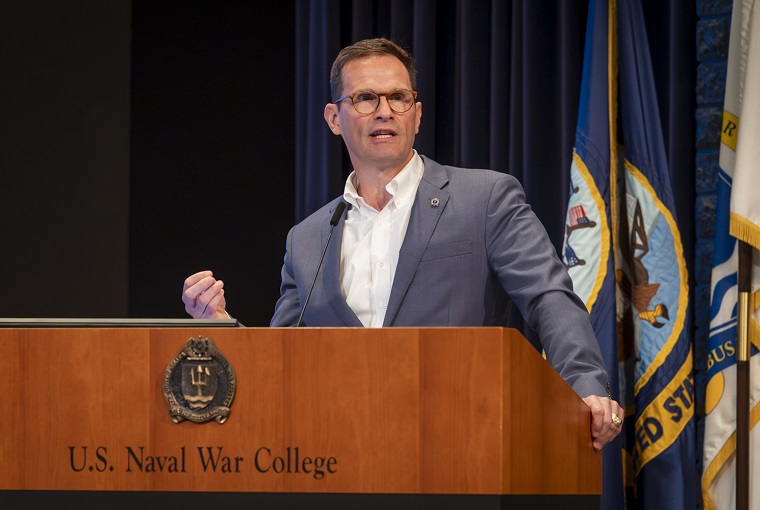
“True readiness is rooted in the stability and fulfillment of the people who call USAG Bavaria – Hohenfels home,” said Angela Lane, deputy garrison manager for the Hohenfels community, during opening remarks. “Today’s fair is more than just a networking event; it is a bridge. It connects the incredible talent within our community to the organizations that need it most.

USAG BAVARIA – HOHENFELS, Germany — Angela Lane, deputy garrison manager for U.S. Army Garrison Bavaria – Hohenfels, speaks to the organizations gathered at the start of a career fair. USAG Bavaria’s Army Community Service hosted the annual Hohenfels Career and Volunteer Fair May 14, 2026 at the Community Activity Center. Community members met with prospective employers and volunteer organizations to explore new career paths. (U.S. Army photo by Bryan Gatchell, USAG Bavaria Public Affairs) (Photo Credit: Bryan Gatchell) VIEW ORIGINAL

“Whether you are an employer looking for the unique discipline of a military spouse,” Lane continued, “or a volunteer agency seeking the heart of a servant leader, you are in the right place.”

Denise Hughes, the Employment Readiness Program manager, organized the event.

“The goal of this is to bring the community together,” said Hughes. “It’s great for making those connections and networking. We have military spouses who have maybe just arrived, and they’re not familiar with what’s out there. So this is a great way to get that exposure and land a career.”

Representatives from ACS were on hand to assist community members with their resumes and to answer career advice. Representatives from the Transition Assistance Program spoke to Soldiers to provide them insight into what their post-military careers could offer them. Members of the Joint Multinational Readiness Center Viper team took professional headshots for jobhunters entering the market.

Also new this year, students from the Hohenfels Middle / High School visited the fair to learn the process of gaining employment post-schooling.

Soldiers and their Family members turned out to the event to learn and to make contacts.

Sgt. 1st Class Brandon Williams, a Soldier with the JMRC, had turned in his retirement paperwork the day before, and was at the career and volunteer fair to survey the job market and to educate himself, to “figure out what I want to do when I become an adult.”

“Everyone here is receptive and informative,” Williams said. “This is just an opportunity to expand your picture of opportunities outside the military.”

There were also several organizations who offered community members volunteer opportunities, including the American Red Cross – Hohenfels and the Hohenfels Community and Spouses Club.

“We always stress volunteerism,” said Hughes of these organizations. “That is kind of a gateway to employment, especially here, just building that relationship, getting in, volunteering, and many of our volunteer organizations end up hiring those that volunteer with them because of that relationship they’ve built.”

Hughes added that volunteering can also help community members gain valuable skills that will aid them in succeeding in their future careers.

Army Community Service for U.S. Army Garrison Bavaria is scheduled another career and volunteer fair in the autumn at Rose Barracks.

Locally, ACS holds a resume lab (its next iteration is from 10 a.m. to 2 p.m. May 29 at the ACS building). Online, community members can sign up for a federal resume writing workshop from 10 a.m. to 2 p.m. May 21.

To learn more about leveraging ACS’s career expertise, call 09472-708-4860 or DSN 522-4860, visit their web page here, or visit them at Bldg. 10A.