Defense News in Brief: Air Force delivers on acquisition transformation, redesignates executives as PAEs

Source: United States Airforce

Two moves, made in the right order, will break portfolios — and eventually the acquisition system as a whole — out of the compliance trap, writes Timothy Cooke in this op-ed.
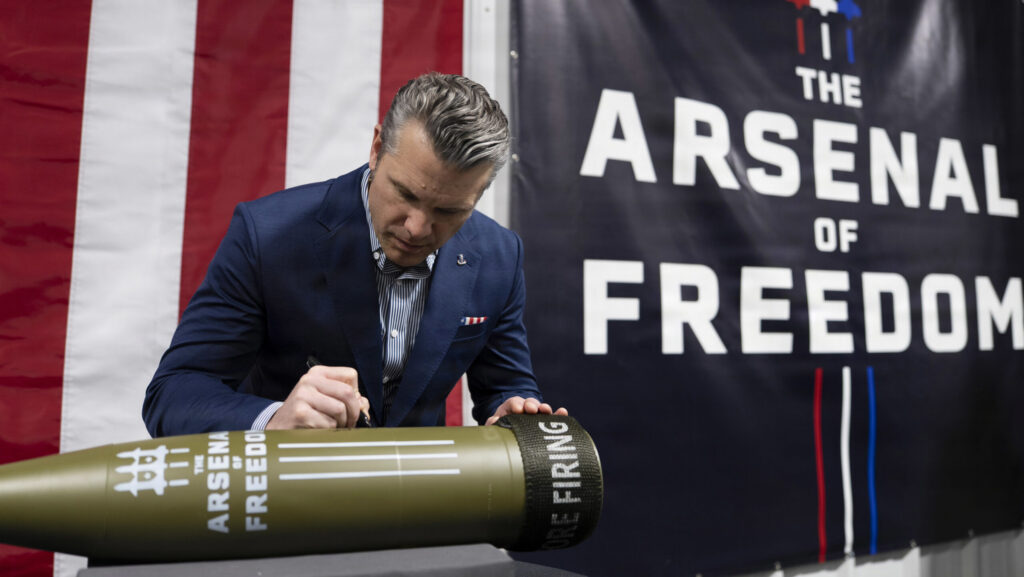
Sec. Pete Hegseth signs a 155 mm howitzer shell during his “Arsenal of Freedom” speaking tour of American defense industry. (DoD photo by US Navy Petty Officer 1st Class Alexander Kubitza)

What will it take for acquisition reform to finally succeed? New org charts aren’t enough: The people in the organization need new incentives.

Since last fall, in a sweeping organizational overhaul, all three military departments have replaced program executive officers with Portfolio Acquisition Executives (PAEs). The Army stood up six, the Navy nine. The Space Force completed its transition in July with nine. The Air Force redesignated all of its program executive officers as PAEs effective July 4.  These new executives have the power to launch sustainable reform that, at long last, shifts defense acquisition from a focus on procedural compliance to one on accomplishing the mission — if and only if they use that power to take two crucial and complementary steps. First, they must provide believable, executable top cover for contracting officers, not just lip service about taking risks. Second, they must refocus performance metrics to measure whether and how quickly acquisition outcomes produce mission results.

Both moves fall within the PAEs’ authority under Section 1802 of the fiscal 2026 National Defense Authorization Act. Modeling of acquisition workforce behavior shows that the two together break a portfolio out of the compliance trap; neither one alone does.

RELATED: Service acquisition leaders: Why this time will be different for defense acquisition

Prior reforms aimed at the acquisition workforce, but none changed the conditions under which it worked. What the PAEs do next will determine whether 30 years of acquisition reform produces yet another wave of promise, then reverts back to the bureaucratic mean, or delivers the change previous waves promised.

The PAE is the first acquisition official made responsible by statute for delivering capability across a portfolio rather than simply for milestone compliance on individual programs.

Compliance culture is not an attitude problem. The acquisition workforce is not timid or indifferent — it is rational. Consider the contracting officers (COs) in any PAE’s portfolio today. The COs aren’t ignorant: They know the Federal Acquisition Regulation (FAR) permits commercial procedures, oral presentations, Other Transaction Agreements (OTAs), and statements of objectives (SOOs) instead of detailed statements of work (SOWs). They know that the Revolutionary FAR Overhaul, triggered by Executive Order 14275, signed in April 2025, has expanded that legal operating space, stripping non-statutory content from most of the FAR. They know the Defense Secretary’s November 2025 directive [PDF] launched the transition to a Warfighting Acquisition System, with speed of capability delivery as the organizing principle.

That’s well and good, but when COs exercise flexible methods and face a protest, an audit, or a congressional inquiry, they are personally exposed. They’re the ones who sign for the government: Their name is literally on the line. When COs follow standard procedures and an acquisition produces a poor outcome, bad career consequences rarely follow. Under those conditions, rational COs default to the safest available procedure — not from cowardice, but from judgment. Compliance remains the smart choice.

Section 1802 alters that calculus. The PAE now holds direct authority over the program managers (PMs) and COs within a portfolio: a group of related programs managed together so resources can shift across them as missions evolve. Section 1802 makes the PAE responsible for capability delivery across that portfolio as a whole, not just for milestone compliance on any single program.  For the first time, the leaders with institutional authority over COs have a mission that requires them to provide real top cover, because the PAE’s own success depends on the outcomes that cover enables.

This is what every past reform lacked. The Federal Acquisition Streamlining Act, the Office of Federal Procurement Policy’s procurement innovation guidance, and the Section 809 Panel each sought to enable better behavior at the CO level. But none altered the chain of authority above the CO to link senior leaders’ performance to portfolio outcomes. Section 1802 does. That is the structural difference.

Of course, top cover and outcome metrics are not new ideas. The reform literature has called for them for decades. What simulating the acquisition system reveals, and previous reform efforts missed, is that the order of deployment determines whether the reforms take off or are absorbed.

Deploy outcome metrics first, and the CO sees a dashboard that measures behaviors the system still punishes. The metrics are accurate. The career risk is unchanged. The CO does not move.

Deploy top cover first, and the CO begins exercising flexible methods, because the risk that mattered most — professional exposure — has been removed. When metrics arrive, they make the resulting outcomes visible. The PAE can see what is working. Resources flow toward what works. The loop closes.

Simulation showed that top cover paired with outcome metrics revolutionized portfolio management, a “phase change” as dramatic as solid ice melting into liquid water. But neither one alone was sufficient to break the hold of compliance culture.

A second simulation finding sharpens the urgency: Building the outcome culture is harder than losing it. It takes roughly twice the institutional commitment to establish the new pattern as to maintain it. Reforms that fail to reach the threshold collapse, and the system reverts, as it has after every previous reform wave. Reforms that cross the threshold stick.

The system is now closer to that threshold than at any point in three decades, but it has not yet crossed it.

The PAE is the binding constraint. The first decision — whether to provide real institutional protection for contracting officers who exercise flexible methods — determines whether everything else can be sustained or is absorbed by the old pattern.

Top cover is not a memo encouraging innovation or a speech about speed. It is a written, public commitment by the PAE, by name, to defend specific contracting decisions made in good faith using specific flexible methods. It specifies which methods the institution will support, from oral presentations to OTA prototype agreements. It commits dedicated legal resources and senior leadership engagement when a flexible-method award is challenged. It assures that a CO acting in good faith, with a documented rationale, will not face career consequences for an imperfect outcome or a sustained protest. And it changes how COs are evaluated.

Documented business judgment replaces procedural perfection as the standard, with mission delivery and procedural compliance carrying equal weight.

Three metrics constitute a viable starting set. First, time-to-mission-effect tracks elapsed time from a validated operational need to capability in the operator’s hands — the full pipeline that traditional metrics like procurement administrative lead time (PALT) cannot capture, since it runs only from solicitation to award. Second, post-award mission satisfaction, a structured assessment conducted by the requiring activity at six and 12 months, links the contract to the operator’s lived experience of how the product actually performs, rather than to technical acceptance alone. Third, competitive yield, the number and quality of offers received, makes visible the firms that did not bid because the solicitation signaled that innovative vendors were unwelcome.

None of this requires new authorities now that the system structure has changed with the creation of PAEs. It requires a decision to measure what matters.

The PAE does not need to push every program through Other Transaction Authority or exotic procurement vehicles. Moving the portfolio’s default requirements format from the detailed SOW to the outcome-focused SOO, paired with credible cover, is sufficient. A CO who can describe what the operator needs rather than which technical solution to pursue, and who is protected when the resulting award attracts a protest, will make the trades that get capability to the warfighter faster.

This is well within Section 1802 authority. All that’s needed to start the journey is the decision, the top-cover document, and the outcome metrics.

The PAE need not transform an entire portfolio at once. Pick one or two programs as pathfinders. Apply maximum cover and flexibility. Measure the results. The first successful pathfinders become seeds visible to the next CO, the next PM, the next portfolio, and the effects propagate.

The authority exists. The regulatory space exists. The leadership signal exists. The statutory foundation exists. The system is closer to the threshold than it has ever been.

The question is whether this generation of acquisition leaders will push it across.

Timothy W. Cooke is president and CEO of ASI Government LLC, which advises federal agencies on acquisition strategy and organizational transformation.
Defense News in Brief: Air Mobility Command welcomes new commander

Source: United States Airforce

  • Air Mobility Command Public Affairs

Air Mobility Command officially welcomed Lt. Gen. Daniel H. Tulley as its new commander during an assumption of command ceremony held at Scott Air Force Base, Aug. 3.

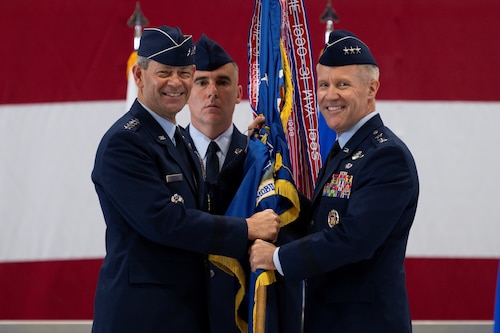
U.S. Air Force Lt. Gen. Daniel H. Tulley accepts the Air Mobility Command guidon from Air Force Chief of Staff Gen. Ken Wilsbach during the AMC Assumption of Command ceremony on Scott Air Force Base, Illinois, August 3, 2026. Tulley assumed command of AMC, leading nearly 107,000 Total Force Airmen and more than 1,100 aircraft dedicated to delivering Rapid Global Mobility that enables the Joint Force to rapidly deploy, sustain and maneuver combat power across the globe. (U.S. Air Force photo by Tech. Sgt. Dalton Williams)
Lt. Gen. Daniel H. Tulley accepts the Air Mobility Command guidon from Air Force Chief of Staff Gen. Ken Wilsbach during the AMC assumption of command ceremony at Scott Air Force Base, Illinois, Aug. 3, 2026. Tulley assumed command of AMC, leading nearly 107,000 Total Force Airmen and more than 1,100 aircraft dedicated to delivering rapid global mobility. (U.S. Air Force photo by Tech. Sgt. Dalton Williams)

Air Force Chief of Staff Gen. Ken Wilsbach presided over the event as Tulley assumed command of AMC.

“Recent operations like Absolute Resolve and Epic Fury have reminded us that airlift, aerial refueling, aeromedical evacuation, and global logistics are not simply supporting functions,” Wilsbach said. “They create options for our nation’s leaders, provide freedom of action for combatant commanders, and make the employment of military power possible. In every sense of the word, they enable maneuver.”

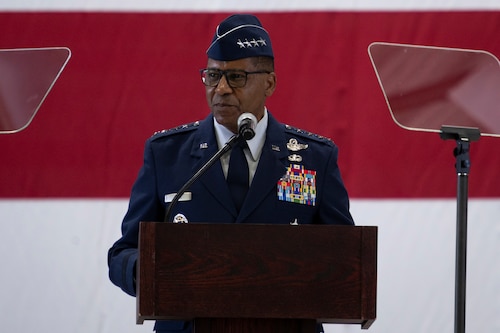
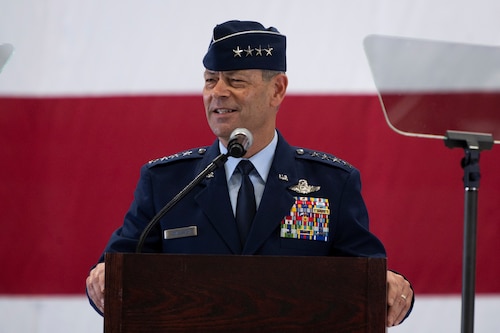
Air Force Chief of Staff Gen. Ken Wilsbach delivers opening remarks during the AMC Assumption of Command ceremony on Scott Air Force Base, Illinois, August 3, 2026. Lt. Gen. Daniel H. Tulley assumed command of AMC, leading nearly 107,000 Total Force Airmen and more than 1,100 aircraft dedicated to delivering Rapid Global Mobility that enables the Joint Force to rapidly deploy, sustain and maneuver combat power across the globe. (U.S. Air Force photo by Tech. Sgt. Dalton Williams)
U.S. Air Force Chief of Staff Gen. Ken Wilsbach delivers opening remarks during the Air Mobility Command assumption of command ceremony at Scott Air Force Base, Illinois, Aug. 3, 2026. Lt. Gen. Daniel H. Tulley assumed command of AMC, leading nearly 107,000 Total Force Airmen and more than 1,100 aircraft dedicated to delivering rapid global mobility. (U.S. Air Force photo by Tech. Sgt. Dalton Williams)

Wilsbach also remarked on Lt. Gen. Rebecca Sonkiss’ leadership and accomplishments during her tenure as interim commander of AMC.

“These accomplishments speak for themselves, but they reflect something more important than operational success,” Wilsbach said. “They reveal a leader who built trust across the enterprise, and ensured every organization understood both its mission and its role in achieving a common objective. I know that a source of inspiration for you, Reba, is the people you serve with every day, and I am so grateful for your steadfast leadership during combat operations. Thank you for your vision, professionalism, and dedication to the command and to our Airmen.”

U.S. Air Force Gen. Randall Reed, commander of U.S. Transportation Command, delivers remarks during the AMC Assumption of Command ceremony on Scott Air Force Base, Illinois, August 3, 2026. Lt. Gen. Daniel H. Tulley assumed command of AMC, leading nearly 107,000 Total Force Airmen and more than 1,100 aircraft dedicated to delivering Rapid Global Mobility that enables the Joint Force to rapidly deploy, sustain and maneuver combat power across the globe. (U.S. Air Force photo by Tech. Sgt. Dalton Williams)
Gen. Randall Reed, commander of U.S. Transportation Command, delivers remarks during the Air Mobility Command assumption of command ceremony at Scott Air Force Base, Illinois, Aug. 3, 2026. Lt. Gen. Daniel H. Tulley assumed command of AMC, leading nearly 107,000 Total Force Airmen and more than 1,100 aircraft dedicated to delivering rapid global mobility. (U.S. Air Force photo by Tech. Sgt. Dalton Williams)

Gen. Randall Reed, commander of U.S. Transportation Command, provided additional comments during the ceremony, speaking to Tulley’s leadership background and the pivotal role the command has in delivering rapid global mobility for the joint force.

“The expectations are high, but you are well prepared,” Reed said. “General Dan Tulley is a proven leader having commanded at the squadron, group and wing levels. Equally as important, his experience in strategy and policy, demonstrating his ability to understand the evolving strategic environment, and he is clear-eyed about the need to deliver solutions to meet national objectives and to be my air component commander.”

Prior to assuming command, Tulley served as commander and president of Air University, where he led the U.S. Air Force’s center for professional military education, leadership development, research and outreach. He provided a crucial learning foundation for every stage of an Airman’s career, developing more than 50,000 resident and 120,000 non-resident officers, enlisted members and civilian personnel annually.

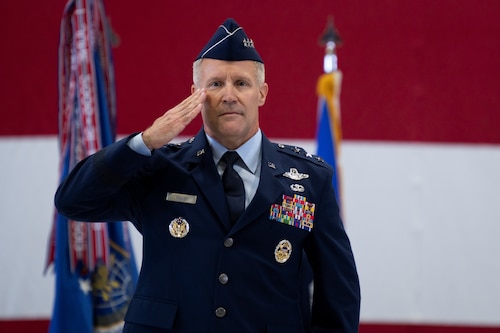
U.S. Air Force Lt. Gen. Daniel H. Tulley renders his first salute as Air Mobility Command commander during the AMC Assumption of Command ceremony on Scott Air Force Base, Illinois, August 3, 2026. Tulley assumed command of AMC, leading nearly 107,000 Total Force Airmen and more than 1,100 aircraft dedicated to delivering Rapid Global Mobility that enables the Joint Force to rapidly deploy, sustain and maneuver combat power across the globe. (U.S. Air Force photo by Tech. Sgt. Dalton Williams)
Lt. Gen. Daniel H. Tulley renders his first salute as Air Mobility Command commander during an assumption of command ceremony at Scott Air Force Base, Illinois, Aug. 3, 2026. Tulley assumed command of AMC, leading nearly 107,000 Total Force Airmen and more than 1,100 aircraft dedicated to delivering rapid global mobility across the globe. (U.S. Air Force photo by Tech. Sgt. Dalton Williams)

“AMC today reflects no single leader; it reflects generations of professional warriors united by a commitment to the nation, the joint force, and to answer the call,” Tulley said. “AMC is a warfighting command – we plan, integrate, and fight alongside every combatant command. We shape the plan, set the force, sustain the campaign, and preserve freedom of maneuver for joint force commanders. When the mission is complete, we bring that force home.”

As commander, Tulley will oversee the employment and integration of approximately 107,000 Total Force Airmen and more than 1,100 aircraft. Through airlift, air refueling, aeromedical evacuation and a global mobility support network, Air Mobility Command delivers rapid global mobility that enables the joint force to rapidly deploy, sustain and maneuver combat power around the globe.

Defense News in Brief: A-10’s take fini flight at Davis-Monthan AFB

Source: United States Airforce

  • By Airman Najzee Kuzu, 355th Wing Public Affairs

The familiar growl of the A-10C Thunderbolt II echoed across southern Arizona one final time July 29, as Airmen and local civic leaders gathered at Davis-Monthan Air Force Base to witness the aircraft’s final flight, marking the end of nearly five decades of A-10 operations at the installation.

“It’s not a place. It’s not people. It’s a mindset,” said Chief Master Sgt. Dave Anderson Jr., 355th Operations Group senior enlisted leader. “Hopefully that attack mindset will continue to live on, and it will make every single Airman it touches, every single airframe it touches, every single organization it touches better.”

The flight served as both a celebration and a farewell, honoring an aircraft that became synonymous with the 355th Wing and its close air support mission. As the aircraft passed overhead, the sound that had long defined Tucson’s skies became a reminder of the generations of Airmen who flew, maintained and supported the A-10 throughout its legendary service at Davis-Monthan AFB.

“The reason the A-10 flies, and the reason why our enemies are afraid of that, is because of the level of support every single Airman in all career fields gives to make sure that platform departs and comes back safely,” Anderson said.

For nearly five decades, the A-10 represented more than a weapon system; it reflected the discipline, professionalism and commitment of the Airmen who ensured the aircraft remained ready to answer the nation’s call. Every sortie, every training mission contributed to a legacy built on supporting forces on the ground in some of the most austere operational environments in the world.

“We’ve always had A-10s on the ramp; for the last 50 years they’ve been on the ramp,” said Lt. Col. Rodney Dwyer, 355th Operations Group commander. “To see the sunshades get torn down, to see the jets divest, fewer and fewer A-10s out there … it’s definitely bittersweet.”

As the aircraft landed following its final flight, the significance of the moment settled across the flightline. The Warthog’s mission at Davis-Monthan had ended, but the legacy created by the Airmen who flew, maintained and supported the aircraft will remain woven into the history of the base and the Tucson community for generations to come.

“I got out of the aircraft and went over to him [Dwyer] and told him, ‘I don’t want to do this, man. I don’t want to,'” Lt. Col. Ryan Rutter, 357th Fighter Squadron commander, said. “It’s tough, and I think a lot of it is you’ve just spent years being part of this team and flying this aircraft all over the world and building friends and relationships in the community. So, when you shut down the jet for the last time, it’s that realization that some of that will change, some of that will go away.”

The A-10’s final flight marked the closing chapter of a mission that shaped the identity of the installation and forged lasting connections between the base and the surrounding community. Residents grew accustomed to the unmistakable sound of the twin-engine aircraft overhead, recognizing it as a symbol of the military presence that has remained an enduring part of Tucson.

“Thanks for trusting us,” Rutter said. “Thanks for letting us train and improve our skills and develop the culture.”

Defense News in Brief: Wolf Pack executes Beverly Sentinel 26-4

Source: United States Airforce

Exercise Beverly Sentinel 26-4 tested the 8th Fighter Wing’s readiness and ability to defend Kunsan Air Base through simulated high-intensity attacks. The joint training involved Airmen and Marines executing Ability to Survive and Operate scenarios, tactical casualty care, and base defense measures to ensure operational continuity in a contested environment.

Defense News in Brief: Senior leaders chart course for future force

Source: United States Airforce

  • By Tech. Sgt. William A. O’Brien
  • Secretary of the Air Force Public Affairs

More than 60 Air Force senior leaders gathered at Wright-Patterson Air Force Base, Ohio, June 10-12, for the semiannual Corona summit, a strategic planning forum focused on policy development, force readiness and future force initiatives.

Formalized by Gen. Curtis LeMay in 1961, Coronas serve as a venue for the Air Force’s top echelon to foster collaboration and refine strategic decisions on an array of topics as diverse as training, deterrence and air warfare doctrine. This recent iteration provided a decision-making forum designed to build upon recent policy modifications and address key areas essential for maintaining a ready and capable future force.

“I have traveled to our installations worldwide, meeting face-to-face with the Airmen who execute our mission every day,” said Air Force Chief of Staff Gen. Ken Wilsbach. “They share their real, day-to-day challenges with me, and Corona is where we turn that feedback into strategic action – making decisions to dismantle barriers, modernize our capabilities, and build a better Air Force from the bottom up.”

The three-day summit provided a decision forum to build on recent policy changes and discuss key areas to ensure a ready and capable force for the future.

Joining the traditional cadre of Major Command commanders and Headquarters Air Force senior leaders were their respective Command Chief Master Sergeants, alongside a diverse group of general officers representing various operational and functional directorates.

The group agreed on a host of policies and changes, including those related to basic military training, the use of AI and protecting bases from drones and other threats.

BMT Next (Modernizing Basic Military Training)

To better prepare incoming personnel for the complexities of future conflicts, a comprehensive curriculum update will be implemented for BMT by 2027. Under this revitalized model, training will more closely align Airmen with the broader Air Force mission. The curriculum will heavily emphasize “Airmindedness,” military professionalism and the Air Force Core Values.

Pairing those three skills with the specialty training that follows, Airmen will arrive at their first duty stations equipped with the foundational skillsets essential for modern warriors.

Not only will what they learn change, the physical training environment will undergo a significant transformation, too. There are plans to construct a dedicated Air Force Training Range, which will serve as the centerpiece of the BMT compound. This facility is designed to orient the trainees’ mindset around the Air Force’s primary power projection platform: the air base.

Point Defense of Air Bases

Recognizing the evolving threat environment, the decision was made to establish Point Defense Flights at select Air Force installations. Initially, these specialized units will be composed of personnel drawn from multiple career fields.

Concurrently, a dedicated new Air Force Specialty Code is being developed to formalize and sustain this base defense capability.

Artificial Intelligence

To harness the strategic advantages of emerging technologies, Wilsbach announced forthcoming Headquarters Air Force-level guidance regarding AI integration. This initiative aims to institutionalize proven AI best practices currently utilized across the enterprise.

A primary objective includes developing programs that leverage AI to automate repetitive administrative tasks, thereby freeing up Airmen for mission-critical duties.

Emphasizing a forward-looking approach, the summit also highlighted the ongoing efforts of the Chief Master Sergeant of the Air Force’s task force dedicated to AI innovation.

The Future of Guardian Angel & Tactical Air Control Party Weapon Systems

The Air Force will not combine its Guardian Angel (GA) and Tactical Air Control Party (TACP) weapon systems into a single unit. Each will retain its distinct identity and core, specialized competencies.

GA remains focused on personnel recovery, while TACP continues its role in precision strike, distributed command and control and integrating airpower with ground combat. The two may train together periodically to be interoperable in conflict, with MAJCOMs setting the training standards.

Building on TACP’s existing expertise in airpower integration, it was designated as the lead weapon system for One-Way Attack missions for employment by the Joint Forces Air Component Commander.

Leaders also moved to bring greater discipline to how the Air Force uses the term AFSPECWAR (Air Force Special Warfare) for the GA and TACP communities. Over recent years, the term has increasingly been used in an operational context, and the summit reaffirmed that AFSPECWAR is neither a mission nor a weapon system. It remains a term of enduring value for recruiting, accessions, initial skills training and the shared warrior ethos that unites communities of extraordinary Airmen.

To ensure clear command relationships, distinct capabilities, accurate authorities, preserved community identity and specificity in combat employment, the Air Force will use precise terms for specific weapon systems. This decision ensures operational clarity and honors the valor of the Airmen in the GA and TACP weapon systems.

Audit

In compliance with congressional directives, the enterprise-wide comprehensive financial audit continues. To ensure effective execution and accountability, Wilsbach directed all MAJCOM commanders to provide bi-monthly progress updates, emphasizing that audit readiness must remain at the forefront of their daily operational workflows.

In addition to the key decisions listed, other priorities were discussed at the forum to include readiness, both aircraft and personnel, along with streamlining enterprise-wide logistics-informed command and control (C2). Leaders focused on taking care of Airmen with talent management discussions, mission focused assignments and developmental opportunities.

Other operational discussions included a renewed focus on Camouflage, Concealment and Decoys, as well as the speed of information and the ability to make tactical adjustments in dynamic threat environments with a Digital Fires Report.

As the Air Force’s senior leaders gathered in Dayton to tackle the most complex challenges facing the force, the above decisions impact not only the 665,000 Airmen, but also allies, partners, industry and supportive local communities. Some of the initiatives are internal to the Air Force, while others are further reaching.

“This summit was a resounding success because we didn’t just talk about the future – we made concrete decisions to shape it,” Wilsbach said. “Whether we are modernizing our training, fortifying our defenses to guarantee readiness, or leveraging AI to return valuable time to our Airmen and their families, we are building a force postured to win.”