Defense News in Brief: Air Force Reserve welcomes new commander

Source: United States Airforce

  • By Lt. Col. Carrie Kessler
  • Headquarters Air Force Reserve Command

Members of the Air Force Reserve Command welcomed their new leader during an assumption of command ceremony held at the Robins’ Museum of Aviation Aug 21.

Lt. Gen. Paul R. “Speedy” Fast took command in a ceremony presided over by Air Force Chief of Staff Gen. Ken Wilsbach. Fast succeeds Lt. Gen. John P. Healy, who retires in October after 37 years of service.

The new AFRC Commander, who has served under Wilsbach’s command multiple times, was readily endorsed by the CSAF.

“I’ve seen Speedy’s brilliant leadership firsthand,” said Wilsbach. “He has the operational credibility, the strategic vision, and the command experience to lead this enterprise.”

As the new Reserve commander, Fast will have full responsibility for nearly 70,000 Reserve Airmen and civilians at three numbered air forces, 34 flying wings, 8 independent groups, a space wing, a cyber wing, and an intelligence, surveillance and reconnaissance wing, and other subordinate units. As Chief of Air Force Reserve, he will serve as principal adviser on reserve matters to the Secretary of the Air Force and the Air Force Chief of Staff.

Wilsbach emphasized to the hundreds of reserve command Airmen in audience that “the challenge ahead of us is clear. We must continue to accelerate our modernization, integrate our forces, and break down any barriers to our collective readiness.”

He added, “Our adversaries are watching, and our unity of effort is our strongest deterrent signal.”

Following receipt of the guidon, Fast presented five Task Areas that will continue to be refined over the coming weeks.

Task Area 1: Prepare for war, Ready Always!

Task Area 2: Develop our Airmen

Task Area 3: Preserve and protect our Reservists’ ability to serve

Task Area 4: Fiercely manage and execute our resources

Task Area 5: Curate a Reserve force of the future

“We’ll be the reserve that the nation needs and leverages the unique set of attributes and capabilities that can only be found in the Air Force Reserve,” said Fast.

He added that, “as challenging as these tasks will be in the coming years, there has never been a better time to get after them.”

Fast entered the Air Force in 1991, after receiving his commission through the Air Force Reserve Officers’ Training Corps program at Miami University, Oxford, Ohio. While serving on active duty from 1992 to 2001, he accumulated more than 1,000 hours in the E-3 Airborne Warning and Control System. In October 2001, Fast joined the Air Force Reserve.

Throughout his 25 years as a Reservist, he has supported exercises and operations across the globe, served as the interim 36th Wing commander at Andersen Air Force Base and interim deputy commander of Joint Region Marianas, Guam, and led the reconstitution of Andersen Air Force Base after Super Typhoon Mawar. Prior to assuming his current role, Fast served as the 4th Air Force commander.

“Over the past year, as Commander of Fourth Air Force, he immersed himself in Mobility Air Force dynamics, executing the largest mobilization of Reserve forces in over 30 years for Operation Epic Fury.” said Wilsbach. “(Fast) knows how to generate, present, and deploy combat power at scale.”

Fast ended by addressing his gratitude for the opportunity to continue to serve.

“To my teammates in Air Force Reserve Command, I am honored and I am humbled to lead with you now and in the coming years,” said Fast. ‘Thank you for accepting me as your new commander. I can’t wait to fly and fix and fight and win alongside every one of you. Fight’s on.”

Defense News in Brief: Cold War-era law finds new use at America’s B-2 bomber base

Source: United States Airforce

  • By Thomas Brading
  • AFOSI Public Affairs

Qilin Wu, a Chinese national who returned to Whiteman Air Force Base after being warned not to photograph the installation, was sentenced to six months in federal custody following a case built on a 76-year-old executive order signed by President Harry Truman.

The conviction showed how a Cold War-era legal framework can be used against repeated, unauthorized photography around sensitive military installations, and how Special Agents will investigate similar cases before they develop into something more.

“For our Special Agents, this isn’t about a single case,” said Col. David Bethel, commander of the Air Force Office of Special Investigations Region 8. “It’s about recognizing that the operating environment has changed.”

Bethel was referring to a shift from clear-cut threats in overseas environments to more ambiguous activity around military installations inside the United States. In Wu’s case, investigators said the concern was not just his camera, but that he returned after being warned and photographed more than the aircraft.

That conduct ultimately led to an investigation, guilty plea and sentencing. After the hearing, held earlier last month, the court remanded Wu to the U.S. Marshals Service. He was later processed on an Immigration and Customs Enforcement detainer and will be deported to China.

“When someone gathers information around a sensitive military installation, AFOSI has the tools to hold them accountable,” Bethel said.

The encounter began on Dec. 2, 2025, when members of the 509th Security Forces Squadron responded to a report of a suspicious minivan near Whiteman’s perimeter. Wu, who was driving a vehicle with Massachusetts license plates, said he had come to observe the B-2.

“What made this different was the pattern of behavior,” said a senior AFOSI official involved in the investigation. Wu’s return after the warning, along with his focus on the base’s perimeter and infrastructure, heightened concerns.

Wu later admitted to photographing aircraft and installations at other U.S. military bases, including locations in Florida and Virginia.

Section 795 of Title 18, together with Executive Order 10104, prohibits unauthorized photographs, sketches, maps and other visual representations of designated military installations, aircraft, weapons and equipment requiring protection from the general dissemination of information.

AFOSI officials said the law provides authorities with a means to address unauthorized photography involving protected military property. In Wu’s case, investigators focused on his repeated conduct, his return after being warned and the subjects captured in his photographs.

Officials said the case also demonstrates the importance of coordination between installation security forces and federal investigators when suspicious activity is reported near sensitive military facilities.

AFOSI will continue to identify, assess and investigate suspected unauthorized photography around protected installations and equipment, officials said, while evaluating each incident based on its specific facts and circumstances.

For Bethel, the case highlights the agency’s role in protecting the homeland.

“Det. 811’s work delivered strategic deterrence,” he said. “This case reflects AFOSI’s professionalism, integration and operational discipline required to defend our installations in an increasingly complex threat environment.”

Note: Some AFOSI personnel and mission partners are not identified by name in this article to protect operational security, personal privacy and ongoing mission readiness.

Defense News in Brief: The Cognitive Weapon System: Under Secretary’s AFSA speech champions authentic leadership, Deliberate Learning

Source: United States Airforce

  • By Tech. Sgt. William A. O’Brien
  • Secretary of the Air Force Public Affairs

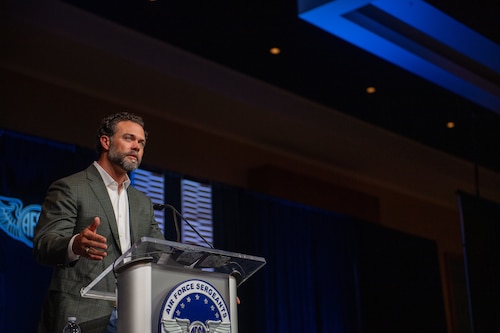
Under Secretary of the Air Force Matt Lohmeier implored Airmen to pursue continuous personal growth, authentic leadership and intentional intellectual development during a keynote address at the Air Force Sergeants Association Professional Airmen’s Conference.

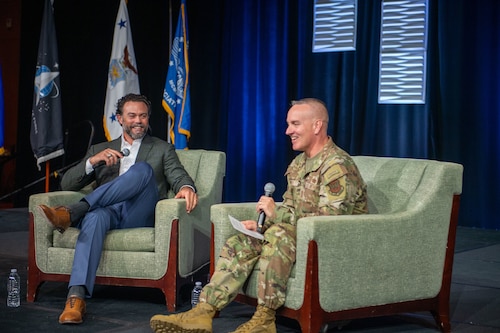
Under Secretary of the Air Force Matthew Lohmeier implored Airmen to pursue continuous personal growth, authentic leadership, and intentional intellectual development during a keynote address at the Air Force Sergeants Association Professional Airmen's Conference, Aug. 12.
Under Secretary of the Air Force Matthew Lohmeier implored Airmen to pursue continuous personal growth, authentic leadership, and intentional intellectual development during a keynote address at the Air Force Sergeants Association Professional Airmen’s Conference, Aug. 12.

Lohmeier turned directly to the leader he would later share the stage with for a question-and-answer session: Chief Master Sgt. of the Air Force David R. Wolfe. As he centered his remarks on the third edition of Wolfe’s “Why Series” essay on deliberate learning, integrating his own thoughts to illustrate why the Chief’s message resonated deeply with him.

Reading Wolfe’s words aloud to the crowded forum, Lohmeier highlighted a central premise that he believes defines modern military readiness.

“The most decisive advantage is no longer just physical or technological; it’s cognitive,” Lohmeier said, quoting Wolfe’s text. “For members of the United States Air Force, the mind isn’t simply a supporting asset; it’s a primary weapon system, and like any weapon system, it must be deliberately developed, maintained, and strengthened.”

While acknowledging the military’s ongoing efforts to train and adapt to artificial intelligence, Lohmeier put a finer, more human point on the cognitive domain.

“AI will soon do things that even some of our best minds cannot,” Lohmeier said. “But your minds, your values, and your psyche should be capable of doing things that AI will never accomplish. If we fail to do that, then we are failing as an Air Force, as an institution, and as human beings.”

Lohmeier’s insights are informed by his routine of breaking bread with frontline Airmen during installation visits. Meeting small groups of junior enlisted members for a lunch or breakfast session allows him to use those forums to gather feedback to carry back to the senior leadership team in the Pentagon.

“Overwhelmingly, I have received positive feedback from our youngest Airmen about the NCOs that they work with, our senior NCOs, and their chain of command,” Lohmeier shared. “One of the things I’ve learned in my time meeting with these Airmen is that they resonate with authentic leadership. They crave authenticity in the workplace. When they get it, they respond appropriately, and they’ll give you everything that they have to solve the tough challenges we’re facing.”

To illustrate what it means to lead authentically and from the front, Lohmeier—a former fighter pilot and Space Force officer—shared a lighthearted but pointed anecdote from a recent physical training session with student pilots at Vance Air Force Base, Oklahoma.

Under Secretary of the Air Force Matthew Lohmeier implored Airmen to pursue continuous personal growth, authentic leadership, and intentional intellectual development during a keynote address at the Air Force Sergeants Association Professional Airmen's Conference, Aug. 12.
Under Secretary of the Air Force Matthew Lohmeier implored Airmen to pursue continuous personal growth, authentic leadership, and intentional intellectual development during a keynote address at the Air Force Sergeants Association Professional Airmen’s Conference, Aug. 12.

After a PT session, Lohmeier challenged the attendees to face him in a pull-up competition. Knowing he was facing a younger, more fit Airman, Lohmeier humorously admitted that he turned to “psychological warfare.” He insisted they both jump onto the bar at the same time, allowing Lohmeier to control the pacing.

In Lohmeier’s recounting of the challenge, he described inserting long, agonizing pauses in the hang position and asking his competitor mid-pull-up if he could perform behind-the-neck variations to break his opponent’s focus. His opponent dropped off the bar just one repetition shy of the Under Secretary.

“I share that to say that I think they’re inspired by your examples,” Lohmeier told the conference attendees. “Our Airmen do best when they’re led by NCOs and senior NCOs who are out leading in the front. You need to hold them accountable to the standards that we’ve set. It has to do with leaders and how they lead, serve, and set an example.”

Reading as an act of service

A self-described avid reader, Lohmeier joked that younger Airmen are “big video gamers, but they’re not big readers.” He challenged the audience to reframe reading from a passive, box-checking activity into a critical component of combat readiness and moral character.

He argued that intellectual discipline is directly tied to the Air Force’s first core value: Integrity First.

“Without this disciplined effort to read deeply, it’s not entirely possible to become the most authentic version of yourself,” Lohmeier explained. “If you’ve not accomplished the work that is necessary to fully develop yourself and fully discover and ground yourself in the values that define you, how can you ever truly have integrity? Rigorous study isn’t just about intellectual stimulation; it’s about values, about character development, and about pursuing the best version of yourself as you lean forward and serve others.”

Lohmeier emphasized that this intellectual preparation is the foundation of military resilience, providing the mental clarity required to withstand disinformation campaigns from adversaries who seek to exploit fear, anger, and historical ignorance.

“As leaders, our job is to foster a culture that values and makes room for continuous learning,” Lohmeier said. “Organizations that encourage Airmen to invest in their cognitive readiness create a force that is agile, innovative, and prepared—transforming learning from an individual effort into shared strength.”

Following his prepared remarks, Lohmeier was joined on stage by Wolfe for a fireside chat, during which, Wolfe tacked onto the theme of reading, officially announcing the release of his latest reading list, the CMSAF Leadership Library: August 2026.

Lohmeier closed his remarks by giving the conferencegoers a reminder of their influence on the future of the force.

“You are the beating heart of the Air Force,” Lohmeier said. “If I questioned it before this job—and I really didn’t, because I was a squadron commander once too, I truly do believe that you are the beating heart. Your leadership is important, and your personal development is absolutely important as we try and shape the minds and hearts of those that you lead and serve.”

Defense News in Brief: Hegseth renames Joint Base Charleston to honor late Sen. Lindsey Graham

Source: United States Airforce

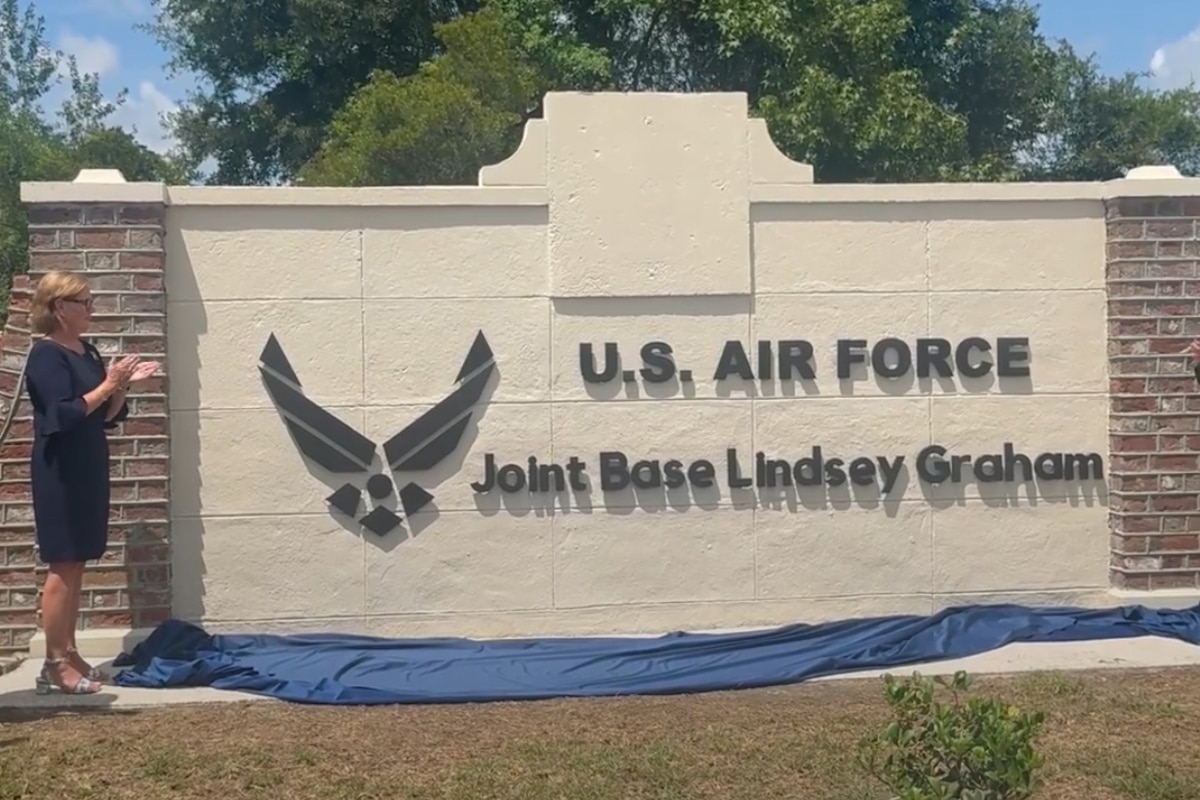
Joint Base Charleston, South Carolina, became Joint Base Lindsey Graham during a ceremony Aug. 10 to rename the installation after the late senator, Air Force veteran and South Carolina native son.


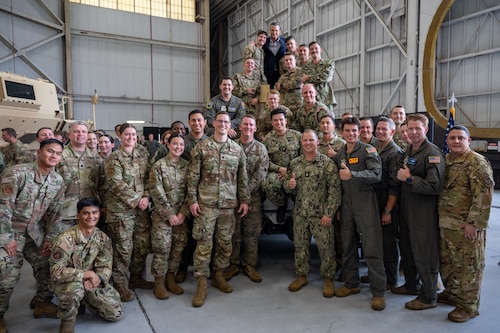
More than a dozen people in camouflage military uniforms pose for a photo in a hangar with a man in a suit as they stand in front of and on top of a military vehicle.
Secretary of War Pete Hegseth poses for a photo with service members at Joint Base Lindsey Graham, S.C., Aug. 10, 2026, after the base renaming ceremony.

Secretary of War Pete Hegseth joined South Carolina Gov. Henry McMaster and Sen. Darline Graham of South Carolina to dedicate the 32-square-mile installation, home to the 437th Airlift Wing, which provides global airlift capability to the joint force with the C-17A Globemaster III aircraft.


Lindsey Graham served as a U.S. senator from South Carolina from January 2003 until his passing July 11. He also served as a lawyer and commissioned officer in the Air Force’s Judge Advocate General Corps, first on active duty from 1982 until 1988, then as a member of the South Carolina Air National Guard until 1995 and finally, in the Air Force Reserve until 2015.

“Sen. Lindsey Graham dedicated his life to serving this state and serving the armed forces of the United States,” Hegseth said. “He served this nation both in uniform and in both houses of Congress. … But in both capacities, it was always the same mission. He knew the timeless truth that to ensure peace, we must be prepared for war. Protect your people, protect your state, protect your sovereignty, or you will lose it to someone else who is willing to take it from you.”

Hegseth said he first met Graham as a young first lieutenant in the Army. Hegseth had returned from Iraq and had aligned himself with a veterans group called “Vets for Freedom.”

“[We] believed in the surge in Iraq and advocating for the troops on the ground,” he said. “We were a young, scrappy veterans’ organization with no money and no access and connections.”


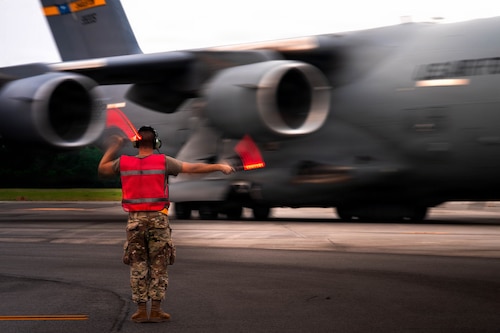
A person in camouflage and an orange reflective vest waves a flag in each hand while facing a transport aircraft on a runway.
An airman assigned to the 437th Airlift Wing marshals a C-17 Globemaster III aircraft onto the runway at Joint Base Charleston, S.C., July 27, 2026. The base was renamed Joint Base Lindsey Graham Aug. 10, 2026.

Only one senator, Graham, was willing to meet with Hegseth and other representatives of the group.


“He welcomed us into his conference room, sat us down as a bunch of lieutenants and [noncommissioned officers] and others around the table — fresh back from Iraq — who wanted the right strategy,” Hegseth said. “He said, ‘Gentlemen, welcome to a place where you can still say the word victory.’ He believed in mission success; he believed in the troops; he believed in giving the troops everything they needed.”

In later years, Hegseth said he recalled mentioning to Graham that he was now serving as an instructor at a counterinsurgency school in Kabul, Afghanistan.

“I had mentioned that we … could give him an update on what the Taliban was up to,” he said. “Sure enough, during his reserve duty, there he was — jet-lagged as all hell — because that man had a schedule like nobody else. But he was there to hear from us because he wanted his ear to the ground from the troops on what was actually happening in the war in Afghanistan.”

Just weeks before the senator’s passing, Hegseth said he met with Graham to discuss the War Department budget — the current request, $1.5 trillion, is the largest in U.S. history. The senator showed his commitment to troops there, too.

“[He asked], ‘Mr. Secretary, what do you need for reconciliation?'” Hegseth said.

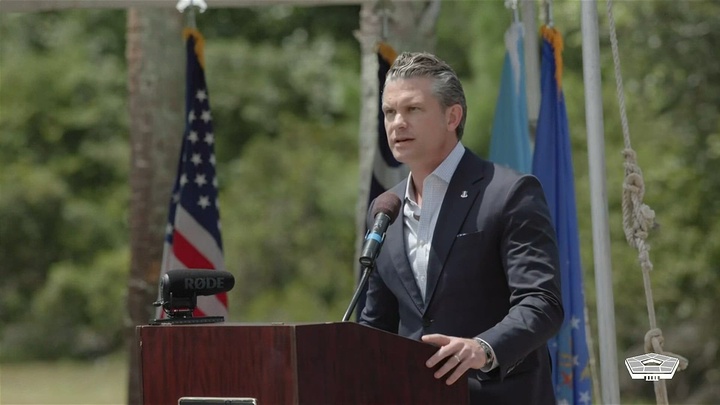
Secretary of War Pete Hegseth speaks during the base renaming ceremony of Joint Base Charleston, S.C., Aug. 10, 2026. The base is being renamed for the late Sen. Lindsey Graham, an Air Force veteran.

Hegseth said he discussed with Graham that he thought the department needed $1.15 trillion in the base budget and $350 billion in reconciliation to get to the needed $1.5 trillion total budget.


“He looked at me and said, ‘How’s $355 billion sound to you?'” Hegseth said. “He wanted to give even more than $350 [billion]. He wanted to ensure our military was as equipped as humanly possible, because he was thinking of places like this one right here.”

Graham, Hegseth said, knew what was needed to keep America safe.

“I saw firsthand as a young first lieutenant, as a captain in a combat zone and as a secretary, the unwavering commitment of Lindsey Graham,” Hegseth said. “He knew that if you’re going to seek peace, you have to be prepared for war. You have to have a prepared military. He talked the talk, and he walked the walk.”

Darline Graham took on his role as senator following her brother’s passing. She said he was proud of his service in the Air Force.

“What an honor for my brother, and what a tribute to his 33 years of service,” Graham said. “Lindsey loved the Air Force. He loved its mission. He loved wearing the uniform of his country. His interest in foreign affairs and national security started with his service in the Air Force.”

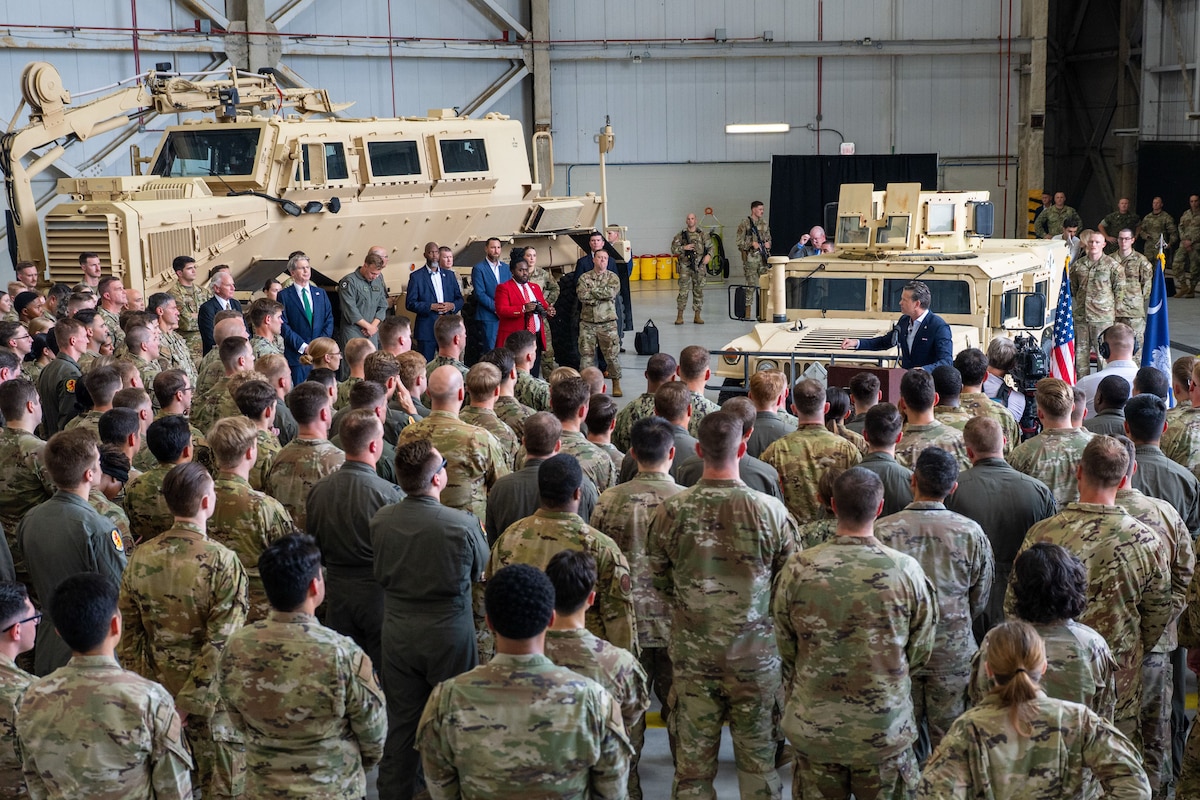
Dozens of people in camouflage military uniforms and business attire stand around a military vehicle in a hangar as a man in a suit speaks to them.
Secretary of War Pete Hegseth speaks to service members following the base renaming ceremony at Joint Base Lindsey Graham, S.C., Aug. 10, 2026.


A person applauds by a large rectangular sign reading "U.S. AIR FORCE Joint Base Lindsey Graham" outdoors.
The sign for Joint Base Lindsey Graham is unveiled at the base in South Carolina, formerly called Joint Base Charleston, Aug. 10, 2026.


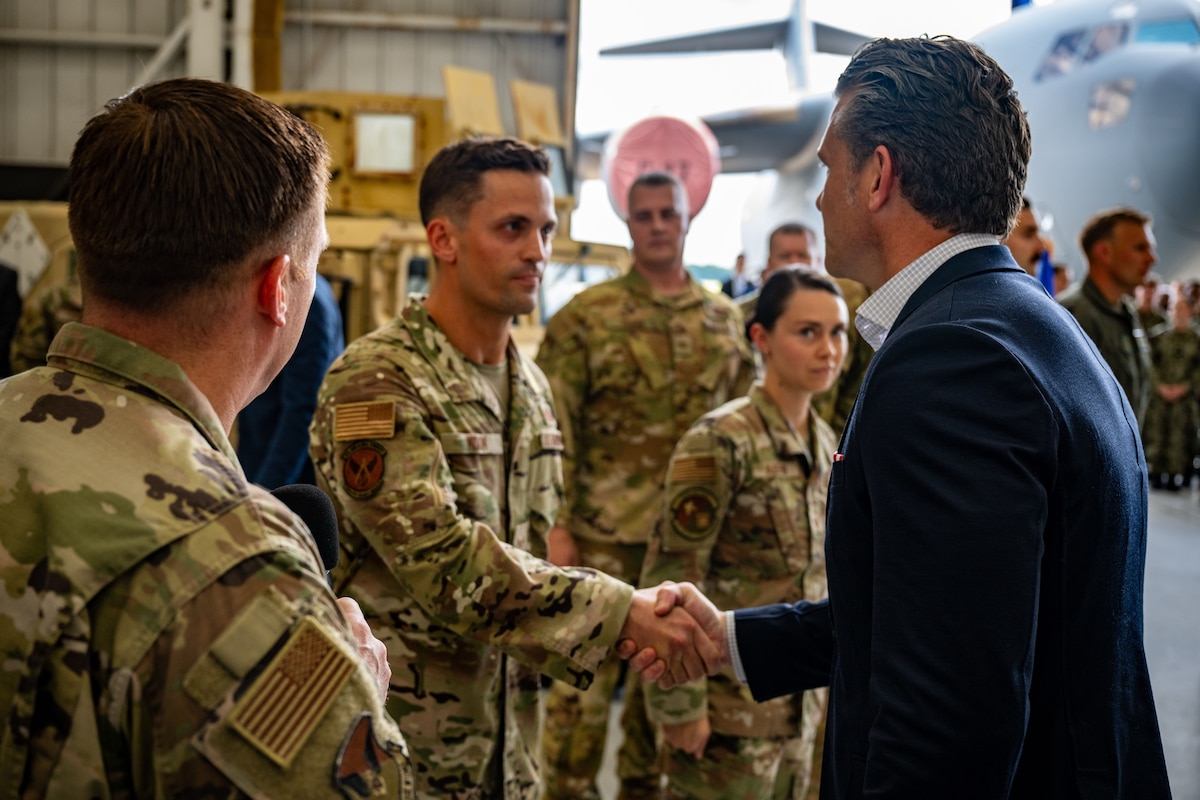
A man in a suit shakes hands with a man in a military camouflage uniform as other people in similar attire look on.
Secretary of War Pete Hegseth shakes hands with a service member at Joint Base Lindsey Graham, S.C., Aug. 10, 2026, after the base renaming ceremony.

Lindsey Graham initially served in state government as a member of the South Carolina House of Representatives. Later, from 1995 to 2003, he served in the U.S. House of Representatives, representing South Carolina’s 2nd District. And finally, he served as a U.S. senator from South Carolina, beginning in 2003.


“It was sometimes hard to tell if Lindsey was a senator who happened to serve in the Air Force or an Air Force lawyer who happened to serve in the Senate,” his sister said. “Such was his love for both. That’s the man this base is named after — a man who loved his country, loved his state and loved the United States Air Force. I could not be more honored or humbled for him to be recognized in such a fashion for his lifetime of service.”

Following the renaming of the installation, Hegseth met with Airmen assigned to the 437th Airlift Wing as well as other troops on the installation who had been involved with Operation Epic Fury, the mission to destroy Iranian offensive missiles and missile production, as well as the Iranian navy and other security infrastructure.

While meeting with airmen, the secretary discussed the importance of logistics. He commended them on their improvements to logistics capabilities and how their unit is contributing to the modernization of the U.S. military.

“Look at what the 437th is doing as the premier maneuver force for the C-17A modernization: leading operational testing for things like palletized munitions, drastically increasing our airborne munitions capacity in future conflicts,” he said. “I’ve been watching. I read the reports of how you iterate, do things faster in congested logistics. It’s incredible, the backbone of what you have enabled in the theater.”

Logistics, Hegseth said, is how wars are won, adding that it’s airmen at Joint Base Lindsey Graham who are making that happen.

“The secret sauce of any successful mission — whether it’s Epic Fury, Southern Spear, Midnight Hammer, Absolute Resolve, Hawkeye Strike, you name it — are the logistics behind it,” he said. “That’s the genius of the United States military.”
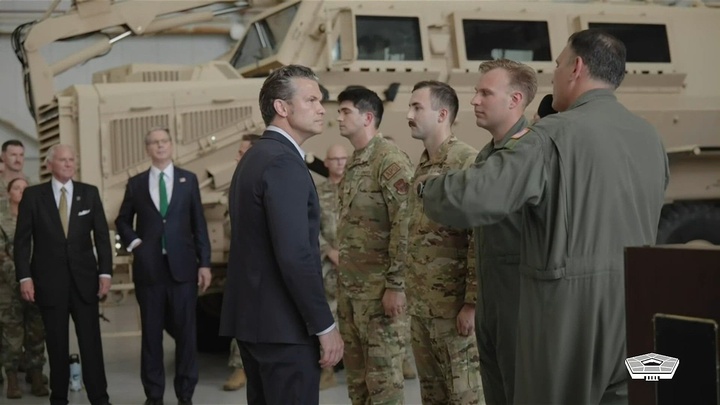
Secretary of War Pete Hegseth meets with service members after a base renaming ceremony at Joint Base Lindsey Graham, S.C., Aug. 10, 2026

The secretary said it’s the strategic lift, the U.S. Transportation Command, logistics, how the U.S. moves things, people, munitions and capabilities that make a difference.


“No one else can touch it, not even close,” Hegseth said, adding that, “All of it is enabled by all of you, incredible Americans at the top of your game, at the prime of your life. … I consider all of you the real 1%, the real elite who give absolutely everything.”
Defense News in Brief: Adapting to aerial threats: How ACC’s Point Defense Task Force is transforming installation defense

Source: United States Airforce

  • By Senior Airman Katie Mullikin
  • Air Combat Command Public Affairs

Through the Point Defense Task Force, Air Combat Command is conducting the experimentation and data analysis required to inform Headquarters Air Force decisions on Point Defense, a rapidly expanding mission designed to safeguard air bases against a full spectrum of airborne threats, ranging from small unmanned aircraft systems to cruise missiles.

“Two years ago, we started as a tiny, agile battle lab with only six people. The threat landscape evolved, so we evolved too,” said Lt. Col. Cody Moore, ACC Directorate of Operations A35 division chief. “Together we adapted and established the very foundation of how the Air Force will protect our installations from airborne threats for years to come. Because of our hard work, the heavy lifting of the initial charter, the foundational concept development is complete, and the playbook has been written.”


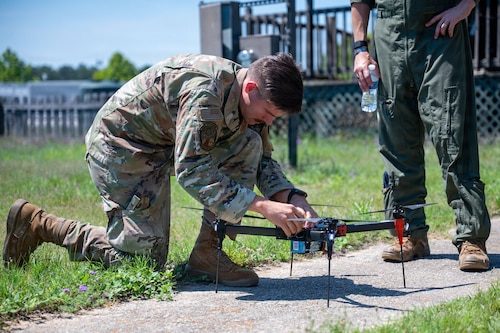
An Airman adjusts rotors on a drone
Senior Airman Luke Wilson, assigned to the 9th Air Force (Air Forces Central) Battle Lab, prepares a small Unmanned Aerial System (sUAS) to be targeted by counter-sUAS systems during a base defense demonstration at Shaw Air Force Base, South Carolina, June 5, 2026. The purpose of the demonstration was to showcase the capabilities of sUAS-based aerial defenses to locate, identify and neutralize unauthorized sUASs near military installations. (U.S. Air Force photo by Airman Will Sherwood)

Within this mission, ACC’s PDTF develops innovative solutions, integrates advanced technologies, and addresses operational challenges to ensure installation security across the Air Force.


“The [Point Defense] Task Force is responsible for the analysis behind how we organize, train, and equip our forces for this mission and we have been working hard to provide recommendations and answers to senior leaders as soon as possible,” said Moore.

To drive this continuous innovation, the task force expanded its program by establishing dedicated battle labs to put testing directly into the hands of tactical total force Airmen.

As a subordinate unit formed under the PDTF, the Point Defense Battle Lab, located at the 319th Reconnaissance Wing in Grand Forks Air Force Base, North Dakota, executes operational rehearsals, and rapid testing and evaluation to validate capabilities such as electronic warfare, and active and passive defenses.

“We drive the priorities for the battle lab and tell them what our top concern is, and they go and develop tactics, techniques and procedures for it,” said Moore. “They are very adaptable when looking at the next big threat and working with industry on what is already out there so we don’t have to reinvent the wheel.”

With support from the 184th Wing, Kansas Air National Guard, the PDBL serves as a hub for collaboration and the primary engine behind ACC’s tactical experimentation and rapid prototyping for counter-sUAS.

Through these ongoing experiments, Moore and his team test their theories to develop the foundations of the future point defense blueprint.

As the Air Force builds a formal training pipeline, ACC is fielding a specialized Mobile Training Team to bridge the immediate readiness and training needs for current point defense operations.

These expert teams are actively deploying to ACC installations across the country, delivering an intensive two-week course to train local Airmen on the newly validated technology and tactics.


A photo of a group of people standing and walking outside on a flightline.
Airmen assigned to the 319th Reconnaissance Wing, prepare to execute a Point Defense Battle Lab exercise on the flightline at Grand Forks Air Force Base, North Dakota, Feb. 13, 2026. The PDBL serves as a hub for collaboration, pushing boundaries in Couter-small Unmanned Aircraft System capabilities, ensuring the Air Force maintains tactical superiority against evolving threats, and is a key part of the service’s effort to develop and evaluate advanced technologies to defend installations from sUAS threats. (U.S. Air Force photo by Airman 1st Class Emma Teel)

“This organization has developed a curriculum and have already sent out their first team of NCO instructors to teach Airmen. They started here at Langley and are now on the road to coach other installations.” said Col. James Price, special assistant to the Director of Operations for Headquarters ACC.


Point Defense capabilities require a closely integrated team of specialists, including base defense personnel, command and control operators, airspace managers, and radar maintenance and sustainment experts.

“You need all of those pieces of the puzzle to provide effective defense and to deconflict the airspace around our bases,” said Moore. “It’s not just the Air Force; it’s a whole-of-government problem. We are working with local air traffic control, local law enforcement, and joint partners to build those relationships.”

With the PDTF established, ACC continues driving the innovative tactics and joint-force integration necessary to protect against evolving airborne threats.

Defense News in Brief: DAF updates COVID-19 reinstatement process, reduces time for members returning to service

Source: United States Airforce

  • Secretary of the Air Force Public Affairs

The Department of the Air Force implemented two changes to its COVID-19 reinstatement process, shifting to parallel processing of screening requirements and Air Force Board for Correction of Military Records actions and deploying dedicated case managers to accelerate the return of eligible service members.

“The Department of the Air Force has a resolute commitment to rapidly return affected service members to the ranks,” said Assistant Secretary of the Air Force for Manpower and Reserve Affairs Honorable Richard L. Anderson. “By running medical certifications and record-correction board actions in parallel rather than sequentially, and establishing dedicated reinstatement case managers as single, proactive points of contact for applicants, we aim to increase the speed and ease of returning former members to service under the DAF COVID-19 reinstatement program.”

The changes align with the SECWAR’s May 7, 2026, establishment of the Department of War COVID-19 Reinstatement and Reconciliation Task Force, which charged the services with identifying and removing impediments to reinstatement, standardizing procedures, and proactively communicating with affected members through individualized contact.

Previously, medical certifications and board-correction actions were processed sequentially, creating an average 30-day bottleneck associated with medical clearances. The department has restructured the workflow so the two now proceed at the same time.

Dedicated reinstatement case managers now serve as single, proactive points of contact for applicants. Case managers aim to eliminate delays caused by missing documents, guide and assist members through each step, connect them with the right agencies, drive handoffs between the organizations that touch a case, resolve administrative roadblocks, provide updates, and answer questions to ensure rapid and accurate reintegration.

Case managers will help members correctly fill out all necessary forms to ensure a smooth application process, which in turn will help members avoid resubmitting forms and accelerate the reinstatement process.

Additionally, because case managers handle direct communication and preparation with members, the Air Force Review Board Agency COVID-19 Reinstatement Team is freed up to focus solely on adjudicating and finalizing cases, accelerating decisions for everyone.

The changes apply to former Airmen and Guardians pursuing a return to service under Executive Order 14184, “Reinstating Service Members Discharged Under the Military’s COVID-19 Vaccination Mandate,” signed Jan. 27, 2025. The expedited reinstatement program is operating under a one-year extension directed by the Secretary of War and remains open until April 1, 2027.

Former Airmen and Guardians who were unjustly discharged for declining the vaccine, voluntarily separated or allowed service to lapse rather than comply, transferred to the Individual Ready Reserve, or received a “General (Under Honorable Conditions)” discharge for refusing the COVID-19 vaccine can find eligibility criteria, checklists, forms, and frequently asked questions at the Air Force’s COVID reinstatement page, www.af.mil/COVID-Reinstatement, or contact:

• DAF COVID Task Force: SAF.COVID.TaskForce@us.af.mil

• Air Force Recruiting Service: afrs.hqrsopa.accessionsstandards@us.af.mil

Defense News in Brief: CMSAF announces EPME Modernization, additional enlisted force initiatives at AFSA Summit

Source: United States Airforce

Chief Master Sgt. of the Air Force David R. Wolfe announced a series of changes to the enlisted professional military education Aug. 11 during his keynote address at the Air Force Sergeants Association’s Summit 26, outlining an effort to make professional development more continuous, accessible and connected throughout an Airman’s career.

The changes, known as the Enlisted Professional Military Education Modernization, standardizes installation professional development centers into a three-tier structure and consolidates installation enlisted development, including the Airman Leadership School and Noncommissioned Officer Academy schoolhouses, under them.

“We are taking the pieces that already exist, organizing them into a more coherent system, clarifying who is responsible for that system, and filling the developmental gaps between formal EPME experiences,” Wolfe said.

During the initial phase of the EMPE Modernization, what Airmen learn does not change, and neither does who sets and certifies it. All EPME and Foundations Course curriculum development and accreditation remains with Air University’s Barnes Center for Enlisted Education. The Barnes Center continues to schedule Noncommissioned Officer Academy classes, and the Air Force Personnel Center continues to schedule students.

ALS and NCO Academy in-residence education continues.

“Over time, [EPME Modernization] will allow us to build a more agile, adaptive and dynamic delivery model for the development and education opportunities…,” Wolfe said.

Wolfe knows the schoolhouses firsthand, having taught at ALS and the NCO Academy at the Elmendorf Professional Military Education Center from 2004 to 2007 and serving as that center’s commandant from 2014 to 2016.

What changes is the role of the professional development center, which is identified as Professional Military Education Centers under the new reorganization. The PME Center becomes the single point of oversight for enlisted development on an installation, with the ALS and NCO Academy schoolhouses aligned under it.

Three tiers

The structure scales to installation size and existing infrastructure.

Eight installations will operate large PME centers with a development advisor, ALS and NCO Academy. Fifty-seven will operate medium centers with a development advisor and ALS, while 15 smaller centers will be built around development advisors at installations without a resident ALS or NCO Academy.

Development advisors will serve as connective tissue across all three PME center models and continue overseeing programs such as Foundations Courses, the First Term Enlisted Course and Informed Decision Seminar.

They will also continue providing career counseling and retraining advice for more complicated cases requiring deeper analysis. Wolfe announced the Air Force is developing an artificial intelligence agent intended to help Airmen more readily understand applicable policies and career opportunities, allowing development advisors to focus their expertise on cases requiring greater analysis.

Reporting and oversight

PME Centers will align under the wing command chief and command team for staff supervision, integration and administrative oversight. The wing commander retains command authority. The wing command chief exercises functional oversight for enlisted development and serves as the principal enlisted adviser for PME Center priorities, curriculum integration and developmental outcomes.

Command chiefs already carry the responsibility to develop their wing’s Airmen; the EMPE Modernization gives them the corresponding oversight of the organization that delivers that development.

Installation command chiefs will also track and report a Status of Professional Development covering a range of data across EPME, submitted through a dashboard now in development. The dashboard will provide information to the Enlisted Force Development Panel to inform strategy, policy and senior leader decisions. Specific reporting requirements will be published in forthcoming guidance.

Adjunct Faculty

The Air Force plans to build on the existing Foundations Courses through an adjunct faculty model that draws on qualified Airmen with specialized experience and instructor backgrounds to teach subjects in which they have expertise.

“We have more than 10,000 former 8Ts in our Air Force—I’m talking to you,” Wolfe told the audience. “You have something to offer, and we are going to establish a method for you to be able to deliver your expertise to our Airmen on demand.”

Air University will develop and deploy a virtual Foundations Course capability in two phases: Phase I, synchronous instruction delivered by video teleconference through a centralized integration hub, and Phase II, asynchronous, self-paced courses available on demand.

Implementation work is under way across the Air Staff, major commands, Air Education and Training Command and Air University, spanning organization, management, resourcing, policy, the virtual Foundations Course and messaging.

Additional Updates

Wolfe also used the keynote to announce changes to enlisted promotion processes and a new initiative supporting military spouses.

Beginning with the current cycle, the Stripes for Exceptional Performers nomination windows for promotion to staff sergeant and technical sergeant will align with their respective static closeout dates, giving commanders additional time to evaluate eligible Airmen after promotion results are released.

“Timing should not unnecessarily narrow opportunity,” Wolfe said. “Extending the window gives commanders more time to evaluate performance and recognize Airmen who have demonstrated exceptional potential.”

Wolfe also announced a change intended to prevent promotion vacancies from going unfilled when selected members decline promotion.

Over the past four years, 59 senior master sergeants selected for chief master sergeant declined promotion. Under the new approach, the Air Force will use the board-established order of merit to identify the next qualified Airman when a promotion vacancy is created by a declination.

The process begins with the 2026 chief master sergeant promotion cycle and is planned to continue with senior master sergeant and master sergeant boards in 2027.

Wolfe informed the Airmen in attendance of the Global Military Spouse Connection, a new Air Force Personnel Center initiative designed to better connect qualified military spouses with civilian employment opportunities across the Department of the Air Force.

The initiative uses a pre-vetted résumé repository to help connect hiring managers with qualified military spouses. The pilot is underway at Travis Air Force Base, California; Patrick Space Force Base, Florida; and Ramstein Air Base, Germany.

Wolfe said the initiative is not a mandatory hiring directive but intended to create a more direct connection between military spouse talent and Department of the Air Force civilian workforce requirements.

The full keynote address can be found on the official Chief Master Sergeant of the Air Force Facebook page.