Defense News in Brief: CMSAF Flosi highlights Airmen’s agility, readiness during East Africa tour

Source: United States Airforce

CMSAF Flosi met with Airmen during a recent multi-base visit, where he observed how small, agile teams are delivering results in one of the most strategically significant and operationally complex regions in the world.

From low-resource expeditionary hubs to forward operating locations facing real threats, Airmen are staying mission-focused, supporting one another and delivering results in demanding conditions.The visit began at Camp Lemonnier, where Flosi received mission briefings from 449th Air Expeditionary Group leadership and visited squadron work centers. Operating in a constrained environment, Airmen there continue to deliver essential capabilities with flexibility and focus. They are leveraging available technologies to counter a growing small unmanned aerial system threat in the region, an evolving operational concern requiring agile solutions at the tactical edge.

Chief Master Sgt. of the Air Force David Flosi answers questions
Chief Master Sgt. of the Air Force David Flosi answers questions from Airmen assigned to the 475th Expeditionary Air Base Squadron during a Q&A session at Manda Bay, Kenya, July 12, 2025. The visit gave Flosi the opportunity to engage directly with Airmen across East Africa, address their concerns and recognize their contributions to regional security. (U.S. Air Force photo by Tech. Sgt. Timothy Hayden)

“The AFRICOM AOR is a challenging environment,” Flosi said. “You continue to operate in a low-resource setting, executing the mission with focus and flexibility to counter threats in the region.”

The senior leader then traveled to Camp Simba, Manda Bay, Kenya, where the deployed team is embodying the “Mission Ready” mindset. Airmen are stepping outside their core Air Force Specialty Codes to fill mission gaps, support each other and sustain forward operations, often in joint and host-nation integrated environments.

Chief Master Sgt. Ben Weavers, senior enlisted leader of the 475th Expeditionary Air Base Squadron, said the visit highlighted the growing strategic relevance of Manda Bay.

“It was great to highlight the strong partnership we share at Manda Bay with our host nation Kenyans, sister services and tenant units,” Weavers said. “They were impressed with what our Airmen are doing in support of our nation.”

Weavers said the visit helped reframe the narrative of Manda Bay from a site that was formerly attacked by enemy combatants to a vital node of partner engagement and operational readiness.

“We’ve moved beyond the legacy of the 2020 attack to a stronger security posture that allows us to focus on partnership building,” he explained. “We’ve conducted weekly knowledge exchanges with our Kenyan partners across disciplines like medical, maintenance, air transportation, civil engineering, and more.”

Chief Master Sgt. of the Air Force David Flosi assists munitions Airmen
Chief Master Sgt. of the Air Force David Flosi assists munitions Airmen assigned to the 776th Expeditionary Air Base Squadron with assembling a precision-guided munition at Chabelley Airfield, July 13, 2025. Flosi visited deployed Airmen across East Africa to engage with them directly, gain insight into their mission capabilities, and recognize their contributions to regional security. (U.S. Air Force photo by Tech. Sgt. Timothy Hayden)
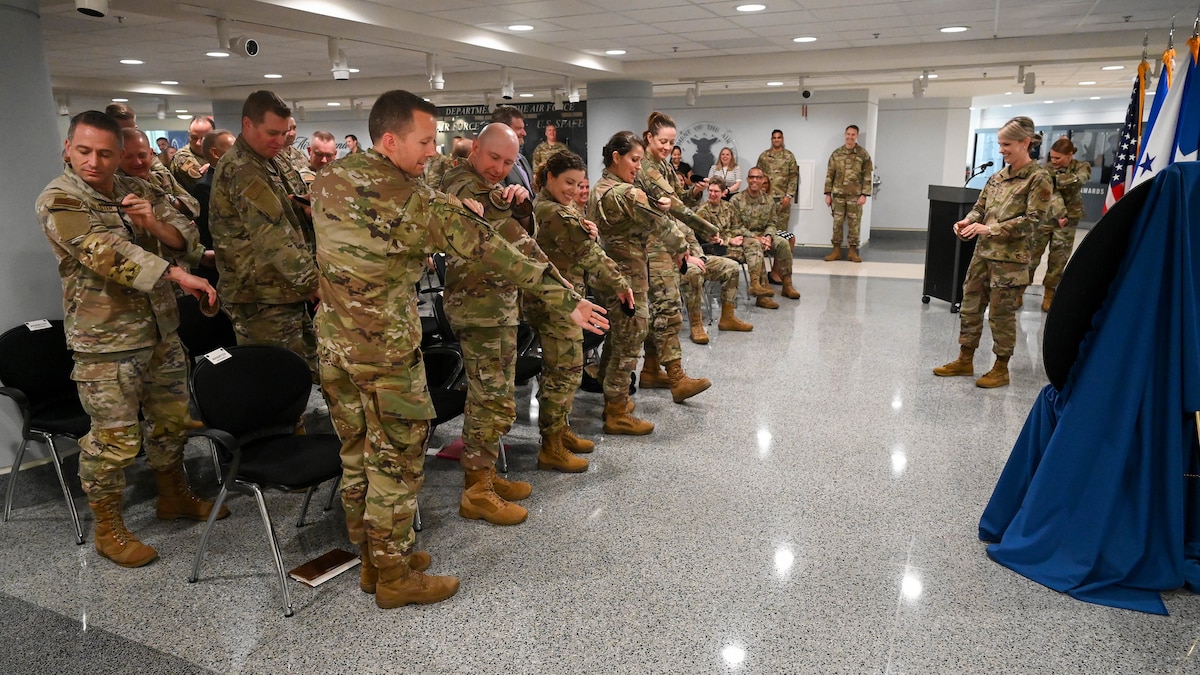
Chief Master Sgt. of the Air Force David Flosi poses for a photo
Chief Master Sgt. of the Air Force David Flosi, third from right, poses for a photo with 475th Expeditionary Air Base Squadron Airmen following the conclusion of his Q&A panel as part of a visit to Manda Bay, Kenya, July 12, 2025. The visit allowed the senior leader to engage directly with Airmen across East Africa, addressing their concerns and recognizing their contributions to regional security. (U.S. Air National Guard photo by Staff Sgt. Kevin Ray J. Salvador)
CMSAF and Sgt launch done
Chief Master Sgt. of the Air Force David Flosi assists U.S. Air Force Staff Sgt. Logan Terrell, a Small Unmanned Aircraft System program manager assigned to the 475th Expeditionary Air Base Squadron, with launching a Puma drone during a visit to Manda Bay, Kenya, July 12, 2025. The visit allowed Flosi to connect with Airmen across East Africa, hear their concerns, and recognize their contributions to regional security. (U.S. Air Force photo by Tech. Sgt. Timothy Hayden)

Lt. Col. Michael S. Ryan, commander of the 475th EABS, described the visit as a success, noting the valuable engagement between deployed personnel and senior leadership.

“CMSAF was able to interact with our deployed Airmen. The question-and-answer session allowed for two-way communication between Department of the Air Force leadership and our Airmen accomplishing the mission,” Ryan said. “We provided CMSAF the importance of Manda Bay and the mission here,” he added.

“We showcased our Airmen and the uniqueness of this deployment. Everything we do here is by, through and with the Kenyans.”

He also noted the positive response from his team.

“Multiple Airmen thanked local leadership for the opportunity to interact with CMSAF,” Ryan said. “This allowed them the opportunity to speak what is on their minds to our highest level of leadership.”

On the final day of the tour, Flosi visited Chabelley Airfield, where Airmen support critical intelligence, surveillance and reconnaissance operations. Here, he helped build a laser-guided bomb and observed how Airmen and Soldiers are detecting and deterring UAS threats with advanced counter-sUAS systems.

These missions play out just miles from the People’s Liberation Army Support Base in Djibouti, a visible reminder of the region’s strategic weight and the importance of maintaining a consistent, capable U.S. presence.

A consistent theme across locations was the deployment of small Unit Type Codes rather than fully aligned teams. Leaders noted that aligning future rotations with the Air Force’s Unit of Action concept, sending cohesive, trained teams that arrive and operate together from day one, may help improve readiness and continuity in the region.

“The missions you support are vital to regional security,” Flosi said. “You’re holding the line, and your work underscores the strategic significance of this region and the importance of a consistent and capable U.S. presence.”


Defense News in Brief: 510th Buzzards, a history of excellence

Source: United States Airforce

Nine pilots from the 510th Expeditionary Fighter Squadron at Aviano Air Base earned Single-Event Air Medals, and two were simultaneously awarded the Distinguished Flying cross, after returning from a deployment to the Central Command area of responsibility. During the deployment, they flew various defensive counter air sorties to protect U.S. Naval assets traveling through the Bab el Mandeb Strait, breaking records along the way.

“As the new Buzzard Commander, I am honored and humbled to lead such an accomplished team,” said Lt. Col. Brent Smith, the newly appointed commander of the 510th EFS. “The legacy of excellence, dedication and professionalism is inspiring and motivating. It’s a privilege to step into this role and work alongside some of the most talented and mission-focused individuals in the Air Force.”

During the deployment, the Buzzards flew 8,800 hours and 1,400 total sorties.

“The Buzzards supported a variety of missions, including Inherent Resolve’s fight against ISIS, Operation Prosperity Guardian’s protection of coalition partners and civilian vessels in the Red Sea, Operation Spartan Shield’s defense of US interests in the Arabian Gulf, and many other force protection and deterrence missions,” Smith said.

The 510th EFS has a long history of excellence, beginning in 1943 as the 625th Bombardment Squadron until being re-designated the 510th Fighter-Bomber Squadron later that same year.

After being stationed at various locations across the globe and experiencing multiple periods of activation and inactivation, the 510th EFS was permanently reactivated in 1994, establishing its current home at Aviano AB, Italy.

The 510th EFS has been the highest flown PSAB fighter unit since 2019, highest flown Aviano deployed unit since 2010, and the highest flown rotation fighter unit in the area of responsibility.

The Buzzards have flown combat missions during World War II, the Vietnam War, Operation Desert Storm, Operation Provide Comfort, Operation Deny Flight and many more. During their most recent deployment to support Operation Prosperity Guardian, the squadron exuded excellence while protecting American assets overseas.

“Each decoration represents not only a specific event, but also the precision, teamwork and unwavering commitment to the mission required to successfully execute in combat,” Smith said. “They represent countless hours of preparation, sacrifice and high intensity training by the whole Buzzard operations and maintenance team. They are proof of a culture that demands and delivers high performance every single day.”


Defense News in Brief: RIAT 2025 highlights global readiness, cooperation

Source: United States Airforce

During the Royal International Air Tattoo, the U.S. Air Force, alongside NATO allies and partners from around the globe, showcased what the strength of multinational relationships can achieve.

The weather was calm and the sky was blue, yet thunder forced itself to be heard. From July 18-20, thousands of onlookers in the crowd gleefully braced themselves for a procession of roaring aerial acrobatics, helicopter rescue demonstrations, and raw airpower flooding the cloudy air above Royal Air Force Fairford.

Photo of the flightline
Royal International Air Tattoo static aircraft displays of military aircraft are viewed from the fuselage of a C-5 Galaxy at RAF Fairford, England, July 19, 2025. The interaction and exchanges we have with allies and partners at events like RIAT allows us to learn from and leverage the strengths and capabilities our allies and partners bring to the table. (U.S. Air Force photo by Airman 1st Class Cody J. A. Mott)

The Royal International Air Tattoo is not only the largest air show in the world – it is a convention of lethality, ingenuity, and partnership. The U.S. Air Force, alongside NATO allies and partners from around the globe, showcased what the strength of multinational relationships can achieve.

“America’s international partners are one of its greatest strengths,” said U.S. Air Force Capt. Mercer Martin, 99th Expeditionary Reconnaissance Squadron U-2S pilot. “Spending our time meeting our partners in person while forging bonds and friendships is an extremely important addition to the relationships we have with our allied nations around the world.”

CSAF speaks with Airmen on flightline.
U.S. Air Force Gen. David Allvin, USAF Chief of Staff, speaks with Airmen assigned to the 95th Reconnaissance Squadron during the Royal International Air Tattoo at RAF Fairford, England, July 19, 2025. The interaction and exchanges we have with allies and partners at events like RIAT allows us to learn from and leverage the strengths and capabilities our allies and partners bring to the table. (U.S. Air Force photo by Airman 1st Class Cody J. A. Mott)
Pilot speaks with air show visitors about aircraft U-2S Dragon Lady.
U.S. Air Force Capt. “Yeti” Martin, 99th Expeditionary Reconnaissance Squadron U-2S pilot, explains the capabilities of the U-2S Dragon Lady to Royal Air Force cadets during the Royal International Air Tattoo at RAF Fairford, England, July 18, 2025. One of the many benefits of RIAT is exposing allies, partner nations and the general public to our aircraft and the aircrews who operate them. These aircraft demonstrate our vast capabilities and ability to rapidly respond to threats and assure allies and partners. (U.S. Air Force photo by Airman 1st Class Cody J. A. Mott)
Man announces aerial demonstration.
RAF Red Arrow aerobatic team member Graeme Muscat, announces the pilot’s aerial demonstrations during the Royal International Air Tattoo at RAF Fairford, England, July 20, 2025. Through high-impact aerial displays and multinational participation, RIAT highlights the strategic reach and operational readiness of allied and partner air forces. (U.S. Air Force photo by Airman 1st Class Cody J. A. Mott)

Exposing both the U.S. and partner-nation personnel to diverse strategies and training methods strengthens the goal of a cohesive, interoperable force. These relationships play a key part in times of peace as much as they do in the theater of war.

“I enjoy flying an aircraft that’s so close in league with our American colleagues. It’s a real change of pace,” said an RAF Rivet Joint pilot. “Your training systems and operational focus into different deployable locations make it so U.S. Airmen are more versed on how it all works in different areas of the world. It’s nice to be exposed to that and fly more often with pilots who have different techniques.”

As in years past, one of RIAT’s greatest strengths this year was the access it provided allies, partner nations and the public to U.S. aircraft, aircrew, and the stories behind them. It was a rare chance for global audiences to witness both the capabilities and the humanity behind modern airpower. This visibility builds confidence, strengthens support, and reinforces the value of continued collaboration.

“As aircrew stationed in the United Kingdom, I’m flying tanker missions and working with NATO allies while refueling them in the air,” said U.S. Air Force Capt. Tobin Nelson, 100th Air Refueling Wing pilot. “Being on the ground and meeting them face-to-face at RIAT is amazing. Knowing I’ve worked with their people gives me the ability to network, plan new training missions, and forge new bonds through flying.”

RIAT 2025 served as a powerful reminder that diplomacy and military strength go hand in hand. By bringing together allies and partners in a shared celebration of innovation and skill, the air show fostered trust, mutual understanding, and camaraderie that extended far beyond the runway. The relationships built not only enhance all nations’ operational readiness but also promote a culture of cooperation and respect that is vital in today’s complex environments.

RIAT’s ability to inspire generations also underscores the profound impact of bringing military aviation into the public eye. For many attendees, witnessing these aircraft in action and hearing firsthand accounts from dedicated personnel sparks a passion for service and a belief in the importance of teamwork.

Flight engineer speaks with participant about career.
U.S. Air Force Tech. Sgt. John Stortecky, right, 337th Airlift Squadron flight engineer, speaks about his career to a Royal International Air Tattoo participant at RAF Fairford, England, July 19, 2025. RIAT is a means for us to remove barriers and foster a sense of solidarity and mutual support among allied and partner nations. This shared sense of purpose enhances the overall effectiveness of collective defense efforts, improving interoperability and strengthening trust among participating forces. (U.S. Air Force photo by Airman 1st Class Cody J. A. Mott)

“When you come here and see participants and children from every walk of life with a sparkle in their eye, you don’t ever want to stifle those dreams,” said U.S. Air Force Tech. Sgt. John Stortecky, 337th Airlift Squadron flight engineer. “Hopefully one day someone will say, ‘I had that tour through the aircraft and I saw them fly – and it inspired me to become who I am today.’”


Defense News in Brief: F-35 international interfly at Talisman Sabre 25 – A first for the USAF

Source: United States Airforce

Two U.S. Air Force pilots successfully flew Royal Australian Air Force F-35A Lightning II aircraft during an international interfly training mission during exercise Talisman Sabre 25, in Northern Territory, Australia, July 16.

This display of interoperability signified the first time USAF pilots flew 5th Generation aircraft belonging to a partnered or allied nation.

The U.S. Air Force pilots achieving this first-ever feat were Air Force Reserve Maj. Justin Lennon, 48th Fighter Wing, U.S. Air Forces in Europe-U.S. Air Forces Africa F-35A evaluator pilot, and Maj. Colby Kluesner, 388th Fighter Wing F-35A evaluator pilot.

“In the short term, Interfly events like this allow us to exchange information and best practices,” Lennon explained. “In the long term, as a coalition, normalizing Interfly gives commanders additional options for agility and versatility in a future conflict. In a prolonged conflict, airplanes are capable of flying more hours a day than a pilot. Having the added flexibility to put any pilot in any F-35 and generate combat airpower anywhere in the world adds to the F-35 coalition’s lethality.”

The RAAF has also increased its efforts in normalizing F-35 Interfly training among allies by the creation of its Lighting-X program: a 2023 initiative developed to take advantage of the mutual benefits provided to F-35 communities that Interfly concepts provide.

“[The Lightning-X program] allows RAAF commanders to treat our coalition counterparts as RAAF aircrew when we consider things like medical, dental, physiological issues, egress systems and human factors,” said RAAF Squadron Leader Nicholas Reynolds, No. 77 Squadron executive officer. “It is a big win to be able to seamlessly integrate here at Talisman Sabre 25 with 77 Squadron.”

In addition to the two USAF pilots, the RAAF also invited Royal Air Force Squadron Leader Daniel Goff, and U.S. Marine Corps Lt. Col. Johnny Rose, both F-35B instructor pilots, to participate in the international Interfly.

The USAF, USMC, and RAF pilots embedded with two of RAAF’s F-35 squadrons, No. 77 Squadron and No. 75 Squadron.

After a day of simulator training and academic courses, the four F-35 pilots were approved to conduct training exercises during Talisman Sabre 25 using RAAF’s F-35 aircraft.

“The crew are treated no differently than any other RAAF F-35 pilot during Talisman Sabre 25,” Lennon said. “The only way anyone might know it’s not an Australian in the RAAF F-35 is the accent on the radio.”

Lennon also added that familiar training and equipment usage in the F-35 makes adapting to another nation’s aircraft easier than one might think.

“Thanks to the commonality of F-35 variants, aligned training and operational practices between F-35 users, the flying portion is the easiest part,” Lennon explained. “Our visiting USAF pilots are able to execute and fly a RAAF F-35 no different from their Australian wingmen.”

This recent effort in pilot interchangeability by multiple branches and nations in the F-35 community is aimed at preparing the U.S. and its allies for future conflicts long into the future.

“Interfly has allowed the USAF to train partner nations on weapons systems they have purchased, as well as conduct exchange assignments,” Lennon said. “However, until now the USAF has never performed international interfly on an ad-hoc basis. This effort is part of a larger plan to normalize F-35 Interfly training with our allies.”

Talisman Sabre 25 is a large-scale, bilateral military exercise between Australia and the U.S. which advances a free and open Indo-Pacific by strengthening relationships and interoperability among key allies and enhances our collective capabilities to respond to a wide array of potential security concerns. This year marks the eleventh iteration of the exercise.

Defense News in Brief: US, Australian C-17s spearhead multinational joint force entry during Talisman Sabre 25

Source: United States Airforce

Multiple U.S. Air Force and Royal Australian Air Force C-17 Globemaster IIIs executed a joint force-entry operation into Australia, deploying U.S. Army and international paratroopers in support of Talisman Sabre 25.

Originating from Joint Base Elmendorf-Richardson, Alaska, the mission spanned the immense distances of the Pacific, sustained by U.S. Air Force aerial refueling operations. It culminated in the precision insertion of 314 U.S. Army 11th Airborne Division, Australian Defence Force and German Army paratroopers into a designated drop zone in eastern Australia.

“We employ large formations to quickly and effectively place mass at the time and place of our choosing,” said U.S. Air Force Lt. Col. Christopher Bukowski, 535th Airlift Squadron, 15th Wing, director of operations. “Executing a drop like this at speed and scale, and in conjunction with our allies and joint partners, is crucial to honing that skill and sending a deterrent message to our adversaries.”

The one-way, trans-Pacific journey spanned over 6,200 miles and was conducted by 13 C-17 aircraft assigned to the 15th Wing, Pacific Air Forces, 437th Airlift Wing, Air Mobility Command, and 164th Airlift Wing, Tennessee Air National Guard, underscored the robust U.S.-Australia partnership and shared commitment to regional defense.

“Through the strategic employment of U.S. Air Force mobility aircraft, our highly proficient teams—operating in close coordination with partners and allies — refined the ability to project personnel and mission-critical material across the vast Pacific with precision and speed,” said U.S. Air Force Capt. Ana Donohue, 535th Airlift Squadron C-17 pilot. “This critical capability was showcased during a recent joint forcible entry operation, where the air domain proved to be the decisive bridge between strategic airlift and ground-based objectives, enabling the rapid achievement of essential outcomes across a geographically expansive and demanding operational theater.”

The meticulous planning required for this complex joint force-entry operation extended months in advance of the Talisman Sabre 2025 exercise, highlighting the extensive coordination between allied forces.

Talisman Sabre, the largest bilateral military exercise between Australia and the United States, is pivotal to advancing a free and open Indo-Pacific. It fortifies relationships and interoperability among key allies and partners, concurrently enhancing collective capabilities to address a spectrum of complex security challenges.

Defense News in Brief: REFORPAC 2025: US Air Force executes unprecedented surge into Pacific theater

Source: United States Airforce

Over the last week, U.S. Pacific Air Forces accomplished a rapid, mass deployment and reception of personnel, equipment and aircraft to multiple locations in the Indo-Pacific theater of operations for Exercise Resolute Force Pacific 2025.

“We’ve seen amazing global teamwork completing an incredible lift to kick off REFORPAC,” said Gen. Kevin Schneider, PACAF commander. “Airmen have innovated and overcome tough obstacles to get critical pieces in place, demonstrating our collective capability to project decisive air power into and throughout the Indo-Pacific with dramatic speed and scale.”

The U.S. Air Force, alongside its joint allies and partners, will continue to train and integrate over the next several weeks, enhancing interoperability and readiness across the Pacific theater. REFORPAC is part of the first-in-a-generation Department-Level Exercise series, a new way the Air Force is exercising to conduct large operations in contested, dynamic environments. The aim is to improve interoperability and multilateral cooperation, leading to a stronger, more capable, deterrent force.

The DLE series encompasses all branches of the Department of Defense, along with allies and partners, employing approximately 400 U.S. and coalition aircraft and more than 12,000 members at more than 50 locations spanning 3,000 miles.

The monumental effort is made possible by extensive planning and coordination efforts throughout the Air Force, along with joint, allied and partner forces, which have shown the ready ability of combined joint forces to mobilize in great numbers for any contingency. In lockstep with PACAF, Air Mobility Command has provided critical airlift, air refueling and command and control capabilities to project, connect, maneuver and sustain joint forces.

“We’re witnessing a complex operation in the Indo-Pacific driven by logistics – rapid, deliberate and mission-driven,” said Brig. Gen. Athanasia Shinas, mobilization assistant to PACAF’s director of logistics. “Our Total Force concept is critical to this capability, leveraging the unparalleled expertise and diverse talent drawn from every industry and sector of society through our Guard and Reserve. This integration creates extraordinary opportunities to strengthen our Total Force and coalition Airmen.”

Airmen are exercising robust contested logistics and engineering capabilities, sustainment over vast distances, fuel resupply and access to forward operating locations.

U.S. Air Force C-130J Super Hercules assigned to the 36th Airlift Squadron stand by for mission operations in support of Department-Level Exercise 2025 as part of the 374th Air Expeditionary Wing at Yokota Air Base, Japan, July 14, 2025. Through this DLE, the Department of the Air Force is preparing to be a stronger, more lethal deterrent force, to provide an advantage against competitors and adversaries across all domains, and to ensure regional stability in the Indo-Pacific and beyond. (U.S. Air Force photo by Airman Kayla Karelas)

U.S. Airmen assigned to the 106th Rescue Wing disembark from a C-17 Globemaster III aircraft ahead of their support for exercise Resolute Force Pacific (REFORPAC) 2025 at Misawa Air Base, Japan, July 11, 2025. REFORPAC is part of the first-in-a-generation Department-Level Exercise series, employing more than 400 Joint and coalition aircraft and more than 12,000 members at more than 50 locations across 3,000 miles. (U.S. Air Force photo by Airman 1st Class Andre Medina)

F-35s parked on flightline.
U.S. Air Force F-35A Lightning II’s from the 354th Air Expeditionary Wing park on the flight line in Guam for Resolute Force Pacific (REFORPAC) 25 exercise, July 12, 2025. REFORPAC is part of the first-in-a-generation Department-Level Exercise series, employing more than 350 Joint and coalition aircraft and more than 12,000 members at more than 50 locations across 3,000 miles. (U.S. Air Force photo by Tech. Sgt. Andrea Posey)

“This is a logistical movement at an unprecedented scale – an explosive surge into the theater driven by precision and a resilient joint network,” said Brig. Gen. Mike Zuhlsdorf, PACAF director of logistics, engineering and force protection. “What makes it exceptional is the partnership with local leaders abroad, as well as infrastructure; their participatory enthusiasm has turned REFORPAC into a truly integrated regional effort. This support brings essential access and shared purpose to an extraordinary training landscape.”

The tested Agile Combat Employment operational strategy, used to support joint operations, has prepared sites throughout the theater. ACE preparations have included shoring up building infrastructure and ensuring a constant flow of critical supplies, all to facilitate uninterrupted mission execution during the exercise.

“PACAF continually seeks to improve our readiness to respond to any contingency, defend the interests of the United States and work closely together with our allies and partners to ensure a free and open Indo-Pacific,” Schneider said.


Defense News in Brief: Rescue squadrons unite, strengthen interoperability during REFORPAC

Source: United States Airforce

Resolute Force Pacific highlights how exercises strengthen combined capability and coordination for real-world contingencies across the Indo-Pacific region.

Airmen of the Japan Air Self-Defense Force Air Rescue Wing, the U.S. Air National Guard’s 102nd Rescue Squadron, and the 130th Rescue Squadron came together for a cross-unit static display and capability exchange during exercise Resolute Force Pacific 2025 at Misawa Air Base, July 15.

The event featured aircraft from both nations, including a JASDF UH-60J helicopter and U-125A search-and-rescue coordination aircraft, as well as a U.S. Air Force HC-130J Combat King II from the 102nd Rescue Squadron.

“The goal of the capabilities briefing and aircraft tours was to enable partner nation integration and foster mutual understanding among our rescue squadrons,” said U.S. Air Force Tech. Sgt. Richard Conner, 130th Rescue Squadron HC-130J rescue loadmaster. “This lays the groundwork for future collaboration in the INDOPACOM area, which is a part of our unit’s mission.”

The static display was one of many engagements conducted as part of REFORPAC, a Pacific Air Forces-led contingency readiness exercise nested under the Department of the Air Force’s new Department-Level Exercise series. This DLE is a first-in-a-generation approach to preparing for operations in contested, dynamic environments, spanning more than 50 locations and involving more than 12,000 joint and coalition personnel and over 400 aircraft.


U.S. Air Force Airmen assigned to the 102nd and 130th Air Rescue Squadrons are shown a Japan Air Self-Defense Force (JASDF) Air Rescue Wing UH-60J helicopter for a cross-unit static display and capability exchange during exercise Resolute Force Pacific (REFORPAC) 2025 at Misawa Air Base, July 15, 2025.
U.S. Air Force Airmen assigned to the 102nd and 130th Air Rescue Squadrons are shown a Japan Air Self-Defense Force Air Rescue Wing UH-60J helicopter for a cross-unit static display and capability exchange during exercise Resolute Force Pacific 2025 at Misawa Air Base, July 15, 2025. The interaction reinforces REFORPAC’s goal to deepen allied coordination and advance shared security objectives in the Indo-Pacific. (U.S. Air Force photo by Airman 1st Class Koby Mitchell)

U.S. Air Force Airmen assigned to the 102nd and 130th Rescue Squadrons are shown a Japan Air Self-Defense Force Air Rescue Wing U-125A search-and-rescue coordination aircraft for a cross-unit static display and capability exchange during exercise Resolute Force Pacific (REFORPAC) at Misawa Air Base, July 15, 2025.
U.S. Air Force Airmen assigned to the 102nd and 130th Rescue Squadrons are shown a Japan Air Self-Defense Force Air Rescue Wing U-125A search-and-rescue coordination aircraft for a cross-unit static display and capability exchange during exercise Resolute Force Pacific (REFORPAC) at Misawa Air Base, July 15, 2025. Events like this highlight how REFORPAC strengthens combined capability and coordination for real-world contingencies across the Indo-Pacific region. (U.S. Air Force photo by Airman 1st Class Koby Mitchell)

A Japan Air Self-Defense Force Airman assigned to the Air Rescue Wing displays the internals of a UH-60J helicopter for a cross-unit static display and capability exchange during exercise Resolute Force Pacific (REFORPAC) 2025 at Misawa Air Base, July 15, 2025.
A Japan Air Self-Defense Force Airman assigned to the Air Rescue Wing displays the internals of a UH-60J helicopter for a cross-unit static display and capability exchange during exercise Resolute Force Pacific 2025 at Misawa Air Base, July 15, 2025. These exchanges support REFORPAC’s objective to improve understanding and reinforce multilateral response readiness in contested environments. (U.S. Air Force photo by Airman 1st Class Koby Mitchell)

Throughout the display, participating Airmen discussed aircraft capabilities and differences in personnel recovery methods.

“One notable difference is in the pararescue insertion methods,” Conner said. “JASDF Pararescue typically insert via hoist from the UH-60J, since their fixed-wing aircraft belong to the Airlift Command. Meanwhile, our HC-130J enables personnel airdrops, which allows our Pararescue to get to the fight.”

Conner also pointed out technical details that stood out during the tour.

“I was surprised to see the UH-60J outfitted with external fuel tanks — that really extends its loiter time,” he added.

More than a showcase of equipment, the event fostered personal relationships, improved operational communication and strengthened shared tactics.

“This event is extremely important in building a framework for further cooperation,” Conner said. “It puts faces and names to specific units and enables us to fly real-world missions together during REFORPAC. By briefing and mission planning together, we’re able to execute helicopter air-to-air refueling and speak the same language and brevity terms while flying in close formation over the Sea of Japan.”

The visit concluded with a group photo symbolizing shared commitment among the rescue units. A common thread across all participating squadrons stood out: their shared motto, That Others May Live.

“Everyone got a kick out of the fact that our units all share the same motto,” Conner said. “It’s a powerful reminder that no matter the uniform, our mission is the same.


Defense News in Brief: SOUTHERN STAR ’25: 27th Special Operations Wing projects power with partners in Chile

Source: United States Airforce

The multinational training exercise emphasizes operational and tactical missions, bringing together joint, combined, interagency and military forces to strengthen coordination and interoperability within a unified special operations command.

From the sunbaked airstrips of Antofagasta to the bustling port of Valparaíso and the icy channels of Punta Arenas, elite troops from six nations dived into SOUTHERN STAR 25, Latin America’s premier multinational special operations exercise. Designed around a simulated United Nations stabilization mandate, the event brings together special forces from Chile, the United States, Spain, Argentina, Colombia and Paraguay, with 10 additional nations participating as observers.

A key part of the U.S. contribution is the 27th Special Operations Wing, whose aircraft and Air Commandos have delivered mobility, surveillance, and refueling capabilities across more than 3,700 kilometers of challenging terrain — an unmistakable demonstration of the U.S. commitment to its partners in the Southern Cone and the broader Western Hemisphere.

Deploying from Cannon Air Force Base, New Mexico, the 27 SOW brought two of the most versatile aircraft in the U.S. Air Force’s arsenal: the MC-130J Commando II and the U-28A Draco. Designed to thrive in austere, high-threat environments, these platforms were crucial to the operational tempo and complexity of SOUTHERN STAR 25.

“We’re closely integrated with our joint partners in U.S. Special Operations Command and that partnership drives how we operate across the world. Down here in Chile, we are integrating and providing the same type of support to the exercise that we would anywhere else in the world if there’s a special operations mission set going on,” said Lt. Col. Graydon Sponaugle, 27 SOW mission commander for SOUTHERN STAR 25.

An Air Commando assigned to the 27th Special Operations Wing pulls a hose connected to an MC-130 Commando II for a forward arming and refueling point demonstration for Chilean Airmen at Antofagasta, Chile, May 29, 2025 as part of Southern Star 2025
An Air Commando assigned to the 27th Special Operations Wing pulls a hose connected to an MC-130 Commando II for a forward arming and refueling point demonstration for Chilean Airmen at Antofagasta, Chile, May 29, 2025, as part of Southern Star 25. Southern Star is a multinational training exercise emphasizing operational and tactical missions, bringing together joint, combined, interagency, and military forces to strengthen coordination and interoperability within a unified special operations command. (U.S. Air Force photo by Airman 1st Class Gracelyn Hess)

U.S. and Chilean Air Commandos work together to process intelligence video from multiple platforms, including the U-28A Draco, in Rancagua, Chile, June 2, 2025, as part of exercise SOUTHERN STAR 25.
U.S. and Chilean Air Commandos work together to process intelligence video from multiple platforms, including the U-28A Draco, in Rancagua, Chile, June 2, 2025, as part of exercise SOUTHERN STAR 25. Southern Star ’25 is a multinational special operations exercise across Chile from May 26 to June 8. The exercise brings together forces from six nations and 10 observer countries to enhance interoperability and strengthen global special operations partnerships through joint training from Antofagasta to Punta Arenas. (U.S. Air Force photo by Airman 1st Class Gracelyn Hess)

A U-28A Draco from the 27th Special Operations Wing provides surveillance over a visit, board, search, and seizure training exercise involving Air Commandos, Chilean Special Forces, Navy Seals, and the Chilean Navy in Valparaiso, Chile, June 6, 2025, as part of exercise SOUTHERN STAR 25.
A U-28A Draco from the 27th Special Operations Wing provides surveillance over a Visit, Board, Search, and Seizure training exercise involving Air Commandos, Chilean Special Forces, Navy Seals, and the Chilean Navy in Valparaiso, Chile, June 6, 2025, as part of exercise SOUTHERN STAR 25. The exercise is a multinational special operations exercise taking place across Chile from May 26 to June 8. The exercise brings together forces from six nations and 10 observer countries to enhance interoperability and strengthen global special operations partnerships through joint training from Antofagasta to Punta Arenas. (U.S. Air Force courtesy photo)

In Antofagasta, Air Commandos conducted a forward arming and refueling point demonstration using the MC-130J, showcasing to Chilean airmen how expeditionary refueling operations can sustain special operation forces units operating far from traditional bases. The very next day, the same aircraft supported static line jump training for Chilean paratroopers, or paracaidistas, who practiced airborne insertion techniques alongside U.S. aircrews, strengthening tactical interoperability and deepening trust between the nations’ forces.

Meanwhile, the U-28A provided critical intelligence, surveillance, and reconnaissance support across multiple mission profiles.

In Rancagua, U.S. Air Commandos established a satellite communications node to receive real-time full-motion video from the Draco in flight, illustrating the rapid ISR integration capabilities essential to success during fast-moving missions. Later in the exercise, in Valparaíso, the U-28A provided overwatch during a Visit, Board, Search, and Seizure training operation involving U.S. Navy SEALs, U.S. Air Commandos, Chilean Special Forces, and the Chilean Navy. The mission enhanced maritime interdiction capabilities while exemplifying the layered coordination enabled by airborne ISR platforms.

Operating across a country as long and geographically diverse as Chile posed logistical challenges that tested every aspect of special operations capability — command, sustainment, adaptability, and communication. Yet, the 27 SOW thrived in this environment, reaffirming AFSOC’s ability to project power and sustain complex missions far from home. From austere airfields to maritime staging areas, the wing’s involvement helped exercise vital capabilities such as the protection of sea lines of communication and affirmed U.S. and partner readiness near strategic regions like the approaches to the Antarctic.

SOUTHERN STAR 25 also served as a proving ground for innovation. With their involvement in distributed mission planning, real-time ISR delivery and satellite communications, the Air Commandos contributed to emerging integration efforts across the space and cyber domains. These forward-leaning efforts, paired with proven platforms like the MC-130J and U-28A, point toward a future in which special operations forces can operate even more effectively across domains and coalition partnerships.

“Southern Star has helped demonstrate, yet again, how the U.S. can integrate with anyone across the world to achieve common objectives — and do so in a mutually beneficial manner,” Sponaugle said.

From airborne operations and tactical refueling to maritime ISR overwatch and technology integration, the 27 SOW’s performance during SOUTHERN STAR 25 was a testament to the strength of partner cooperation and the versatility of AFSOC. As the U.S. and its partners continue to face evolving global security challenges, exercises like this not only prepare forces for what lies ahead — they strengthen the partnerships and interoperability that will define success in the years to come.

Defense News in Brief: REFORPAC 2025: U.S. Air Force executes unprecedented surge into Pacific theater

Source: United States Airforce

Over the last week, U.S. Pacific Air Forces accomplished a rapid, mass deployment and reception of personnel, equipment and aircraft to multiple locations in the Indo-Pacific theater of operations for Exercise Resolute Force Pacific 2025.

“We’ve seen amazing global teamwork completing an incredible lift to kick off REFORPAC,” said Gen. Kevin Schneider, PACAF commander. “Airmen have innovated and overcome tough obstacles to get critical pieces in place, demonstrating our collective capability to project decisive air power into and throughout the Indo-Pacific with dramatic speed and scale.”

The U.S. Air Force, alongside its joint allies and partners, will continue to train and integrate over the next several weeks, enhancing interoperability and readiness across the Pacific theater. REFORPAC is part of the first-in-a-generation Department-Level Exercise series, a new way the Air Force is exercising to conduct large operations in contested, dynamic environments. The aim is to improve interoperability and multilateral cooperation, leading to a stronger, more capable, deterrent force.

The DLE series encompasses all branches of the Department of Defense, along with allies and partners, employing approximately 400 U.S. and coalition aircraft and more than 12,000 members at more than 50 locations spanning 3,000 miles.

The monumental effort is made possible by extensive planning and coordination efforts throughout the Air Force, along with joint, allied and partner forces, which have shown the ready ability of combined joint forces to mobilize in great numbers for any contingency. In lockstep with PACAF, Air Mobility Command has provided critical airlift, air refueling and command and control capabilities to project, connect, maneuver and sustain joint forces.

“We’re witnessing a complex operation in the Indo-Pacific driven by logistics – rapid, deliberate and mission-driven,” said Brig. Gen. Athanasia Shinas, mobilization assistant to PACAF’s director of logistics. “Our Total Force concept is critical to this capability, leveraging the unparalleled expertise and diverse talent drawn from every industry and sector of society through our Guard and Reserve. This integration creates extraordinary opportunities to strengthen our Total Force and coalition Airmen.”

Airmen are exercising robust contested logistics and engineering capabilities, sustainment over vast distances, fuel resupply and access to forward operating locations.

U.S. Air Force C-130J Super Hercules assigned to the 36th Airlift Squadron stand by for mission operations in support of Department-Level Exercise 2025 as part of the 374th Air Expeditionary Wing at Yokota Air Base, Japan, July 14, 2025. Through this DLE, the Department of the Air Force is preparing to be a stronger, more lethal deterrent force, to provide an advantage against competitors and adversaries across all domains, and to ensure regional stability in the Indo-Pacific and beyond. (U.S. Air Force photo by Airman Kayla Karelas)

U.S. Airmen assigned to the 106th Rescue Wing disembark from a C-17 Globemaster III aircraft ahead of their support for exercise Resolute Force Pacific (REFORPAC) 2025 at Misawa Air Base, Japan, July 11, 2025. REFORPAC is part of the first-in-a-generation Department-Level Exercise series, employing more than 400 Joint and coalition aircraft and more than 12,000 members at more than 50 locations across 3,000 miles. (U.S. Air Force photo by Airman 1st Class Andre Medina)

F-35s parked on flightline.
U.S. Air Force F-35A Lightning II’s from the 354th Air Expeditionary Wing park on the flight line in Guam for Resolute Force Pacific (REFORPAC) 25 exercise, July 12, 2025. REFORPAC is part of the first-in-a-generation Department-Level Exercise series, employing more than 350 Joint and coalition aircraft and more than 12,000 members at more than 50 locations across 3,000 miles. (U.S. Air Force photo by Tech. Sgt. Andrea Posey)

“This is a logistical movement at an unprecedented scale – an explosive surge into the theater driven by precision and a resilient joint network,” said Brig. Gen. Mike Zuhlsdorf, PACAF director of logistics, engineering and force protection. “What makes it exceptional is the partnership with local leaders abroad, as well as infrastructure; their participatory enthusiasm has turned REFORPAC into a truly integrated regional effort. This support brings essential access and shared purpose to an extraordinary training landscape.”

The tested Agile Combat Employment operational strategy, used to support joint operations, has prepared sites throughout the theater. ACE preparations have included shoring up building infrastructure and ensuring a constant flow of critical supplies, all to facilitate uninterrupted mission execution during the exercise.

“PACAF continually seeks to improve our readiness to respond to any contingency, defend the interests of the United States and work closely together with our allies and partners to ensure a free and open Indo-Pacific,” Schneider said.


Defense News in Brief: JBSA Airmen bring help, hope to flood-stricken Hill Country communities

Source: United States Airforce

Members of the 33rd Cyberspace Operations Squadron, 59th Medical Wing and 502d Air Base Wing assisted with flood relief operations in the Texas Hill Country, supporting efforts in the communities of Ingram and Hunt.

In a display of service and compassion, members of the 33rd Cyberspace Operations Squadron, 59th Medical Wing and 502nd Air Base Wing assisted on July 11 with flood relief operations in the Texas Hill Country, supporting efforts in the communities of Ingram and Hunt.

One team assembled at City West Church in Kerrville, partnering with Mercy Chefs to organize and distribute hot meals. Three additional groups were dispatched to Hunt to assist with debris removal and participate in search and recovery operations in flood-damaged areas.

Kerrville Disaster Relief Efforts
Tech. Sgt. Adrian Gomez, 426th Network Warfare Squadron cyber warfare operator, combs through the demolished landscape in Kerrville, Texas, on July 11, 2025. Volunteers from Joint Base San Antonio traveled to Hill Country’s Guadalupe River area to provide chaplain support and assist with debris removal following the historic events that affected lives throughout Texas. (U.S. Air Force photo by Zelideth Rodriguez)

“We partnered with Heroes for Humanity, the Mexican National Fire Department, and local rescue teams, including K-9 units, to help bring closure to families in the wake of this tragedy,” said Master Sgt. Nicholas Galbraith, 33rd Cyberspace Operations Squadron flight chief.

“It was incredibly moving to see our Airmen volunteer their personal time to come out and serve. Efforts like this strengthen our bonds, not just within the unit, but with the community,” Galbraith said. “Our presence matters. We want these families to know they’re not alone, and that the Air Force is here for them, standing alongside them during their time of loss.”

The response was part of a broader effort following the catastrophic flash floods that struck the Texas Hill Country on July 4-5. According to news reports, 130 people died, including 103 in Kerr County alone, with around 160 others still missing.

At the direction of Galbraith, Joint Base San Antonio mobilized volunteers from across multiple units to assist in the recovery and support efforts.

At City West Church, JBSA personnel partnered with Mercy Chefs, a nonprofit organization specializing in feeding disaster victims and first responders. The Airmen worked side by side with civilian volunteers to prep meals, organize donations, and provide emotional and spiritual care to anyone who needed it.

Kerrville Disaster Relief Efforts
A dog from Mexico’s criminal investigation agency joins Airmen in the mission to help with recovery and disaster relief in Kerrville, Texas, on July 11, 2025. Volunteers from Joint Base San Antonio traveled to Hill Country’s Guadalupe River area to provide chaplain support and assist with debris removal following the historic events that affected lives throughout Texas. (U.S. Air Force photo by Zelideth Rodriguez)

“Mercy Chefs was founded nearly 20 years ago in the aftermath of Hurricane Katrina,” said Gary LeBlanc, CEO and founder of the organization. “We provide high-quality, chef-prepared meals to victims, volunteers and first responders, both across the country and around the world.”

LeBlanc said his team had been vacationing and picnicking over the holiday when they saw the flooding and immediately mobilized.

“We were able to deploy quickly and got our first meals out by Saturday night, most of which went directly to the rescue teams that had started responding on Friday,” LeBlanc said.

The arrival of Air Force personnel on Friday provided a significant boost to their efforts.

“When the Air Force came in today, it was a game changer,” LeBlanc said. “They were incredibly sharp, followed instructions, were proactive, and immediately integrated into the operation. It was an amazing lift for us. We prepared nearly 4,000 meals just today.”

“We saw people truly struggling as they worked to recover and heal,” said Maj. Todd Leathermon, chaplain with the 59th Medical Wing. “There was a clear need, and this gave us a chance to use the skills we’ve gained both through Air Force training and our ministry experience before joining the military. Whether it’s providing spiritual and emotional support, helping prepare meals, or simply being present, we’re here to care for them.”

Meanwhile, in Hunt, three JBSA-led teams entered flood-damaged zones to help clear debris and aid in search and recovery efforts.

Kerrville Disaster Relief Efforts
John Taylor, volunteer Crisis Response Operator, holds up a label for properly identifying evidence in Kerrville, Texas, on July 11, 2025. Volunteers from Joint Base San Antonio traveled to Hill Country’s Guadalupe River area to provide chaplain support and assist with debris removal. (U.S. Air Force photo by Zelideth Rodriguez)

“I’ve always wanted to join special forces, and this is great experience for me as I plan to cross-train in that field,” said Staff Sgt. Roberto Castro, with the 426th Cyberspace Operations Squadron. “I’ve been through several hurricanes so I understand how devastating they can be. I just thought, why not help out where I can?”

Though the tasks varied — from chopping vegetables to hauling debris — the heart behind the mission remained the same.

Throughout the day, chaplains remained available to volunteers and locals, ready to offer a listening ear or a quiet moment of spiritual care.

“It’s been incredible to see all levels of government come together from our local law enforcement, military members, and even our brethren from Mexican emergency services to help bring closure to families,” said Master Sgt. James Newcomb, superintendent of cyber support operations. “For me, it’s meaningful because this is my duty. As military members, it’s our job to give back to the community — to help, serve, protect, support and defend the American people.”