Defense News in Brief: Holloman AFB medics enhance fitness and expeditionary capabilities in Medic-X exercise

Source: United States Airforce

The medics of the 49th Medical Group added a new layer of depth to their monthly training day by incorporating field tactics and wartime medical practice in a Medic-X exercise on July 16, 2025.

The training consisted of 16 stations and substations that ranged from spinal immobilization to infection control to post-mortem protocol, all scenarios that are critically important for a medic to know but unlikely to experience in a clinical setting such as the clinic at Holloman Air Force Base.

“Gone are the days when a medic would only be expected to perform duties within their specific specialty – our medics need to be versatile and better equipped to provide speedy and effective support to the warfighter,” said U.S. Air Force Chief Master Sgt. Jason Estrada, 49th MDG senior enlisted leader. “That versatile mindset is what our medical group education and training team has used to shape our Medic-X and other hands-on training.”
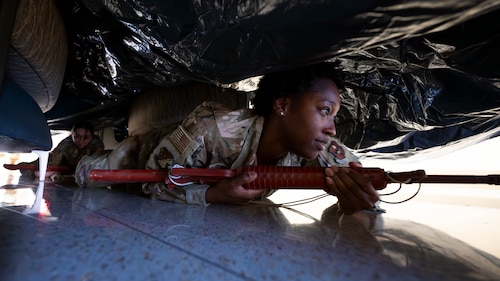
U.S. Air Force Airman 1st Class Da’Ja Thomas, 49th Healthcare Operations Squadron mental technician, low-crawls through an obstacle course during a Medic-X exercise at Holloman Air Force Base, New Mexico, July 16, 2025.
U.S. Air Force Airman 1st Class Da’Ja Thomas, 49th Healthcare Operations Squadron mental technician, low-crawls through an obstacle course during a Medic-X exercise at Holloman Air Force Base, N.M., July 16, 2025. This iteration of Medic-X integrated field exercises for medics who typically perform clinical and administrative duties, allowing them to sharpen their tactical skills while supporting lethal warfighters downrange. (U.S. Air Force photo by Tech. Sgt. Victor J. Caputo)

The Air Force is one of the most lethal parts of the Department of Defense, and the flipside of lethality is the medical skill needed to keep the warfighters in the fight downrange. This more hands-on approach to training was brought about after an education and training member went through the intense two-week Tactical Combat Casualty Care Tier 3 course and realized how important it would be to bring lessons learned to the entire medical group.

“We’re focusing on operating in an austere environment where it’s not going to be calm, it’s not going to be like day-to-day clinic operations,” said U.S. Air Force Capt. Natasha Lindbloom, 49th MDG education and training flight commander. “You could tell somebody to recite the alphabet, but if it’s stressful, they’re going to mess it up. We want our people to be able to do this until they can perform these simple tasks under pressure.”

Although we cannot mirror a battlefield environment, we can put our medics in situations where critical thinking and a sense of urgency fuels their training to ‘kick in.’Chief Master Sgt. Jason Estrada, 49th MDG senior enlisted leader

Coupled with the chance to exercise underutilized but combat-effective skills, the exercise served to underscore the importance of medics who are fit to fight and capable of doing what’s needed when it’s needed in a stressful and possibly deadly environment. A low-crawl obstacle course was put together using furniture and gear inside the clinic, streamlining the flow of training and simulating a more realistic urban environment.
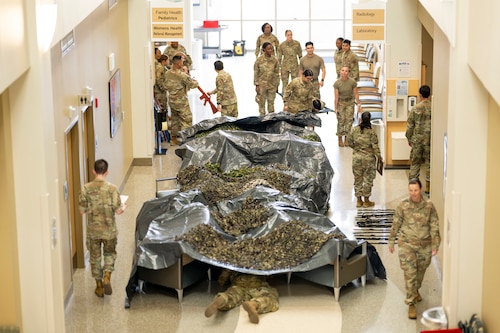
Airmen from the 49th Medical Group rotate between stations during a Medic-X exercise at Holloman Air Force Base, New Mexico, July 16, 2025.
Airmen from the 49th Medical Group rotate between stations during a Medic-X exercise at Holloman Air Force Base, N.M., July 16, 2025. This exercise allowed every member of the medical group to sharpen field skills they are not able to practice every day while providing critical clinical support to Team Holloman. (U.S. Air Force photo by Tech. Sgt. Victor J. Caputo)

“Although we cannot mirror a battlefield environment, we can put our medics in situations where critical thinking and a sense of urgency fuels their training to ‘kick in,’” Estrada said. “Since so few of our current medics possess the real-world experience, it’s our training team that brings these scenarios to life with realism and pressure-induced decision making, which results in the desired sets & reps our teams need to build muscle memory.

Constant Improvement

Medic-X training exercises are not a new concept for medical personnel; in fact, Medic-X was rolled out across the enterprise two years ago and has provided quarterly training objectives to all Defense Health Agency members. The ever-changing global environment and nature of future warfare were other driving factors in the 49th MDG collectively getting ahead of the curve and practicing these critical wartime skills on top of staying adept at their daily clinical duties.

“I’m hoping this gives people the mindset of ‘Hey, I know I’m in this job right now and I’m comfortable, but I’m not always going to be comfortable if we’re put in these situations in real life,’” said U.S. Air Force Senior Airman Claire Pruitt, 49th MDG education and training program manager.

All Airmen take TCCC Tier-1 training that covers the basics of what was formerly known as self-aid and buddy care, while all medics are required to take Tier-2 training to gain more expertise in the ability to treat wounds sustained in combat. Tier-3 training is optional but available for all medics and provides a realistic, grueling experience of austere field conditions and the physical limits that medics can be pushed to in wartime.
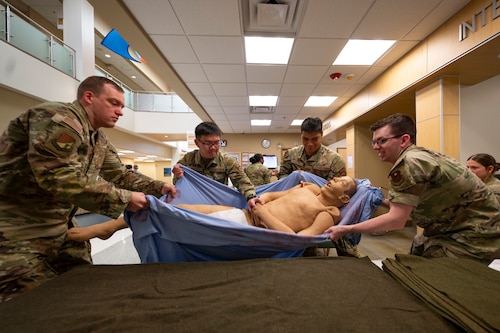
Airmen from the 49th Medical Group transfer a 200-pound training dummy from a gurney to an operating table during a Medic-X exercise at Holloman Air Force Base, New Mexico, July 16, 2025.
Airmen from the 49th Medical Group transfer a 200-pound training dummy from a gurney to an operating table during a Medic-X exercise at Holloman Air Force Base, N.M., July 16, 2025. This exercise allowed every member of the medical group to sharpen field skills they are not able to practice every day while providing critical clinical support to Team Holloman. (U.S. Air Force photo by Tech. Sgt. Victor J. Caputo)

“There’s going to be a bit of a shock factor for people working in a clinic, where even though we’re incredibly busy, a lot of it is just administrative work instead of intense, hands-on medical practice,” Pruitt said. “I’m trying to integrate some of the things that they did with us in a physical aspect at the Tier 3 training so that these Airmen have more experience and understand that if they have to do this in real life tomorrow, it’s not going to be easy. They’ll have to think about getting the patient out of the combat zone, treating their wounds, stopping the bleeding, loading them onto a helicopter, etc.”

The success of the first iteration of integrated field work with Medic-X has laid the groundwork for an ever-improving series of exercises to better prepare Team Holloman’s medics for unpredictable and challenging fights of future conflict.

“Today’s potential adversaries are better equipped and more prepared than any potential foe has ever been,” Estrada said. “For that reason, every uniform-wearing member of our military needs to understand that he/she is one bad day, one ill-guided decision, one perceived threatful action away from finding themselves, in support of our country, inside a combat environment where the old rules may not apply.”
 

Defense News in Brief: CNRC Launches “Top Doc” in Fort Lauderdale

Source: United States Navy

FORT LAUDERDALE, Fla. — Navy Recruiting Command launched its national initiative pilot program, “Top Doc,” showcasing Medical Corps capabilities and career paths at Nova Southeastern University’s Fort Lauderdale campus on Saturday, July 12.

“Top Doc,” is designed to draw in a wide variety of people in various stages of their medical career path. This includes medical students, residents, residency program leaders and staff, and attending physicians in any type of practice or specialty.

“The involvement of a scholarly team of professionals, enabled by Nova Southeastern University’s prestigious health sciences programs, is a cornerstone of our excitement for launching the ‘Top Doc,’ pilot in South Florida, where we’ve received unparalleled community support,” said Capt. Tara Mcginnis, medical officer programs officer, Navy Recruiting Command. “This event captivates Florida residents by showcasing Navy Medicine’s advanced emergency care techniques, directly relevant to the state’s veteran and active-duty communities. It offers local medical professionals and students the chance to explore rewarding careers in Navy Medicine, while residents take pride in the military-civilian partnerships fostered here.”

Mcginnis believes the “Top Doc” initiative prioritizes the Medical Corps by attracting top medical talent from medical schools, residencies, and direct accessions.

“The experience offers military medical trainees and staff the opportunity to collaborate with civilian healthcare programs, foster a mutual exchange of knowledge, innovation, and service,” said Navy Counselor (Recruiting) 1st Class Jason Catano, assigned to the Hometown Medical Recruiter pilot program with Medical Accessions, Navy Recruiting Command. “The whole intent with this is to bring that all to the table and also give an opportunity to have hands-on training with the different professionals that are here from different career fields.”

Navy Bureau of Medicine and Surgery (BUMED), the headquarters for Navy Medicine, was represented at “Top Doc,” by surgeons, an anesthesiologist, and a dermatologist. Tactical Combat Casualty Care (TCCC) instructors, Nurse Corps officers, and enlisted hospital corpsmen also lent their experience and expertise to the event.

Matthew Chenworth, senior director of military affairs for Nova Southeastern University and Marine Corps veteran, believes ensuring connecting the university’s students, faculty, and staff with the military is a top priority. Chenworth says NSU’s collaboration on “Top Doc,” and the long-standing relationship with NTAG Miami helps to achieve that goal.

“We’ve been coordinating a lot of scholarship opportunities specifically with our medical students who are looking to serve their country as a medical officer with the United States Navy upon their graduation,” said Chenworth. “We introduced [“Top Doc”] to our pre-medicine students, our nursing students, and to those who are currently within our health profession division that are going to be [Doctor of Osteopathic Medicine, Medical Doctors, and Physician Assistants]. We also extended the invite to our public safety office as well because those might be skills that our security officers here on campus may need.”

This joint effort brought in local medical professionals and community leaders, adding to the value of the event. Dr. Joshua Lenchus, former Florida Medical Association president, and Dr. Aeyal Oren, general surgeon in private practice, spent time working with simulation manikins and leading procedural demonstrations.

“It was a big role to step into, but I have prior experience doing simulation experience with my training down in Miami as well as dealing with the military because we ran trauma simulations there as well,” said Lenchus. “I think that the opportunities in the military are tremendous and there’s never enough gratitude that we can pay to the people who choose to put on the uniform and serve this country.”

Lenchus believes that while financial aid is extremely important, the leadership development gained through the military’s specialized training and coursework—often not available in the civilian sector—is equally vital.

Those in attendance gained insights from active-duty and reserve healthcare professionals working in the fleet.

Navy Medicine personnel presented specialized training capabilities on simulation tools, such as the TCCC Cut Suit, used to train medical personnel in treating battlefield traumas. Several presenters shared information sessions explaining the availability and requirements of medical officer programs and how they applied those programs in their careers.

Lt. Gahen Pendlebury, a full-time out-service medical officer and, emergency medicine resident, facilitated at the event.

“What I’ve realized through talking with civilian colleagues is that there are a lot of misconceptions [about military careers],” said Pendlebury. “Some people think that they’re too old, and they are no where near that. Some think that because they went to a Caribbean school, they can’t join as physicians. There are all sorts of entryways. These types of events really help not only expand Navy branding, but really help people understand that it’s not too late and that there are different pathways.”

Pendlebury believes there is a need for these kinds of events where interested people can obtain information about different career paths in Navy Medicine whether as active duty or reserve Sailors.

David Missel, a first-year optometry student at NSU and Navy medical officer applicant, said he attended “Top Doc,” to learn more about Navy Medicine and to celebrate his commitment to serve upon graduation.

“I decided to come here today because I’ve really had a passion for the Navy ever since I was a little kid,” said Missel. “I didn’t even know that I could be an optometrist in the Navy until very recently. Speaking to a recruiter and other people in the Navy, the more I learned about it the more I realize that this is such an amazing program and it’s a wonderful career opportunity. I’m just really looking forward to diving into this.”

Navy Medicine, represented by more than 44,000 highly trained military and civilian health care professionals, provides enduring expeditionary medical support to the warfighter any time, any place.

Missed the event but want to learn about Navy Medicine opportunities? Visit www.navy.com/navy-medicine or call 1-800-USA-NAVY for information.

NTAG Miami, has 38 recruiting locations throughout South Florida, Puerto Rico and the Virgin Islands, with the combined mission to recruit the highest caliber Sailors to meet the needs of the Fleet.

Navy Recruiting Command consists of a command headquarters, two Navy Recruiting Regions, Navy Recruiting Reserve Command, and 26 NTAGs that serve more than 970 recruiting stations around the world. Their mission is to attract the highest quality candidates to assure the ongoing success of America’s Navy.

Justice Department Supports Seattle’s Motion to Terminate Police Department Consent Decree

Source: United States Department of Justice Criminal Division

The Justice Department’s Civil Rights Division today announced that it has filed a response in support of the City of Seattle’s Motion to Terminate the Consent Decree in United States v. City of Seattle. The decree required reforms in the Seattle Police Department’s practices regarding use of force, crisis intervention, stops and detentions, supervision and accountability. With support from the Justice Department, the Seattle Police Department (SPD) achieved sustained substantial compliance.

The Justice Department brought this case pursuant to the Violent Crime Control and Law Enforcement Act of 1994 and the Omnibus Crime Control and Safe Streets Act of 1968. The U.S. Attorney’s Office’s Civil Division and the Special Litigation Section of the U.S. Department of Justice’s Civil Rights Division jointly investigated and found that the Seattle Police Department (SPD) had engaged in a pattern or practice of unnecessary or excessive force that violated the Constitution and federal law. The U.S. District Court for the Western District of Washington entered the consent decree in 2012.

“We congratulate the Seattle Police Department on its achievement of sustained substantial compliance with this thirteen-year-old consent decree,” said Assistant Attorney General Harmeet K. Dhillon of the Justice Department’s Civil Rights Division. “This Civil Rights Division will continue to work with police departments across the country to help make America’s communities safe again.”

“The U.S. Attorney’s Office, Western District of Washington, believes the district court should terminate the consent decree and monitorship, which have been in place for 13 years,” said Acting U.S. Attorney Teal Luthy Miller for the Western District of Washington. “Seattle has been held up as an example of successful police reform and has done recent work on its crowd control policies and accountability systems. We trust it will continue to lead the way on constitutional policing.”

New Jersey Construction Company Owner Sentenced for Tax Evasion

Source: United States Department of Justice Criminal Division

A New Jersey construction company owner was sentenced yesterday to 15 months in prison for evading employment tax penalties assessed against him.

The following is according to court documents and statements made in court: Joseph Caravella, of Randolph, owned several masonry companies in New Jersey. From 2008 to 2016, the IRS assessed approximately $650,000 in Trust Fund Recovery penalties against Caravella for causing three masonry businesses that he owned to not pay their federal employment taxes. The timely payment of federal employment taxes is critical to the functioning of the U.S. government because, for example, they are the primary source of funding for Social Security and Medicare. The federal income taxes that are withheld from employees’ wages also account for a significant portion of all federal income taxes collected each year. Congress empowered the IRS to impose a penalty equal to the amount of the unpaid taxes — called a Trust Fund Recovery Penalty — against any responsible individual who fails to ensure that these taxes are paid timely. Caravella pleaded guilty to attempting to evade these Trust Fund Recovery penalties.  

From around March 2008 through April 2019, Caravella sought to evade the payment of these penalties by placing companies that he controlled in the names of nominee owners and avoiding the use of a bank account in his own name to prevent the IRS from levying the funds. Also during that time, Caravella continued to cause his businesses not to pay employment taxes, resulting in an additional loss of $1.2 million to the IRS.

In total, Carvalla caused a tax loss to the IRS of $1,885,519.39.

Acting Deputy Assistant Attorney General Karen E. Kelly of the Justice Department’s Tax Division and U.S. Attorney Alina Habba for the District of New Jersey made the announcement.

IRS Criminal Investigation is investigating the case.

Trial Attorney Hayter L. Whitman of the Tax Division and Assistant U.S. Attorney Christopher Fell for the District of New Jersey are prosecuting the case.

Defense News in Brief: U.S.-Philippine Airmen strengthen ties during Cope Thunder 25-2

Source: United States Airforce

PACAF participated in Cope Thunder 25-2, a unique platform that integrates U.S. and Philippine Air Forces and enhances interoperability through bilateral fighter training, subject matter expert exchanges and key leadership engagements.

U.S. Pacific Air Forces and Philippine Air Force members participated in Cope Thunder 25-2, a bilateral training conducted across multiple locations in the Philippines. The exercise aimed to strengthen partnerships and support the Philippine Air Force’s modernization efforts, promoting regional and global stability.

Established in the Philippines in 1976, Cope Thunder provides a unique platform to integrate U.S. and Philippine Air Forces and enhance interoperability through bilateral fighter training, subject matter expert exchanges and key leadership engagements. Cope Thunder 25-2 also marked the first time a U.S. Air Force F-35A Lightning II squadron has deployed to the Philippines.

“It’s obvious that this isn’t a relationship that’s simply on paper,” said Lt. Col. Bryan Mussler, 421st Mission Generation Force Element commander. “We’ve been integrating with them for a long time, and their mentality and approach to operations is very similar to ours.”

Subject matter expert exchanges during the exercise enabled U.S. and Philippine Airmen in similar career fields to share best practices and effective techniques aimed at improving day-to-day operations for both forces. These exchanges included maintenance, firefighting, airfield operations, electromagnetic warfare and basic fighter manoeuvres with U.S. and Philippine pilots flying side by side.

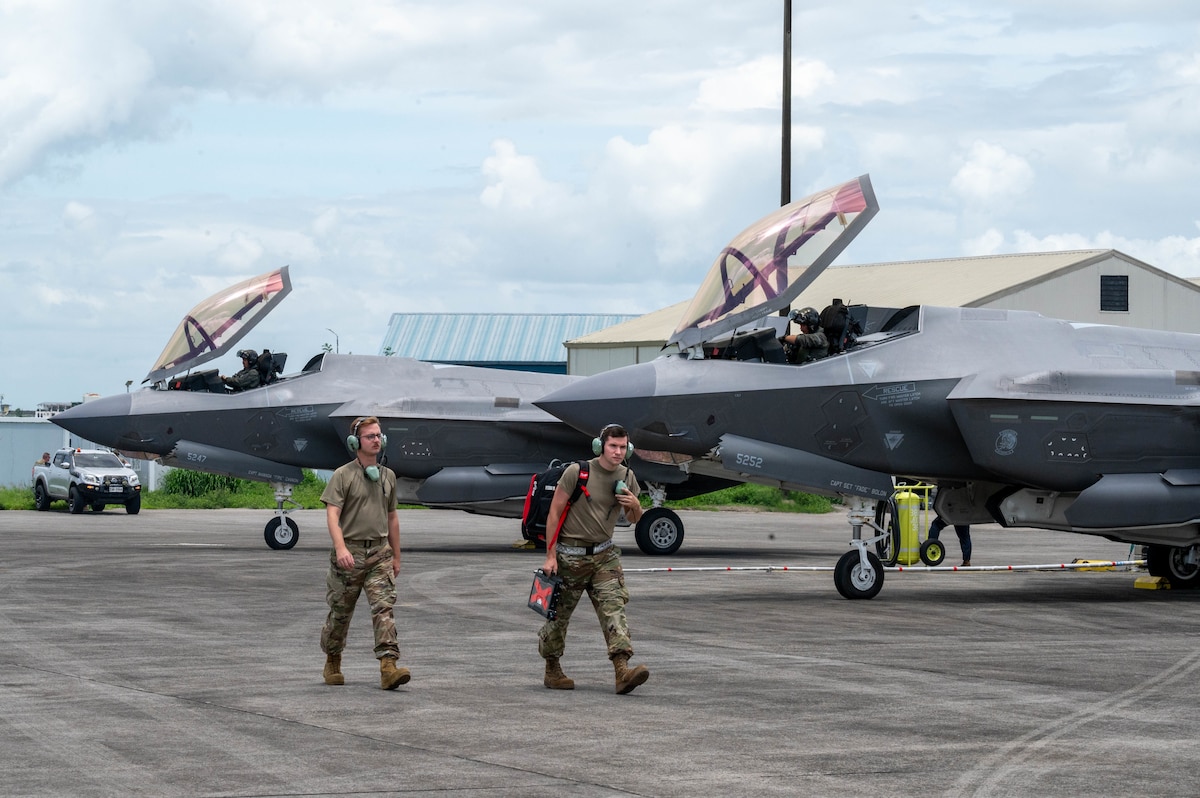
U.S. Air Force maintainers, assigned to the 421st Mission Generation Force Element, depart the flightline after conducting preflight operations on an F-35A Lightning II during Cope Thunder 25-2 at Clark Air Base, Philippines, July 7, 2025. The exercise enhances interoperability between the U.S. Air Force and the Philippine Air Force and supported the Armed Forces of the Philippines' modernization efforts. (U.S. Air Force photo by Airman 1st Class Aden Brown)
U.S. Air Force maintainers, assigned to the 421st Mission Generation Force Element, depart the flightline after conducting preflight operations on an F-35A Lightning II during Cope Thunder 25-2 at Clark Air Base, Philippines, July 7, 2025. The exercise enhances interoperability between the U.S. Air Force and the Philippine Air Force and supported the Armed Forces of the Philippines’ modernization efforts. (U.S. Air Force photo by Airman 1st Class Aden Brown)

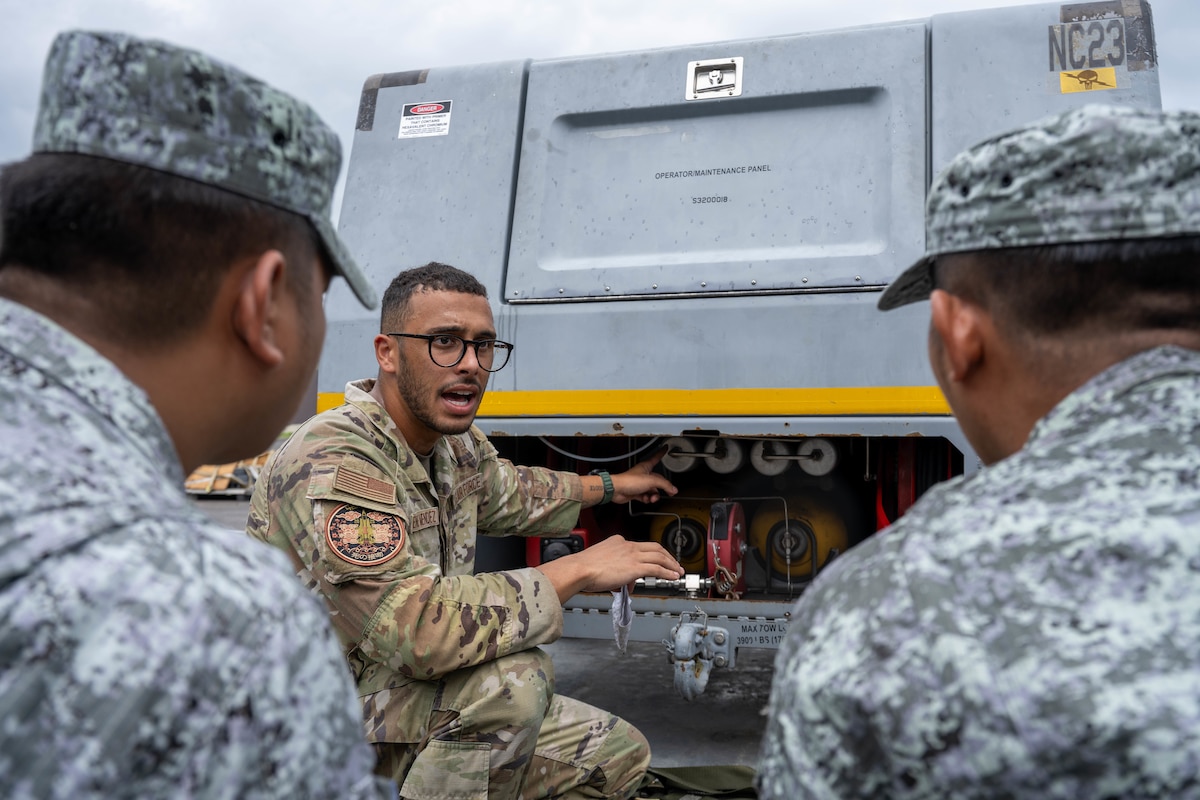
U.S. Air Force Staff Sgt. Arnaldo Puente Mendez, 421st Mission Generation Force Element aerospace ground equipment maintainer, briefs Philippine Air Force airmen on a self generating nitrogen servicing cart during Cope Thunder 25-2 at Clark Air Base, Philippines, July 9, 2025. During the subject matter expert exchange, U.S. Airmen provided valuable insight into equipment used for aircraft maintenance, supporting Armed Forces of the Philippines’ modernization efforts. (U.S. Air Force photo by Airman 1st Class Aden Brown)
U.S. Air Force Staff Sgt. Arnaldo Puente Mendez, 421st Mission Generation Force Element aerospace ground equipment maintainer, briefs Philippine Air Force airmen on a self-generating nitrogen servicing cart during Cope Thunder 25-2 at Clark Air Base, Philippines, July 9, 2025. During the subject matter expert exchange, U.S. Airmen provided valuable insight into equipment used for aircraft maintenance, supporting Armed Forces of the Philippines’ modernization efforts. (U.S. Air Force photo by Airman 1st Class Aden Brown)

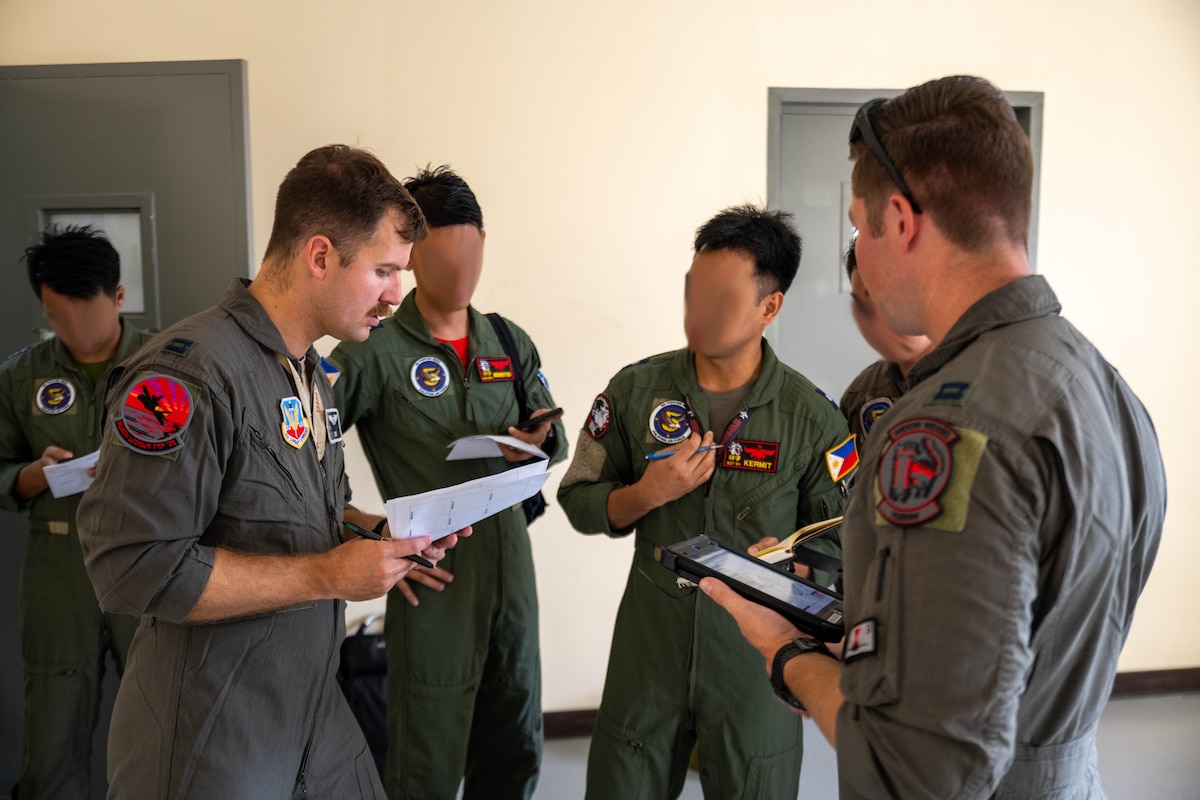
U.S. Air Force Capt. Tyler Rico (2nd left) and Capt. Toney Fisher (right), 421st Mission Generation Force Element F-35A pilots, coordinate flight plans with Philippine Air Force pilots during the Cope Thunder 25-2 exercise at Clark Air Base, Philippines, July 7, 2025. The training conducted between the U.S. and Philippine Air Force strengthens both the ability to respond together for potential future crises, contingencies and natural disasters. (U.S. Air Force photo by Airman 1st Class Aden Brown) (Image blurred for operational security)
U.S. Air Force Capt. Tyler Rico, second to the left, and Capt. Toney Fisher, right, 421st Mission Generation Force Element F-35A pilots, coordinate flight plans with Philippine Air Force pilots during the Cope Thunder 25-2 exercise at Clark Air Base, Philippines, July 7, 2025. The training conducted between the U.S. and Philippine Air Force strengthens both the ability to respond together for potential future crises, contingencies and natural disasters. (U.S. Air Force photo by Airman 1st Class Aden Brown) (Image blurred for operational security)

“We worked closely with the PAF pilots, and it was clear they are professional and highly capable aviators that employ their weapon systems with skill and precision,” said Capt. Tobey Fisher, 421st Mission Generation Force Element F-35A instructor pilot. “Additionally, this exercise afforded the 421st MGFE the opportunity to operate at a remote airfield with minimal support.”

The F-35A maintenance team supported Cope Thunder 25-2 with a lean, agile team, operating with roughly one-third of the personnel they typically have at their home station.

“It’s really cool to see such a small team come here and execute the mission,” said Maj. Clinton Bialcak, 421st Fighter Generation Squadron commander, referring to executing the F-35 maintenance mission. “I think everyone in the region, in the world and in the Department of Defense sees that we can do it and they can rely on us.”

The U.S. Air Force’s participation reflects ongoing efforts to strengthen coordination with regional allies and partners.


Defense News in Brief: Next-gen TOC-L systems announced to boost agile C2 capabilities

Source: United States Airforce

The DAF has announced the upgrade of the Tactical Operations Center-Light capability with its Major Release 2 prototype, designed to advance contributions to Combined Joint All-Domain Command and Control.

The Department of the Air Force recently announced the upgrade of the Tactical Operations Center-Light capability with its Major Release 2 prototype, July 22.

This rapid prototyping effort, developed with support from long-standing industry partners, will deliver more than 40 next-generation TOC-L systems designed to advance the DAF’s contribution to Combined Joint All-Domain Command and Control.

“This has been a major push from our team and industry partners to see the TOC-L MR2 prototype developed with all the lessons learned from MR1,” said Maj. Gen. Luke Cropsey, DAF’s Program Executive Officer for Command, Control, Communications and Battle Management. “This achievement truly embodies our agile acquisition approach, setting the stage for a phased deployment where we can rapidly field operationally relevant upgrades based on feedback from the field.”

U.S. Air Force photo by Staff Sgt. Noah Sudolcan
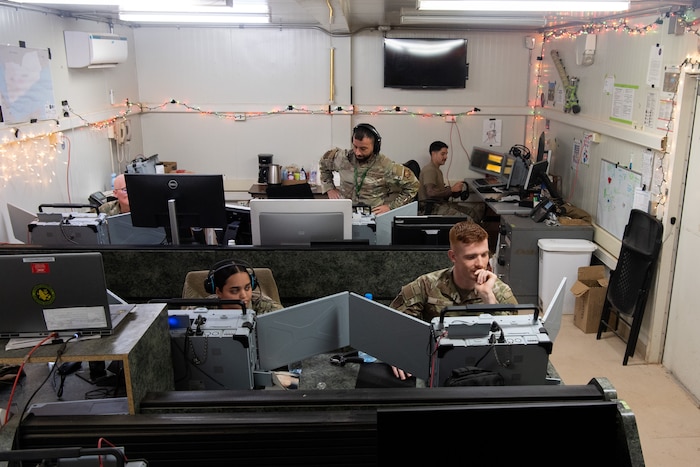
U.S. Air Force Airmen assigned to the 606th Air Control Squadron perform their daily tasks on the Tactical Operations Control – Light command and control system at Camp Lemonnier, Djibouti, Feb. 17, 2025. The 606th Air Control Squadron, callsign “Primo,” is a mobile command and control combat unit “Ready Now” to meet the nation’s call for exceptional tactical C2. (U.S. Air Force photo by Staff Sgt. Noah Sudolcan)

Managed by DAF PEO C3BM’s Advanced Battle Management System Division, the TOC-L integrates data from multiple sources to create a synchronized air picture. The MR2 prototype represents a crucial leap forward for the TOC-L. While 16 MR1 prototypes focused on minimizing the system’s physical footprint, MR2 also prioritizes enhanced integration capabilities.

“The MR2 aims to enhance portability, survivability, mobility and ease of use through reduced size, weight, power, while featuring improved usability and maintainability to reduce training time and improve operational readiness,” said Lt. Col. Micah Graber, ABMS Deployable Systems Branch materiel leader. “The system will also feature ABMS Digital Infrastructure and Cloud-Based Command and Control software capability for enhanced enterprise interoperability and expanded data access within the DAF BATTLE NETWORK.”  

This shift from maneuverability to integration leveraged insights gained from the MR1 prototype’s first operational deployment to Combined Joint Task Force-Horn of Africa, which provided real-world capability assessment. Along with data from prior experiments, recent participation in the U.S. Army’s Project Convergence Capstone 5 also played a vital role in directly informing MR2 requirements, focusing on the system’s integration with other key technologies.   

“The plan for the MR2 prototypes builds upon the lessons learned from the original 16,” said Stephen Ciulla, ABMS TOC-L program manager. “The potential use cases and operational possibilities have expanded over the last 18 months and MR2 development includes more rigorous testing and design validation to ensure that functional and operational requirements are met.”

The MR2 prototype will serve as the execution arm of the DAF BATTLE NETWORK by utilizing ABMS DI to communicate to various sensors and C2 systems, according to Ciulla. This bridges communication gaps between disparate systems, facilitating seamless cross-domain integration and interoperability. CBC2 functionality additionally employs advanced software and artificial intelligence to assist battle managers in prioritizing and executing actions, while advancing human-machine teaming.

“MR2’s integration advancements, enabled by ABMS DI and CBC2, will enable seamless information sharing and improved coordination among warfighters in contested environments, leading to a more cohesive and effective force,” Graber said. “This enhanced interoperability translates into tangible operational advancements by allowing for better-informed decisions and more decisive actions across all levels – tactical, operational and strategic.”

The TOC-L prototype is a critical component of the DAF BATTLE NETWORK, contributing to enhanced situational awareness and decision-making across the battlespace. The MR2 prototype underscores the Air Force’s commitment to delivering cutting-edge technology to the warfighter, ensuring decisive advantage in future conflicts.


Operation Grayskull Culminates in Lengthy Sentences for Managers of Dark Web Site Dedicated to Sexual Abuse of Children

Source: United States Department of Justice Criminal Division

Operation Grayskull Eradicated Four Dark Web Child Abuse Sites and Led to the Convictions of 18 Offenders to Date, Who Have Collectively Received More than 300 Years in Prison

Today, the Justice Department announced the results of Operation Grayskull, a highly successful joint effort between the Department of Justice and the FBI that resulted in the dismantling of four dark web sites dedicated to images and videos containing child sexual abuse material (CSAM). To date, the operation has led to the convictions of 18 offenders, including a Minnesota man who was sentenced yesterday to 250 months in prison and lifetime supervised release for his involvement with one of these dark web sites. He was also ordered to pay $23,000 in restitution.

“Today’s announcement sends a clear warning to those who exploit and abuse children: you will not find safe haven, even on the dark web,” said Acting Assistant Attorney General Matthew R. Galeotti of the Justice Department’s Criminal Division. “These offenders thought that they could act without consequences, but they were wrong.  Thanks to the relentless determination of our prosecutors and law enforcement partners we have exposed these perpetrators for who they are, eliminated their websites and brought justice to countless victims.”

“This operation represents one of the most significant strikes ever made against online child exploitation networks,” said FBI Director Kash Patel. “We’ve not only dismantled dangerous platforms on the dark web, but we’ve also brought key perpetrators to justice and delivered a powerful message: you cannot hide behind anonymity to harm children.”

“Yesterday’s sentencing reaffirms our steadfast commitment to protecting our children, the most vulnerable among us, from those who exploit and harm them through the despicable trade in child sexual abuse material,” said U.S. Attorney Hayden P. O’Byrne for the Southern District of Florida. “Thomas Peter Katsampes and his co-conspirators ran some of the darkweb’s most heinous networks, enabling horrific crimes against innocent victims, but Operation Grayskull has shut these sites down and delivered justice. We applaud the FBI and our international partners for their tireless work, and let this be a clear warning: we will relentlessly pursue and prosecute anyone engaged in such atrocities, no matter how they attempt to cover their tracks.”

Thomas Peter Katsampes, 52, of Eagan, Minnesota, pleaded guilty to conspiracy to advertise and conspiracy to distribute child pornography on Feb. 27. According to court documents, Katsampes joined a dark web site dedicated to CSAM in 2022, advertised and distributed CSAM over the website, including CSAM depicting prepubescent children, and eventually worked his way up to a staff position on the web site, which, among other things, involved moderating the site, enforcing the site’s rules for posting CSAM, and advising the site’s users about how to post CSAM.

In addition to Katsampes, eight individuals have been convicted and sentenced in the Southern District of Florida for their involvement in running the primary site targeted by Operation Grayskull.

Defendant Residence Case Status
Selwyn David Rosenstein Boynton Beach, Florida

Pleaded guilty to conspiracy to advertise child pornography, five counts of advertisement of child pornography, and possession of child pornography.

Sentenced on Dec. 12, 2022, to 28 years in prison and ordered to pay $80,500 in restitution to victims of his offense.

Matthew Branden Garrell Raleigh, North Carolina

Pleaded guilty to conspiracy to advertise child pornography and conspiracy to distribute child pornography.

Sentenced on Aug. 1, 2023, to 20 years and 10 months in prison and ordered to pay $158,500 in restitution to victims of his offense.

Robert Preston Boyles Clarksville, Tennessee

Pleaded guilty to conspiracy to advertise child pornography and conspiracy to distribute child pornography.

Sentenced on Aug. 15, 2023, to 23 years and four months in prison and ordered to pay $7,500 in restitution to victims of his offense.

Gregory Malcolm Good Silver Springs, Nevada

Pleaded guilty to conspiracy to advertise child pornography and conspiracy to distribute child pornography.

Sentenced on Aug. 22, 2023, to 25 years and 10 months in prison and ordered to pay $93,500 in restitution to victims of his offense.

William Michael Spearman Madison, Alabama

Pleaded guilty to engaging in a child exploitation enterprise.

Sentenced on Jan. 23, 2024, to life in prison and ordered to pay $123,400 in restitution to victims of his offense.

Joseph Addison Martin Tahuya, Washington

Pleaded guilty to engaging in a child exploitation enterprise.

Sentenced on April 18, 2024, to 42 years in prison and ordered to pay $174,500 in restitution to victims of his offense.

Joseph Robert Stewart Milton, Washington

Pleaded guilty to conspiracy to advertise child pornography and conspiracy to distribute child pornography.

Sentenced on April 18, 2024, to 23 years and 9 months in prison and ordered to pay $19,500 in restitution to victims of his offense.

Keith David McIntosh Grand Rapids, Michigan

Pleaded guilty to conspiracy to advertise child pornography and conspiracy to distribute child pornography, both as a person with a prior conviction for possession of child pornography.

Sentenced on Dec. 19, 2024, to 55 years in prison.

The website’s leaders advertised and distributed CSAM, promulgated rules for the website, enforced the rules by banning or scolding users who violated them, held staff meetings, recruited members to serve as staff members, recommended users for promotion, edited and deleted user posts, praised individuals for participating in and contributing to the website, kept records of CSAM posts made by individual members, and paid for and maintained the website servers, among other things.

Operation Grayskull resulted in the dismantling of a total of four sites dedicated to images and videos depicting child sexual abuse. These websites were some of the most egregious on the dark web, and they included sections specifically dedicated to infants and toddlers, as well as depictions of violence, sadism, and torture. The websites also contained detailed advice on how to avoid detection by law enforcement – for example, by using sophisticated technologies.

In other judicial districts around the country, nine additional individuals have been convicted for their involvement with these websites, including the following:

  • Charles Hand, of Aberdeen, Maryland, was prosecuted in the District of Maryland and was sentenced to 14 years in federal prison;
  • Michael Ibarra, of Wenatchee, Washington, was prosecuted in the Eastern District of Washington and was sentenced to 12 years in prison;
  • Clay Trimble, of Fordyce, Arkansas, was prosecuted in the Eastern District of Arkansas and was sentenced to 18 years in prison;
  • David Craig, of Houston, Texas, was prosecuted in the Southern District of Texas and was sentenced to nine years in prison;
  • Robert Rella of Chesapeake, Virginia, was prosecuted in the Eastern District of Virginia and was sentenced to five years and eight months in prison;
  • Samuel Hicks, of Fort Wayne, Indiana, was prosecuted in the Northern District of Indiana and was sentenced to 16 years in prison;
  • Richard Smith of Dallas, Texas, was prosecuted in the Eastern District of Texas and was sentenced to 14 years in prison;
  • Patrick Harrison, of Grand Rapids, Michigan, was prosecuted in the Western District of Michigan and was sentenced to five years and ten months in prison.
  • Thomas Gailus, of Webbers Falls, Oklahoma, was prosecuted in the Eastern District of Oklahoma, and his sentencing is pending.

Two other individuals in the United States died before being charged for their involvement with the websites. The operation also resulted in arrests in the United Kingdom, the Netherlands, Italy, Germany, Estonia, Belgium, and South Africa.

The FBI’s Child Exploitation Operational Unit and Miami Field Office, West Palm Beach Resident Agency investigated the cases.

Acting Deputy Chief Kyle P. Reynolds and Trial Attorney William G. Clayman of the Justice Department’s Child Exploitation and Obscenity Section (CEOS) and former Assistant U.S. Attorney Gregory Schiller of the Southern District of Florida coordinated the operation and prosecuted the defendants in the Southern District of Florida.

Substantial assistance for the cases prosected in the Southern District of Florida was provided by FBI Field Offices and Resident Agencies in Huntsville, Alabama; Reno, Nevada; Clarksville, Tennessee; Raleigh, North Carolina; Madison, Wisconsin; Tacoma, Washington; Grand Rapids, Michigan; and Minneapolis, Minnesota; CEOS’s High Technology Investigative Unit; and the U.S. Attorney’s Offices for the Northern District of Alabama, District of Nevada, Middle District of Tennessee, Eastern District of North Carolina, Western District of Wisconsin, Western District of Washington, Western District of Michigan, and District of Minnesota.

This case was brought as part of Project Safe Childhood, a nationwide initiative launched in May 2006 by the Department of Justice to combat the growing epidemic of child sexual exploitation and abuse. Led by U.S. Attorneys’ Offices and CEOS, Project Safe Childhood marshals federal, state and local resources to better locate, apprehend and prosecute individuals who exploit children via the Internet, as well as to identify and rescue victims. For more information about Project Safe Childhood, please visit www.justice.gov/psc.