Elder Fraud, in Focus

Source: US FBI

Elder fraud complaints to the FBI’s Internet Crime Complaint Center (or IC3) increased by 14% in 2023, and associated losses increased by about 11%, according to IC3’s 2023 Elder Fraud Report, released April 30.  

This annual publication provides statistics about incidents of elder fraud—or fraud that explicitly targets older Americans’ money or cryptocurrency—that are reported to IC3. The report aims to raise the public’s awareness of this issue and to prevent future and repeat incidents. 

“Combatting the financial exploitation of those over 60 years of age continues to be a priority of the FBI,” wrote FBI Assistant Director Michael D. Nordwall, who leads the Bureau’s Criminal Investigative Division, in the report. “Along with our partners, we continually work to aid victims and to identify and investigate the individuals and criminal organizations that perpetrate these schemes and target the elderly.” 

And elder fraud is probably a more insidious threat than the report shows. Many of these crimes likely go unreported, and, as the report states, “only about half” of the fraud scam complaints submitted to IC3 in 2023 included victims’ ages.

Here are five key takeaways from the 2023 report

1. Elder fraud is an expensive crime. Scams targeting individuals aged 60 and older caused over $3.4 billion in losses in 2023—an increase of approximately 11% from the year prior. The average victim of elder fraud lost $33,915 due to these crimes in 2023. 

2. Older Americans seem to be disproportionately impacted by scams and fraud. Over 101,000 victims aged 60 and over reported this kind of crime to IC3 in 2023. On the flip side, victims under the age of 20 years old seemed to be the least-impacted demographic, with about 18,000 victims in this demographic reporting suspected scams or frauds to IC3 last year. 

3. Tech support scams were the most widely reported kind of elder fraud in 2023. Nearly 18,000 victims aged 60 and over reported such scams to IC3. Personal data breaches, confidence and romance scams, non-payment or non-delivery scams, and investment scams rounded out the top five most common types of elder fraud reported to IC3 last year.  

Charlotte Child Pornography Case Shows ‘Unsettling’ Reach of AI Imagery

Source: US FBI

The FBI last June issued a warning about bad actors manipulating photos and videos using AI technology. In February, FBI Director Christopher Wray said, “advances in generative AI are lowering the barrier to entry,” meaning we’re likely to see more so-called deepfakes going forward.

Last month, the Bureau’s Internet Crime Complaint Center (IC3) issued an alert warning that CSAM created by generative AI and similar online tools is illegal. “Federal law prohibits the production, advertisement, transportation, distribution, receipt, sale, access with intent to view, and possession of any CSAM, including realistic computer-generated images,” the alert states.

Tatum was sentenced to 40 years in prison. In a statement after Tatum’s sentencing, U.S. Attorney Dena King said the child psychiatrist misused artificial intelligence “in the worst possible way: to victimize children.”

FBI Charlotte Special Agent in Charge Robert DeWitt said Tatum’s actions—while in a position of trust, no less—were horrific. “The FBI will never stop working to put predators like Tatum behind bars for a very long time,” he said in a statement after Tatum’s sentencing.

At Tatum’s sentencing, another victim who said she knew Tatum in high school asked the court for the maximum penalty.

“I was a child when the photos were taken that have now been so horribly twisted,” the mother of two children said. “How can this be that there exist pictures of me for which I did not pose, consent? To put it plainly, this mess is not my fault, but it is now part of my life to deal with.”

Investigating Environmental Crimes: The Huntington Oil Spill

Source: US FBI

In January 2021, the Los Angeles Port, one of the country’s largest and busiest shipping hubs, had effectively become a parking lot. COVID-19 had significantly slowed shipping rates globally, and dozens of 150,000-ton cargo ships were backed up and anchored in tight proximity to one another, creating a dangerous situation with little room for error. One or more of these ships was suspected to have damaged the pipeline. But the FBI would need to collect more data to narrow the list of which ships it could have potentially been.

In addition to assisting in the sample collection, USERT also worked to map the impact site. At 100 feet down with little natural light and murky ocean environments, the human eye could not effectively observe the surrounding area.

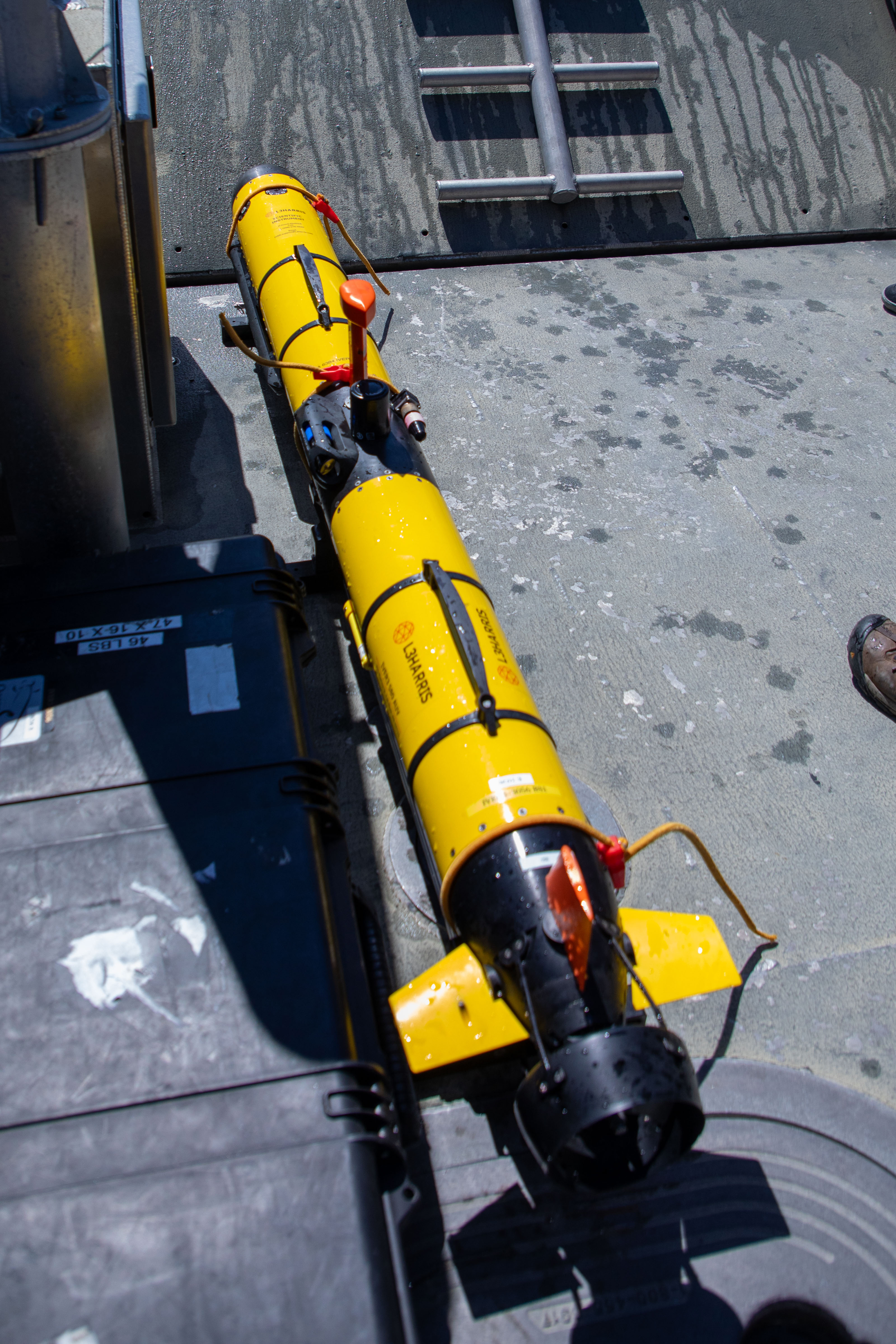
To address this, the FBI used sidescan sonar. Deployed from a remotely operated vehicle, the sonar would be pinged repeatedly. The intent was to divide the area into grids and use multiple sidescan sonar launches to fill in the grids. Dozens of missions over time would yield data for the entire area.

There are several things one can infer from sonar data, including the time it takes the sound to return gives depth. And the strength of the return can tell you what kind of material the sound is reflecting off of. A weak signal indicates muddy, sedimentary ocean floor. Stronger signals can indicate rocky bottom or foreign objects such as metal and concrete.

Summers turned the raw sonar data into a picture of the ocean floor around the break site that showed a few key details. First, the pipeline indeed was out of alignment from where it should have been, another indication it had been dragged. Second, in the soft ocean floor were furrows—scars left by an anchor that had dragged across the ocean floor and ultimately had snagged on the San Pedro pipeline.

The FBI used sidescan sonar, seen here, to help provide data to map the ocean floor surrounding the break.

A sample of the sonar data provided back. The long horizontal rows show the path of the sidescan sonar. Each section was laid side-by-side to produce a larger image of the ocean floor at the break site.

FBI Launches Trauma Notification Training

Source: US FBI

The FBI developed an initial version of the training—titled “We Regret to Inform You”—through a partnership with Penn State University. That course, which launched during National Crime Victims’ Rights Week in 2015 and was housed on PSU’s website, focused primarily on delivering death notifications and outlined a four-step model of planning, preparation, delivery, and follow-up. Over nine years, more than 40,000 individuals took the training.

In addition to positive feedback, Beers received numerous questions about other scenarios the training could used for, such as delivering notifications about arrests, child abductions, or other criminal violations. She began expanding the course to include all trauma notifications, not just deaths.

The updated Trauma Notification Training still teaches the four-step model, with the addition of eight new videos that illustrate best practices for delivering notifications in a variety of scenarios. Beers emphasizes the importance of being trauma-informed before delivering a notification, which includes ensuring victims feel safe and empowered, being honest when responding to questions, and recognizing cultural needs.

“Trauma notifications can significantly impact a loved one’s grieving process, as well as their mental, physical, and emotional health. It’s important to address victims in a trauma-informed manner, as you only get one chance at it,” said Beers.

“Every time I go out and do a notification, I’m anxious knowing I’m going to change that person’s life forever. While delivering a trauma notification can be extremely stressful for all individuals involved, there are methods to ensure the notification is provided to family members with professionalism, dignity, and compassion.”

The FBI’s Victim Services Division (VSD) has victim specialists in all 56 field offices who work to assist victims of crimes and ensure they are given the opportunity to receive the support and services they are entitled to under the law. Since its creation in 2001, VSD has provided services like crisis intervention, emergency travel assistance, referrals for counseling, and housing to nearly 2 million victims.

“How the FBI treats victims is a direct reflection of our core values, and we ensure that victims are supported with all resources available to them,” said VSD Acting Assistant Director Ashley Johnson. “Our Trauma Notification Training helps law enforcement and victim services providers deliver death and trauma notifications to family members following a crime without further traumatization.”

Wray: Chinese Government Poses ‘Broad and Unrelenting’ Threat to U.S. Critical Infrastructure

Source: US FBI

How We’re Fighting Back 

The FBI’s ability to both collect and act on intelligence is crucial to our fight against the China threat.  On the cyber front, this includes sharing lessons learned with the private sector and outreach to potential victims, using our technical prowess to halt cyber intrusions and safeguard victims, and taking additional “law enforcement actions” to disrupt and deter cyber incidents. 

The FBI fights back against China through Bureau-led “joint, sequenced operations” alongside our partners. “As part of those operations, we’re often sharing targeting and other information with partners like U.S. Cyber Command, foreign law enforcement agencies, the CIA, and others, and then acting as one,” he said. 

Wray used the FBI’s responses to the aforementioned cyber compromises to illustrate what these collaborative operations can look like in practice.  

In the case of the Microsoft Exchange hack, he said, the FBI “leaned on our private sector partnerships, identified the vulnerable machines, and learned the hackers had implanted webshells—malicious code that created a back door and gave them continued remote access to the victims’ networks.”  

From there, he said, we co-authored and distributed a joint cybersecurity advisory with our partners at the Cybersecurity and Infrastructure Security Agency to arm “network defenders” with “the technical information they needed to disrupt the threat and eliminate those backdoors.”  

And when some victims had trouble removing the dangerous code on their own, the FBI worked with Microsoft to execute “a first-of-its-kind surgical, court-authorized operation, copying and removing the harmful code from hundreds of vulnerable computers ,” he explained. This, in turn, removed the hackers’ access to victims’ networks. 

And in the case of Volt Typhoon, the FBI leveraged partnerships to share threat intelligence and to combat the actors responsible for the hack. After the Bureau learned that the malware was targeting U.S. critical infrastructure, we co-authored similar advisories that characterized the threat, called out the perpetuators, and provided victims with guidance for protecting themselves.  

Then, we collaborated with private sector partners “to identify the threat vector and conduct a court-authorized operation—in coordination with others—to not only remove Volt Typhoon’s malware from the routers it had infected throughout the U.S., but also to sever their connection to that network of routers and prevent their reinfection.” 

How Partners Can Join the Fight 

Wray said that private sector organizations and academia, alike, can partner with the FBI to protect the nation’s “most essential networks” and to conduct “joint, sequenced operations.”  
Since private companies own most of our nation’s critical infrastructure, they can help the FBI by defending against Chinese attacks and sharing “vital information about what adversaries are doing—or preparing to do—against us,” he said.  

Vigilance, he said, is vital to this effort. “That includes resiliency planning—things like developing an incident response plan, actually testing and exercising that plan, and fortifying networks and devices to make the attack surface as inhospitable as possible,” he added. These plans should indicate when a company will contact the Bureau for assistance in the event of a cyber intrusion, he noted. 

Likewise, he encouraged private sector organizations to keep an eye on their “hardware and supply chains” to avoid potential compromise, such as the Solar Winds hack that used “innocuous-looking software updates” as a vector. 

“Vetting your vendors, their security practices, and knowing who’s building the hardware and software you’re granting access to your network is crucial, so push for transparency into what vendors and suppliers are doing with your data and how they will maintain it,” he said. 
Wray said partnerships are critical to countering the risk posed by China, and that it’s vital for cyberattack victims to promptly notify the FBI. That way, we can gather threat intelligence that can help us both assist victims and mitigate risk to other organizations and sectors. 

“We’ve seen the best outcomes in situations where a company made a habit of reaching out to their local FBI field office even before there was any indication of a problem, because that put everyone on the same page and contributed to the company’s readiness,” he said. 

The FBI has also been long-dedicated to cultivating bonds within academia, he said, noting that partnerships between the FBI and academic institutions can give the Bureau a better understanding of the issues these institutions face when interacting with the Chinese government. They can also benefit academia by giving institutions “a better understanding of national security threats and make informed decisions about how to deal with them,” he added. 

Resources:

‘A Great Partner in the Community’

Source: US FBI

Pitcock eventually hired Black at his car lot, first with odd jobs and later sales, where he flourished. Pitcock invited him to his church, First Church of the Nazarene in Bethany, where Black would later share a testimonial about his life, his time in prison, and his spiritual awakening there. That’s where Pitcock’s friend and fellow congregant Rick Raines heard Black’s story. The tale’s contours sounded unbelievably familiar to Raines, a now-retired FBI special agent who had worked with Gray on the Thaddeus Black investigation more than two decades ago.

“I was like, ‘Oh my gosh, you’ve got to be kidding,’” said Raines. “The next time I was at church I came up behind him and said, ‘Thaddeus, you’re not going to believe this. I was on the surveillance team that followed you around for months in Guthrie. Can you believe that?’”

“It was such a blessing behind it, though,” said Black. “I just knew that my life today was not like my life yesterday.”

Raines and Black became friends in and out of church. The retired agent later nominated Black—who had earned a pastor’s license—to become an ordained minister in his church. Two other special agents on Raines’ surveillance team  attended Black’s ordination ceremony.

Today, Pastor Black leads Tulakes Neighborhood Ministries, which includes the church, a food pantry, and a free clinic. A bus with a basketball hoop attached is often seen at its community events.

Two years ago, when Raines learned that Edward Gray would return to Oklahoma City as special agent in charge, he saw a full-circle moment at hand. He contacted Gray to let him know Black was now a pillar of the community just a few miles from where he’d been arrested long ago.

“I was like, ‘Can you believe this? This is amazing,’” Raines said. “Then Ed was like, ‘We need to get Thaddeus hooked up with our community outreach program so we can do some things together.’”

Last August, FBI Oklahoma City’s Community Outreach Program was invited to set up a booth at the Tulakes Bash, a community event sponsored by Black’s ministry. SAC Gray said Pastor Black provides a valuable connection to the community.

Members of Thaddeus Black’s congregation cheered when the pastor received news during a youth night event at his church in February that he was a recipient of the 2023 Director’s Community Leadership Award.

“He’s been able to help us get into communities we had a hard time getting into,” Gray said. “If I needed someone to kind of vouch for the FBI, having him as a friend, I think he would do that.”

FBI Community Outreach Specialist Veronica Magrath played a role in nominating Black for the Director’s Community Leadership Award. She said hundreds of people attended last summer’s outreach event and met with FBI staff up close and personal. A little girl told her mom that “the police lady” Magrath was her friend now.

“I realized the impact the relationship between Pastor Black and the FBI has on that community,” Magrath said. “There is no way to measure in numbers, but I can tell you had Pastor Black not been the one to open his arms and partner with us, the community would not have had the same response as they have had following his lead.”

Retired Special Agent Raines echoed those remarks. He said the community where Black has his ministry is poor and underserved. But he’s always out helping and setting an example for kids who may be running the streets like he did.

“He just has a trust that he built and can tell them—with his background and what he did—it’s not the way to go,” Raines said. “And they see him there working alongside law enforcement, and the FBI in particular, and it shows them that that’s not something for them to fear if they make the right choices in their life.”

Tajik National Arrested in Brooklyn for Conspiring to Provide Material Support to ISIS

Source: US FBI

Mansuri Manuchekhri, 33, of Sheepshead Bay, Brooklyn, New York, was arrested today for allegedly conspiring to provide material support to the Islamic State of Iraq and al-Sham (ISIS) and to the Islamic State-Khorasan Province (ISIS-K), possessing firearms while unlawfully in the United States, and immigration fraud. Manuchekhri was arrested today and made his initial appearance this afternoon in the Eastern District of New York.

“Under no circumstances will my Department of Justice tolerate terrorism,” said Attorney General Pam Bondi. “We stand ready to find, arrest, and prosecute those who seek to harm American citizens with the full force of the law. I stand with our federal, state, and local law enforcement partners who work to keep Americans safe and evil off our streets.” 

“The defendant allegedly supported ISIS and sent thousands of dollars overseas to individuals connected to ISIS,” said FBI Director Kash Patel. “The FBI is focused on preventing acts of terrorism and ISIS has a long and violent record of harming U.S. citizens. We are committed to working with our law enforcement partners to find and hold accountable those who assist terrorists and endanger the safety of Americans at home or abroad.”

“The Justice Department will relentlessly pursue those who fund and support terrorists,” said Sue Bai, head of the Justice Department’s National Security Division. “We will not allow our immigration or financial systems to be exploited. Our country will not be a safe haven for those who try to harm Americans.”

“As alleged, the defendant, who was in the United States illegally, not only facilitated tens of thousands of dollars in contributions to ISIS extremists overseas, but trained with assault rifles at shooting ranges in the United States and declared his readiness to ISIS,” said U.S. Attorney John J. Durham for the Eastern District of New York. “Protecting the homeland and prosecuting evildoers who assist terrorist organizations by funding their violent and hateful agenda, here and abroad, will always be a priority of this office.”    

As alleged in the complaint, Manuchekhri traveled to the United States from Tajikistan in June 2016 on a non-immigrant tourist visa and remained in the country after his visa expired in December 2016. In March 2017, Manuchekhri paid an American citizen to enter into a sham marriage with him so that he could obtain legal status in the United States. However, he failed to provide supporting documentation that was requested of him and his petition was never granted. 

As alleged in the complaint, Manuchekhri traveled to the United States from Tajikistan in June 2016 on a non-immigrant tourist visa and remained in the country after his visa expired in December 2016. In March 2017, Manuchekhri paid an American citizen to enter into a sham marriage with him so that he could obtain legal status in the United States. However, he failed to provide supporting documentation that was requested of him and his petition was never granted.

From approximately December 2021 through April 2023, while residing in Brooklyn, Manuchekhri facilitated more than $50,000 in payments to ISIS-affiliated individuals in Turkey and Syria, including to an individual who was later arrested by Turkish authorities for his alleged involvement in a January 2024 terrorist attack on a church in Istanbul for which ISIS-K publicly claimed responsibility. Manuchekhri expressed his support for ISIS to others by praising past ISIS attacks in the United States and by collecting jihadi propaganda videos promoting violence and martyrdom.

The complaint further alleges that Manuchekhri possessed and used firearms and made frequent visits to shooting ranges even though he was prohibited from doing so as an alien unlawfully in the United States. In February 2022, Manuchekhri recorded himself firing an assault rifle at a shooting range in New Jersey and sent the video to one of the ISIS-affiliated individuals in Turkey with the message, “Praise God, I am ready, brother.”

If convicted, Manuchekhri faces a maximum penalty of 45 years in prison. A federal district court judge will determine any sentence after considering the U.S. Sentencing Guidelines and other statutory factors.

Assistant U.S. Attorneys Robert M. Pollack and Andrew D. Reich for the Eastern District of New York are prosecuting the case with assistance from Trial Attorneys John Cella, Andrea Broach, George Kraehe, and Ryan White of the National Security Division’s Counterterrorism Section and Paralegal Specialist Wayne Colón.

A criminal complaint is merely an allegation. All defendants are presumed innocent until proven guilty beyond a reasonable doubt in a court of law.

Brian Dugan Named Assistant Director of the Training Division

Source: US FBI

The Federal Bureau of Investigation has named Brian Dugan as the assistant director of the Training Division. Most recently, Mr. Dugan served as the special agent in charge of the Norfolk Field Office in Virginia.

Mr. Dugan joined the FBI as a special agent in 1998 and was first assigned to the San Diego Field Office, where he largely worked domestic terrorism cases. He transferred to the San Francisco Field Office in 1999 to conduct gang investigations.

In 2006, Mr. Dugan reported to the FBI Academy in Quantico, Virginia, as an instructor and developed new law enforcement and human intelligence courses for the FBI. He left the Academy in 2009 to work on a violent gang squad in the Northern Virginia Resident Agency of the Washington Field Office.

Mr. Dugan was promoted to supervisory special agent and transferred to the Chicago Field Office in 2013 to lead a squad investigating child pornography and human trafficking. He also established a new gang squad addressing gun and gang violence on the North Side. In 2017, he was promoted to assistant special agent in charge of a counterintelligence branch at the Washington Field Office.

In 2019, Mr. Dugan was promoted to section chief in the Directorate of Intelligence at FBI Headquarters. He was promoted to special agent in charge of the Norfolk Field Office in 2020.

Prior to joining the FBI, Mr. Dugan served in the U.S. Marine Corps. He was commissioned as a second lieutenant and rose to captain and served in Japan, Korea, and Russia. He earned a Bachelor’s of Science in criminal justice from Pennsylvania State University and a Master’s in Business Administration from Touro University of California.

Timothy A. Ferguson Named Assistant Director of the Criminal Justice Information Services Division

Source: US FBI

The Federal Bureau of Investigation has named Timothy A. Ferguson as the assistant director of the Criminal Justice Information Services Division in Clarksburg, West Virginia. Mr. Ferguson has served as the acting assistant director of the CJIS Division since April 2024.

Mr. Ferguson joined the FBI as a special agent in 2002 and was assigned to the Dayton Resident Agency under the Cincinnati Field Office in Ohio, where he primarily worked criminal investigations with the Southern Ohio Safe Streets Task Force. He was promoted to supervisory senior resident agent in 2011.

In 2015, Mr. Ferguson was promoted to assistant section chief of the Violent Crime and Gang Section in the Criminal Investigative Division at FBI Headquarters in Washington, D.C. He oversaw the division’s Safe Streets and Gang Unit, Violent Crime Unit, and Indian Country Crime Unit.

Mr. Ferguson moved to the Springfield Field Office in Illinois in 2018 to serve as the assistant special agent in charge of the Criminal Branch. In 2020, he returned to FBI Headquarters as the section chief of the Field Operations Section and the Digital Forensics and Analytics Section in the Operational Technology Division.

In 2023, Mr. Ferguson was promoted to deputy assistant director of the CJIS Division, responsible for the FBI’s National Threat Operations Center and the National Instant Criminal Background Check System Section.

During his FBI career, Mr. Ferguson has served as a crisis negotiator, a SWAT Team operator, a medic, an adjunct faculty member, and a Behavioral Analysis Unit coordinator.

Prior to joining the FBI, Mr. Ferguson served in the U.S. Army. He earned a bachelor’s degree in English from Welsh College in Nashville, Tennessee, and a master’s degree in behavioral science from Wright State University in Dayton, Ohio.

Robert K. Tripp Named Assistant Director of the Human Resources Division

Source: US FBI

The Federal Bureau of Investigation has named Robert K. Tripp as the assistant director of the Human Resources Division at FBI Headquarters in Washington, D.C. Mr. Tripp most recently served as the special agent in charge of the San Francisco Field Office.

Mr. Tripp joined the FBI as an intelligence research specialist in 1998 and worked in the Criminal Investigative Division at Headquarters. He became a special agent in 2003 and was assigned to the St. Louis Field Office to investigate public corruption and white-collar crime.

In 2006, Mr. Tripp transferred to the Washington Field Office and was detailed to work international mass marketing fraud through the Department of Justice Fraud Section. He was promoted to supervisory special agent in 2012 and worked in the Director’s Research Group at Headquarters, which prepares the director for meetings, conferences, and events.

Mr. Tripp transferred to the Sacramento Field Office in California in 2014. He first supervised a public corruption and civil rights squad, then a squad responsible for violent crime and violent crimes against children. He was also the supervisor of the Fairfield Resident Agency, a Sacramento satellite office.

In 2018, Mr. Tripp was promoted to assistant special agent in charge of the Sacramento office, responsible for all investigations of criminal and cyber threats and overseeing the criminal squads in Sacramento’s seven resident agencies. He also served as the acting commander of the newly established Sacramento Organized Crime Drug Enforcement Task Force.

Mr. Tripp was promoted to inspector in 2021 and returned to Headquarters. He was promoted to special agent in charge of the San Francisco Field Office in 2022.

Mr. Tripp earned a bachelor’s degree in history from Cornell University in Ithaca, New York, and a master’s and doctorate in history from Washington University in St. Louis.