Director Wray Champions FBI Before House Judiciary Committee

Source: US FBI

Director Wray noted that during a time when other law enforcement agencies have struggled to recruit and retain employees, the FBI continues to attract applicants in near-record numbers and maintain a low attrition rate among special agents. These applicants and employees share a commitment to public service and a willingness to put others before themselves, he said. 

Director Wray also addressed criticism of FBI leadership. “Today’s FBI leaders reflect the best of this organization,” Director Wray said. “An organization that’s made up of 38,000 men and women who are patriots, professionals, and dedicated public servants.”  

Speaking about the FBI’s leadership team, Director Wray noted that the top eight leaders in the Bureau—none of whom is a political appointee—have worked in 21 different field offices and have a combined 130 years of field experience. Prior to joining the FBI, they have served in the Air Force, the Army, the Marines, as well as in state and local law enforcement. 

Among the topics Director Wray was asked about during the lengthy hearing were: 

Combating Violence on the Streets of San Juan

Source: US FBI

“The communities in Puerto Rico are faced with many challenges due to economic hardships, which create an opportunity for criminal enterprises to flourish. As a direct result of gang violence, these communities live in turmoil and have limited access to services that could improve their quality of life,” said Guillermo Gonzalez, assistant special agent in charge of FBI San Juan’s Criminal Branch. “This is why violent gang investigations and arrest operations such as this have a tremendous positive impact in these neighborhoods. We can directly see an improvement as the violence decreases. The FBI is directly enabling these citizens to contribute to future generations’ development and secure Puerto Rico’s future.”

With the investigation starting during the height of the COVID-19 pandemic in 2020, investigators were met with many obstacles—but kept those difficulties from affecting the quality of their work.

Agents had to follow leads, find reliable sources, build strong relationships with fellow law enforcement officers, and gather evidence during a time where life was put on hold. Special Agent Robert Maj of FBI San Juan is proud of their team and the number of challenges they overcame and adapted to.

“The pandemic strained already limited police resources in Puerto Rico. Violence and drug trafficking in the area only temporarily declined, then rapidly soared,” said Maj. “Our team put in the work and continued to make arrests and seizures, conduct interviews, and recruit informants and cooperating witnesses.”

FBI San Juan entered this operation with hopes of restoring peace in communities throughout Puerto Rico—and their investigative work was able to do just that. Law enforcement interrupted the work of Los 1,500 and effectively took down gang members, from runners and lookouts to those leading the conspiracy.

And the investigative work of FBI San Juan and its partners not only uncovered a lucrative drug conspiracy spanning across the island of Puerto Rico but an equally destructive relationship with firearms, too. Of the 40 indicted gang members, 29 also face at least one charge of possession of firearms. Six defendants also face charges related to three different murders.

Navajo Victim Specialist Shows How Role is Key to Supporting Crime Victims, Investigations

Source: US FBI

Fiona Tuttle, a CAFI who works out of the Sacramento Field Office, works frequently with Preston. The FBI’s CAFIs provide regional coverage. So, when she’s needed, Tuttle flies to Phoenix. She then meets Preston in Flagstaff or drives out to the victim’s tribal community. She said Preston’s rapport with victims and families sets a firm foundation for her interviews.

“She has the face and the language of the people she serves,” Tuttle said. “She really is kind of that bridge connecting me to the parents to trust me to tell their story. If we can build the trust with the parent or the caregiver, that goes such a long way for a child who has to disclose a very terrifying, heinous event, and know that their family, through Blanda, trusts me.”

Albert Nez, a criminal investigator for the Navajo Nation, said the trust has been built over many years and at many crime scenes. “She always answers her phone,” Nez said—a remark that carries a lot of weight from someone with more work than there are hours in the day.

Regina Thompson, assistant director of the Bureau’s Victim Services Division, said the mission’s success relies on relationships like these.

“At the heart of our victim services mission is understanding people and the context in which they live, which is why we have victim specialists stationed across the country, living and working in the communities they serve,” Thompson said.

Preston’s phone rang while she was in Tuba City. It was her father, speaking in Navajo, calling to say a friend noticed his daughter was in town. It was a revealing moment of small-town word-of-mouth. And it crystallized how valuable it is for the FBI to reflect the communities it serves.

FBI Program Graduates Pay It Forward as Outreach Specialists

Source: US FBI

FBI community outreach specialists serve as ambassadors for the FBI. They forge partnerships with local, state, and national nonprofits, community groups, businesses, and academia to strengthen the Bureau’s relationship with the people it serves; and support our mission to protect the nation and uphold the Constitution. 

They accomplish this by researching the things that matter to the people they serve and traveling to literally—and figuratively—meet community members where they’re at.  

But outreach specialists also cultivate these relationships by inviting members of the public inside the world of the Bureau through the FBI’s Teen Academy and Citizens Academy programs. These selective programs give outstanding young people and adult community leaders, respectively, crash-courses in all-things FBI.  

Some program alumni are so moved by their experiences that they pursue careers with the Bureau. Two such individuals—Teen Academy graduate Bella Crepeaux and Citizens Academy graduate Jay Mroszczak—are now paying it forward as the next generation of FBI community outreach specialists.  

From serving his country to serving his community

Long before he became an official ambassador for the FBI Chicago Field Office, Jay Mroszczak was an Army soldier who aspired to become a special agent.

“As a matter of fact, when I was still on active duty in the Army with about 16 years of service in, I put in a packet for special agent,” he said, noting that he made it all the way through the application process. However, he decided not to pursue the job and instead focused on his military career.

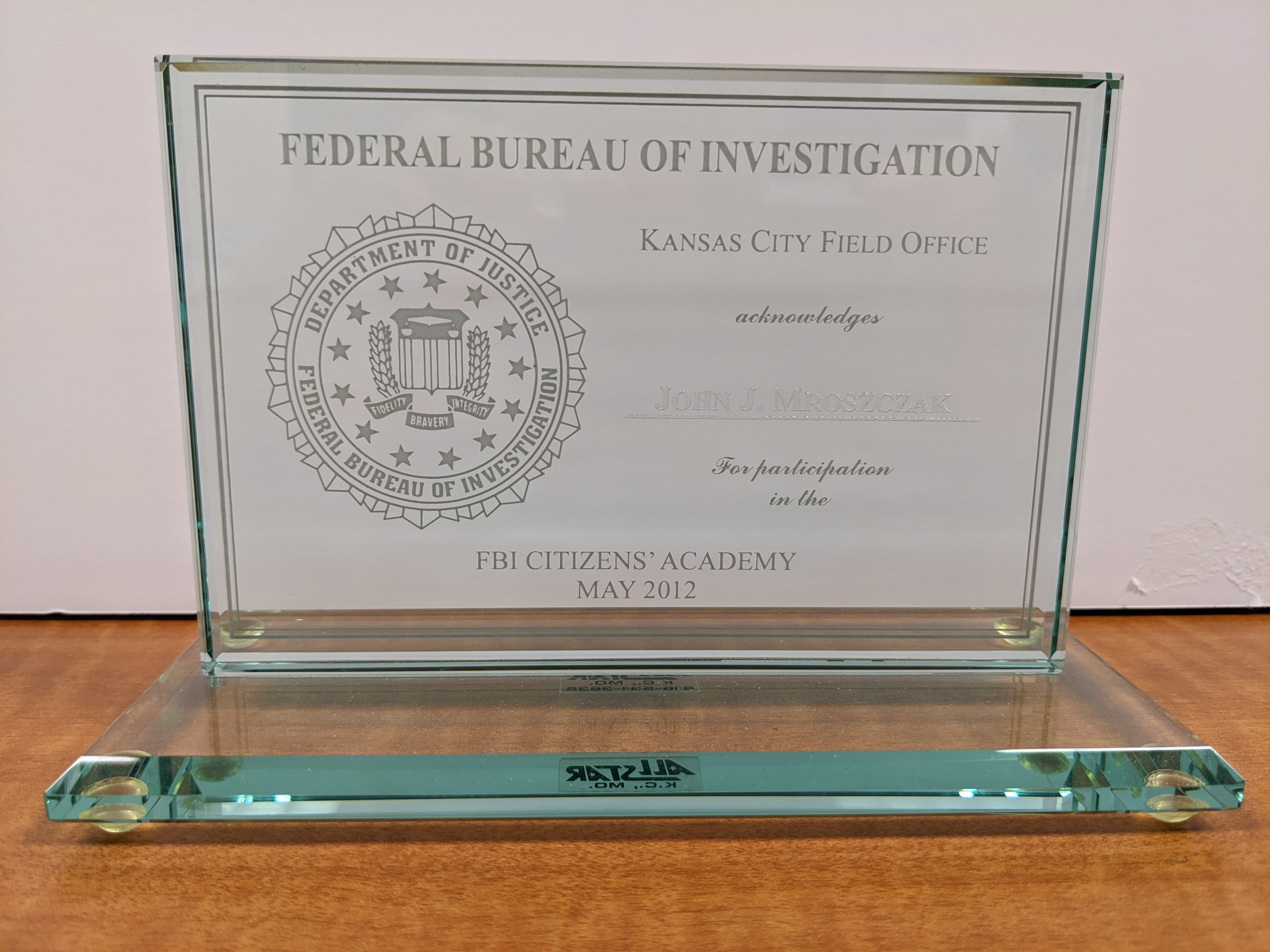
Years later, that calling found him again when his friends nominated the retired Army veteran to attend a Citizens Academy at the FBI Kansas City Field Office. Jay might’ve hung up his uniform by the time he was nominated to attend the FBI Kansas City Citizens Academy, but he was by no means finished giving back to his country and community.

Jay recalled being astounded by the professionalism of the FBI personnel who addressed him and his classmates each week.

“They were personable,” he said. “They never acted like we were an imposition on their time when questions were asked and they had to stay late.”

He especially loved the academy’s range day, when participants meet FBI firearms instructors and SWAT team members. “It very much reminded me of the people I worked with in the military,” Jay said.

Jay Mroszczak’s Citizens Academy participation award

His experience with the course was so positive that it inspired him to join the FBI Kansas City Citizens Academy Alumni Association. This group is a local chapter of the FBI National Citizens Academy Alumni Association, an independent nonprofit that partners with the FBI on its outreach efforts.

“The alumni chapters work hand-in-hand with the field offices, and they participate in initiatives and events,” said Tracey Ballinger, a management and program analyst with the FBI’s Community Relations Unit, which oversees the Bureau’s Citizens Academy program. “And at the end of the day, they want to help further the mission of the FBI.”

Jay went on to become an officer with the Kansas City chapter before joining the National Citizens Academy Alumni Association’s board of directors. Then, “the opportunity came to go back to work for the federal government again, and I was putting in several applications to the FBI,” he said. He was soon invited to interview for a community outreach specialist position in Chicago.

The opportunity would capitalize on his passion for working with people—and seemed like fun, he said. His experience with the Citizens Academy program and its alumni network and his familiarity with the outreach specialist job also informed his decision to take the job.

“I just felt like I had a very good working knowledge of what I was getting into,” he said.

To his day, he said, he works to emulate the example of the community outreach specialist who steered his own Citizens Academy experience. “She was just a benchmark of what an outreach specialist should be,” Jay said, noting that he works to bring that same energy and hunger for learning when he works on programming for FBI Chicago.

FBI Increases Ten Most Wanted Fugitives Reward

Source: US FBI

In May 2023, Donald Eugene Fields II became the 531st addition to the list. Fields is wanted for the alleged sex trafficking of at least one child in Missouri between approximately 2013 and 2017. 

“There is no question that the growing threat of violent crime concerns both law enforcement and communities all over the country,” said Quesada. “The reward offers of up to $250,000 is a significant increase, representing the FBI’s commitment to getting these disruptive criminals off the street.” 

In addition to traditional media outlets—such as newspapers, magazines, television, and radio—the FBI uses digital and electronic technology to share information on the current Ten Most Wanted Fugitives. Their faces are on digital billboards across the United States, as well as on the FBI’s website and social media accounts. Smartphone users can download a free app, FBI Wanted, to have the latest information at their fingertips.   

If you have information to share about a Ten Most Wanted Fugitive, call 1-800-CALL-FBI, submit a tip online at tips.fbi.gov, or contact your local FBI office. If you are outside of the United States, you can contact the nearest American Embassy or Consulate.

Donald Eugene Fields II Added to FBI’s Ten Most Wanted Fugitives List

Source: US FBI

The FBI announced the addition of Donald Eugene Fields II to its Ten Most Wanted Fugitives list on May 25, 2023.

Fields is wanted for the alleged sex trafficking of at least one child in Missouri between approximately 2013 and 2017. A federal arrest warrant was issued for Fields on December 8, 2022, in the U.S. District Court for the Eastern District of Missouri after he was charged with sex trafficking of children.

According to a special agent in the FBI’s St. Louis Division, “Fields has allegedly demonstrated a pattern of abusing minor females in his circle that are entrusted to his care, manipulating them to earn their trust quickly and using their own resources to take advantage of them.”

The FBI is offering a reward of up to $250,000 for information leading to Fields’ arrest. This amount reflects the FBI’s decision in May 2023 to increase the reward from up to $100,000 to up to $250,000 to aid in capturing individuals on the the Ten Most Wanted Fugitives list.

National Missing Children’s Day 2023

Source: US FBI

Karla (Karlita) Carolina Rodriguez had just turned 7 years old when she disappeared on October 20, 1999, in Las Vegas, Nevada. Karla was missing from school that day and was last seen in the evening by a friend in her neighborhood. Unfortunately, she has never returned home.

Karla is one of dozens of missing children the FBI is working to bring home. Every year on National Missing Children’s Day, we reaffirm our commitment to investigating these cases and finding children who have been reported kidnapped or missing, and we continue to encourage parents, caregivers, and others to make child safety a priority.

“We as law enforcement never forget these children and never stop looking for them until we find out what happened to them and bring those responsible for doing any harm to them to justice,” said Todd Tumbleson, a criminal investigator at the Nevada Attorney General’s Office and an FBI Task Force officer on the FBI’s Child Exploitation Task Force who has been investigating Karla’s case. “They and their families deserve nothing less than this.”

The FBI’s Kidnappings and Missing Persons list includes entries for Karla and other missing children. Please take a moment to review the list—and if you recognize anyone or have any information in a case, contact the FBI or local law enforcement or submit a tip online. No detail is too small.

“The public often knows something they think is not important but which we in law enforcement find very important,” said Tumbleson. “Sometimes when people hear about the case, it brings back memories of things a suspect said or things the witness saw that might help to locate a child. Any information the public has should be shared with those investigating the case.”

Elder Fraud Task Force Targets Grandparent Scams

Source: US FBI

In spring 2022, two members of the enterprise that targeted Sandra pleaded guilty in federal court for their roles in swindling about $2 million from more than 70 victims across the country, including 10 in San Diego County who lost over $300,000. According to court documents, one subject ran a network of individuals who conducted cash pick-ups and received wire transfers from victims who believed they were sending money to help a grandchild or other close relative or friend. Six co-conspirators have also pleaded guilty. The pair were sentenced last August to two and nine years, respectively, in prison.

Special Agent Murray said the conspiracy followed a well-trod model for scammers targeting older Americans, particularly grandparents.

“The general theme is ‘I’m in jail. I need to get out. Can you send money for bail or bond? And here’s my attorney.’ Then someone gets on the phone and figuratively puts their arm around the grandparents,” Murray said. “They say this is all going to be OK. And they really try and focus on restricting the grandparent from saying anything to anybody else.”

That’s what happened to Sandra.

“The people are very, very polished about what they do, and it seems like they are telling the truth,” Sandra said. “They don’t give you a whole lot of information, just enough to get you pulled in. And once you feel confident about talking with them, then on and on they go until the money goes up.”

Members of the task force said awareness is the key to stopping this burgeoning crime. Older people—and their families and caregivers—need to understand that even the most savvy senior is not immune to the charms of some of these scams, which are unusually persistent and persuasive.

“The first thing we urge folks to do is slow down and not react,” said Stacey Moy, special agent in charge of FBI San Diego. “It’s important to remain calm. And don’t immediately pay, because once those funds go, there may be no way to recover them.”

Joint Statement from FBI and CISA on the People’s Republic of China Targeting of Commercial Telecommunications Infrastructure

Source: US FBI

The U.S. government’s continued investigation into the People’s Republic of China (PRC) targeting of commercial telecommunications infrastructure has revealed a broad and significant cyber espionage campaign.

Specifically, we have identified that PRC-affiliated actors have compromised networks at multiple telecommunications companies to enable the theft of customer call records data, the compromise of private communications of a limited number of individuals who are primarily involved in government or political activity, and the copying of certain information that was subject to U.S. law enforcement requests pursuant to court orders. We expect our understanding of these compromises to grow as the investigation continues. 

The FBI and the Cybersecurity and Infrastructure Security Agency (CISA) continue to render technical assistance, rapidly share information to assist other potential victims, and work to strengthen cyber defenses across the commercial communications sector. We encourage any organization that believes it might be a victim to engage its local FBI field office or CISA.

Former Air National Guardsman Sentenced to 15 Years in Prison for Unlawfully Disclosing Classified National Defense Information

Source: US FBI

A former member of the U.S. Air National Guard (USANG), Jack Douglas Teixeira, 22, of North Dighton, Massachusetts, was sentenced today in federal court in Boston for retaining and transmitting hundreds of pages of classified National Defense Information (NDI), including many documents designated top secret, on an online social media platform in 2022 and 2023. Teixeira, was sentenced to 15 years in prison to be followed by three years of supervised release. Teixeira was also barred from having contact with foreign agents.

In March, Teixeira pleaded guilty to six counts of willful retention and transmission of classified information relating to the national defense. Teixeira was arrested in April 2023 and charged by criminal complaint with retention and transmission of NDI and unauthorized removal and retention of classified documents or materials. He was subsequently indicted by a federal grand jury in Boston in June 2023. He has remained in federal custody since his arrest.

“Jack Teixeira repeatedly shared classified national defense information on a social media platform in an attempt to impress anonymous friends on the internet – instead, it has landed him a 15 year sentence in federal prison,” said Attorney General Merrick B. Garland. “Teixeira’s profound breach of trust endangered our country’s national security and that of our allies. This sentence demonstrates the seriousness of the obligation to protect our country’s secrets and the safety of the American people.”

“This sentencing is a stark warning to all those entrusted with protecting national defense information: betray that trust, and you will be held accountable,” said FBI Director Christopher Wray. “Jack Teixeira’s criminal conduct placed our nation, our troops, and our allies at great risk. The FBI will continue to work diligently with our partners to protect classified information and ensure that those who turn their backs on their country face justice.”

“Mr. Teixeira is responsible for engaging in one of the most significant leaks of classified documents and information in United States history, which resulted in exceptionally grave and long-lasting damage to the national security of the United States,” said Acting U.S. Attorney Joshua S. Levy for the District of Massachusetts. “He exploited his Top-Secret security clearance to share critical defense information online. In doing so, he exposed sensitive defense information involving our allies, putting our intelligence community and our troops at risk. It is vital that our classified information remains just that – classified. Leaking and distributing this kind of information poses significant and real consequences across the globe. This is disturbing conduct that will not go unnoticed and unchecked.”

Teixeira enlisted in the USANG in September 2019. Until his arrest in 2023, he served with the 102nd Intelligence Wing at Otis USANG Base in Massachusetts as a Cyber Defense Operations Journeyman. Teixeira’s primary responsibility was maintaining and troubleshooting the classified workstations of other members of the 102nd Intelligence Wing. In order to perform his job, Teixeira was granted a Top-Secret//Sensitive Compartmented Information security clearance in 2021. Beginning in or around January 2022, Teixeira unlawfully retained and transmitted NDI classified as “TOP SECRET” or “SECRET” and/or Sensitive Compartmented Information (SCI), onto the social media platform Discord to persons not authorized to receive such information.

Teixeira used a secure workstation at the Otis USANG Base to conduct hundreds of searches for classified documents containing NDI that were unrelated to his duties. On two separate occasions, Teixeira’s superiors warned him not to take notes on classified intelligence information and to stop conducting “deep dives” into classified intelligence information. Despite these warnings and his considerable training, Teixeira purposefully and repeatedly removed classified information and documents containing NDI without authorization from the secure facility where he worked. Teixeira subsequently transmitted the information by typing it into an online social media platform, where it was further transmitted by other users. Teixeira also posted images of hundreds of classified documents to a social media platform, nearly all of which bore standard classification markings – including “SECRET,” “TOP SECRET” and SCI designations – indicating that they contained highly classified U.S. government information. The documents and information illegally disseminated by Teixeira discussed a range of topics including descriptions of the Russia-Ukraine conflict and troop movements on a particular date. The information he retained and disseminated was derived from sensitive U.S. intelligence, gathered through classified sources and methods.

Shortly before his arrest in April 2022, Teixeira took steps to conceal his disclosures by destroying and disposing of his electronic devices, deleting his online accounts, and encouraging his online acquaintances to do the same.

The FBI Washington and Boston Field Offices investigated the case. Valuable assistance was provided by the Naval Criminal Investigative Service, Air Force Office of Special Investigations, and the U.S. Attorney’s Office for the Eastern District of Virginia.

Assistant U.S. Attorneys Nadine Pellegrini, Jared C. Dolan, and Jason A. Casey for the District of Massachusetts and Trial Attorney Christina A. Clark of the National Security Division’s Counterintelligence and Export Control Section prosecuted the case.