Defense News in Brief: USNS Comfort Departs Dominican Republic After Fourth CP25 Mission Stop

Source: United States Navy

PUERTO PLATA, Dominican Republic – The Mercy-class hospital ship USNS Comfort (T-AH 20) departed from Puerto Plata, Dominican Republic, July 21, 2025, after a four-day mission stop during Continuing Promise 2025 (CP25).
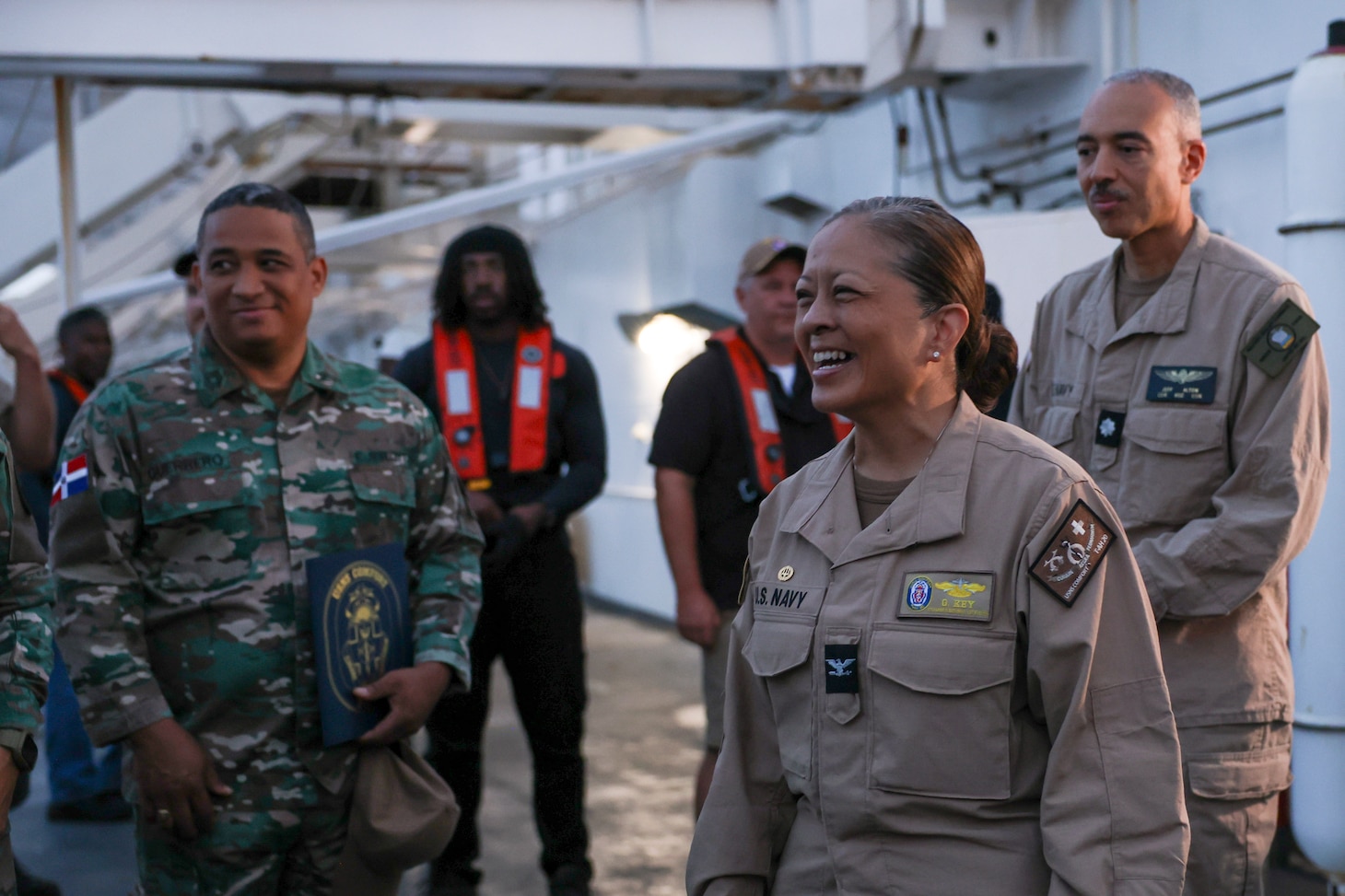
PUERTO PLATA, Dominican Republic (July 20, 2025) Capt. Grace Key, commanding officer, USNS Comfort Medical Treatment Facility, says goodbye to the Dominican Republic medical team as they depart the Mercy-class hospital ship USNS Comfort (T-AH 20) off the coast of Puerto Plata, Dominican Republic during Continuing Promise 2025, July 20, 2025. Continuing Promise 2025 is the 16th iteration of the U.S. 4th Fleet/U.S. Naval Forces Southern Command-led mission since 2007, which aims to foster goodwill, strengthen existing partnerships with partner nations, and form new partnerships between host nations, non-federal entities, and international organizations. (U.S. Navy photo by Mass Communication Specialist 2nd Class Rylin Paul)


At the Dominican mission stop, Comfort’s team provided medical and dental care, veterinary subject matter exchanges, medical subject matter exchanges, a humanitarian aid and disaster response workshop, band performances, and a beach clean-up event. During CP25, a Dominican military medical team embarked with Comfort, where they worked side-by-side with the ship’s crew to provide care to patients at each site visit of the mission.

“The collaboration we experienced here exemplifies what’s possible when partners come together with a shared commitment to service,” said Capt. Grace Key, commanding officer, USNS Comfort Medical Treatment Facility. “It’s through teamwork like this that we achieve a lasting impact.”

U.S. and Dominican providers together encountered 1,588 patient at the Puerto Plata medical site. Comfort’s medical and dental teams completed 248 dental cleaning and fillings, filled 1,158 pharmaceutical prescriptions, and distributed 160 assistive devices to Dominican patients. Additionally, 24 surgeries were performed aboard Comfort. A standout moment came from one of Comfort’s hospital corpsmen who, as a child, received dental treatment at a medical site in the Dominican Republic during a Continuing Promise mission stop in 2007. Hospitalman Flor Jones Garcia, assigned to Comfort, had a tooth extracted in the Dominican Republic by the Continuing Promise medical team when she was seven years old.

“It was awesome being back here,” said Jones Garcia, “I was able to see my mother and this was the first time she saw me in uniform, so I was pretty excited. It is absolutely astounding for me to be on the other side and provide medical care. It means everything to me and I know it does to the people of Puerto Plata as well.”

The mission stop also featured the U.S. Fleet Forces Band, “Uncharted Waters,” who had the opportunity to play alongside Dominican Republic ‘Oleaje’ band and Fuerza Aérea de República Dominicana band for Dominican citizens. They performed four concerts at Central Park of Puerto Plata, Dominican Republic with a total audience of 645 people.

“It’s a great opportunity to not only share cultural aspects in terms of dance and music, but it is also to highlight the work the other lines of effort are doing for the Dominicans,” said Ens. Chris McGann, assistant director of the U.S. Fleet Forces Band.

U.S. Army veterinarians from the 248th Medical Detachment Veterinary Service Support also hosted subject matter expert exchanges while in the Dominican Republic. They trained 187 members of the Fuerza Aérea de República Dominicana in K-9 tactical combat casualty care, as well as Dominican dairy farmers on proper cattle care and sanitization techniques. Furthermore, Comfort Sailors taught a tactical combat casualty care course to Armed Forces of the Dominican Republic members and Comfort’s preventive medicine team took part in a two-day health fair hosted by the Dominican Republic’s Ministry of Public Health.

Field training exercises and a beach clean-up were also conducted in Puerto Plata. The combined efforts for the beach clean-up resulted in the 366 hours of work and the removal of 3,152 pounds of trash from the local beaches. Humanitarian Assistance and Disaster Relief (HA/DR) held Search and Rescue (SAR) field training exercises with 160 Dominican participants, including federal firefighters and paramedics.

Following the mission stop in Dominican Republic, Comfort is scheduled to arrive in Limon, Costa Rica for CP25’s fifth mission stop.

CP25 marks the 16th mission to the region since 2007 and the eighth aboard USNS Comfort. The mission will foster goodwill, strengthen existing partnerships with partner nations, and encourage the establishment of new partnerships among countries, non-federal entities, and international organizations.

U.S. Naval Forces Southern Command/U.S. 4th Fleet supports U.S. Southern Command’s joint and combined military operations by employing maritime forces in cooperative maritime security operations to maintain access, enhance interoperability, and build enduring partnerships in order to enhance regional security and promote peace, stability and prosperity in the Caribbean, Central and South American region.

Learn more about USNAVSOUTH/4th Fleet news and photos, visit facebook.com/NAVSOUS4THFLT, https://www.fourthfleet.navy.mil/, X – @ NAVSOUS4THFLT, and https://www.linkedin.com/company/u-s-naval-forces-southern-command-u-s-4th-fleet
Justice Department Announces Formation of Strike Force to Assess Evidence Publicized by ODNI

Source: United States Department of Justice Criminal Division

WASHINGTON – Today, the Department of Justice announced the formation of a Strike Force to assess the evidence publicized by Director of National Intelligence Tulsi Gabbard and investigate potential next legal steps which might stem from DNI Gabbard’s disclosures.

This Department takes alleged weaponization of the intelligence community with the utmost seriousness.

Upon the formation of the Strike Force, Attorney General Pamela Bondi stated:

“The Department of Justice is proud to work with my friend Director Gabbard and we are grateful for her partnership in delivering accountability for the American people. We will investigate these troubling disclosures fully and leave no stone unturned to deliver justice.”

Florida Man Sentenced for Decades-Long Scheme to Defraud the IRS

Source: United States Department of Justice Criminal Division

A Miami man was sentenced today to 60 months in prison for conspiring to defraud the United States by concealing millions of dollars in assets and income in undisclosed Swiss bank accounts and claiming to the IRS that those assets were not his and instead belonged to foreign nationals.

The following is according to court documents and statements made in court: between 1985 and 2020, Dan Rotta, a dual Brazilian and U.S. citizen, hid more than $20 million in assets in dozens of secret Swiss accounts at five different Swiss banks, including UBS, Credit Suisse, Bank Bonhôte, and Bank Julius Baer. The accounts were held in his own name, in the names of sham structures, and, in one instance, a pseudonym. Over the years, Rotta earned tens of millions of dollars of income from these assets that he did not report on his tax returns and used to fund his lavish lifestyle. He caused a substantial tax loss to the IRS.

Rotta employed increasingly elaborate schemes to keep his accounts hidden. Over the years, he kept his accounts open, in part, by falsely representing that he was not a U.S. citizen, leveraging his Brazilian citizenship to claim he was a Brazilian citizen residing in Brazil.

Starting in 2008, after it was reported publicly that UBS and its bankers were under criminal investigation for helping U.S. taxpayers evade their taxes, Rotta closed his UBS account and moved his funds to Credit Suisse and Bank Bonhôte.

In 2011, after the IRS obtained records related to one of Rotta’s Swiss accounts, he nominally changed the documentation of his accounts at Credit Suisse and Bank Bonhôte to make it appear that his co-conspirator, a Brazilian national and resident, owned the assets in the accounts. Despite the change, Rotta continued to control the assets and transferred millions of dollars out of those accounts for his use.

Shortly after Rotta changed the account documentation, the IRS  audited him. During the audit, Rotta falsely denied that he owned the assets in the foreign financial accounts and, instead, claimed that the millions of dollars he withdrew from the accounts were non-taxable loans from foreign nationals. Rotta provided the IRS with fake promissory notes and false affidavits from the foreign nationals to corroborate his claims. During the audit, Rotta continued to use the funds in his foreign accounts to fund his lifestyle in the United States, but to conceal his use of the funds from the IRS, he often routed transfers from his foreign accounts through nominee accounts and attorney trust fund accounts in the United States.

The IRS did not believe Rotta’s story and assessed millions of dollars of additional taxes as well as penalties and interest against him. Rotta sought to reverse the assessments by filing a false petition in U.S. Tax Court. In that petition, Rotta, through his attorney, falsely denied having any foreign accounts and attached fictitious loan documents. Furthermore, the nominee account owners traveled to the United States to retell the false loan story to IRS attorneys.

In 2017, after Rotta presented the false evidence that the purported loans had been repaid, the IRS reversed the deficiencies and agreed that he owed no additional tax. Unbeknownst to the IRS, however, the “loan repayments” were fake: the funds that Rotta purportedly repaid went back into accounts that he controlled shortly after the IRS dismissed the suit. Also, as part of the conspiracy, Rotta had his U.S.-based attorneys create sham trust structures that he used to transfer his assets to the United States without alerting the IRS. On paper, it appeared that Rotta’s co-conspirator funded the trusts for Rotta’s benefit. In reality, Rotta funded the trusts with transfers from his Swiss accounts.

In 2019, Rotta became aware that the IRS would receive additional account records from Switzerland that contradicted the false claims that he had previously made. In an attempt to avoid criminal liability, Rotta applied to participate in the IRS’s voluntary disclosure practice. Under that practice, taxpayers who failed to comply with their tax and reporting obligations could make timely, accurate, and complete disclosures of their conduct, which might offer a path to resolve their non-compliance and limit their criminal exposure. Rotta made false statements in his submission, including falsely claiming that the assets in the Swiss accounts mostly belonged to others, and that any funds provided to him were non-taxable gifts. Rotta also falsely claimed that the nominee account owner gifted Rotta money because that nominee had no children to benefit from the funds. In fact, that nominee had two children.

In addition to his prison sentence, U.S. District Judge Rodney Smith for the Southern District of Florida ordered Rotta to serve three years of supervised release. The court will determine restitution at a later date.

Acting Deputy Assistant Attorney General Karen E. Kelly of the Justice Department’s Tax Division, U.S. Attorney Hayden O’Byrne for the Southern District of Florida, and Executive Special Agent in Charge Kareem Carter of IRS Criminal Investigation (IRS-CI) Washington, D.C. Field Office made the announcement.

Special Agents from IRS-CI’s International Tax & Financial Crimes specialty group, a team based out of Washington, D.C., and dedicated to uncovering international tax crimes, investigated the case.

Senior Litigation Counsels Sean Beaty and Mark Daly, Trial Attorney William Montague, and former Trial Attorney Patrick Elwell of the Tax Division, as well as Senior Litigation Counsel Christopher J. Clark for the Southern District of Florida, prosecuted the case.

Colorado Man Pleads Guilty to Sexually Exploiting a Minor and Possessing Child Sexual Abuse Material

Source: United States Department of Justice Criminal Division

A Colorado man pleaded guilty today to sexually exploiting a minor and possessing child sexual abuse material (CSAM).

According to court documents, Wesley Chambers, 34, of Fort Collins, sexually abused a minor for years and recorded the abuse. Law enforcement found more than 200 sexually explicit videos and photographs of the minor on Chambers’ cell phone, and more than 20,000 photographs and 2,500 videos of the sexual abuse and exploitation of other minors.

Chambers pleaded guilty to two counts of sexually exploiting a child and one count of possessing material depicting the sexual exploitation of minors. As part of his plea agreement, the defendant also admitted to accessing child pornography on the dark web, including “hurtcore” sites. He is scheduled to be sentenced on Oct. 22 and faces a mandatory minimum penalty of 15 years in prison and a maximum penalty of 70 years in prison. A federal district court judge will determine any sentence after considering the U.S. Sentencing Guidelines and other statutory factors.

Acting Assistant Attorney General Matthew R. Galeotti of the Justice Department’s Criminal Division, U.S. Attorney Peter McNeilly for the District of Colorado, Assistant Director Jose A. Perez of the FBI Criminal Investigative Division, and Special Agent in Charge Mark Michalek of the FBI Denver Field Office made the announcement.

The FBI’s Child Exploitation Operational Unit and the FBI Denver Field Office investigated the case.

Trial Attorney Rachel L. Rothberg of the Justice Department’s Child Exploitation and Obscenity Section (CEOS) and Assistant U.S. Attorney Alecia L. Riewerts for the District of Colorado are prosecuting the case.

This case was brought as part of Project Safe Childhood, a nationwide initiative launched by the Department of Justice in May 2006 to combat the epidemic of child sexual exploitation and abuse. Led by U.S. Attorneys’ Offices and CEOS, Project Safe Childhood marshals federal, state, and local resources to better locate, apprehend, and prosecute individuals who exploit children via the internet, as well as to identify and rescue victims. For more information about Project Safe Childhood, visit www.justice.gov/psc.

Defense News in Brief: Holloman AFB medics enhance fitness and expeditionary capabilities in Medic-X exercise

Source: United States Airforce

The medics of the 49th Medical Group added a new layer of depth to their monthly training day by incorporating field tactics and wartime medical practice in a Medic-X exercise on July 16, 2025.

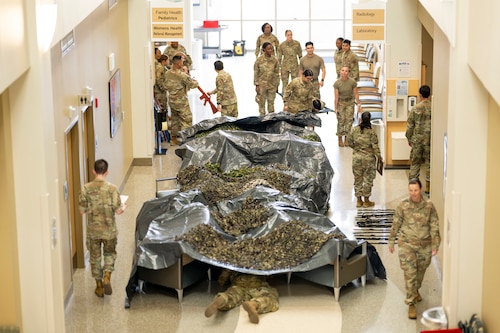
The training consisted of 16 stations and substations that ranged from spinal immobilization to infection control to post-mortem protocol, all scenarios that are critically important for a medic to know but unlikely to experience in a clinical setting such as the clinic at Holloman Air Force Base.

“Gone are the days when a medic would only be expected to perform duties within their specific specialty – our medics need to be versatile and better equipped to provide speedy and effective support to the warfighter,” said U.S. Air Force Chief Master Sgt. Jason Estrada, 49th MDG senior enlisted leader. “That versatile mindset is what our medical group education and training team has used to shape our Medic-X and other hands-on training.”

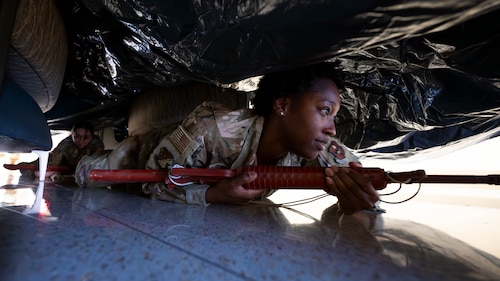
U.S. Air Force Airman 1st Class Da’Ja Thomas, 49th Healthcare Operations Squadron mental technician, low-crawls through an obstacle course during a Medic-X exercise at Holloman Air Force Base, New Mexico, July 16, 2025.
U.S. Air Force Airman 1st Class Da’Ja Thomas, 49th Healthcare Operations Squadron mental technician, low-crawls through an obstacle course during a Medic-X exercise at Holloman Air Force Base, N.M., July 16, 2025. This iteration of Medic-X integrated field exercises for medics who typically perform clinical and administrative duties, allowing them to sharpen their tactical skills while supporting lethal warfighters downrange. (U.S. Air Force photo by Tech. Sgt. Victor J. Caputo)

The Air Force is one of the most lethal parts of the Department of Defense, and the flipside of lethality is the medical skill needed to keep the warfighters in the fight downrange. This more hands-on approach to training was brought about after an education and training member went through the intense two-week Tactical Combat Casualty Care Tier 3 course and realized how important it would be to bring lessons learned to the entire medical group.

“We’re focusing on operating in an austere environment where it’s not going to be calm, it’s not going to be like day-to-day clinic operations,” said U.S. Air Force Capt. Natasha Lindbloom, 49th MDG education and training flight commander. “You could tell somebody to recite the alphabet, but if it’s stressful, they’re going to mess it up. We want our people to be able to do this until they can perform these simple tasks under pressure.”

Although we cannot mirror a battlefield environment, we can put our medics in situations where critical thinking and a sense of urgency fuels their training to ‘kick in.’Chief Master Sgt. Jason Estrada, 49th MDG senior enlisted leader

Coupled with the chance to exercise underutilized but combat-effective skills, the exercise served to underscore the importance of medics who are fit to fight and capable of doing what’s needed when it’s needed in a stressful and possibly deadly environment. A low-crawl obstacle course was put together using furniture and gear inside the clinic, streamlining the flow of training and simulating a more realistic urban environment.

Airmen from the 49th Medical Group rotate between stations during a Medic-X exercise at Holloman Air Force Base, New Mexico, July 16, 2025.
Airmen from the 49th Medical Group rotate between stations during a Medic-X exercise at Holloman Air Force Base, N.M., July 16, 2025. This exercise allowed every member of the medical group to sharpen field skills they are not able to practice every day while providing critical clinical support to Team Holloman. (U.S. Air Force photo by Tech. Sgt. Victor J. Caputo)

“Although we cannot mirror a battlefield environment, we can put our medics in situations where critical thinking and a sense of urgency fuels their training to ‘kick in,’” Estrada said. “Since so few of our current medics possess the real-world experience, it’s our training team that brings these scenarios to life with realism and pressure-induced decision making, which results in the desired sets & reps our teams need to build muscle memory.

Constant Improvement

Medic-X training exercises are not a new concept for medical personnel; in fact, Medic-X was rolled out across the enterprise two years ago and has provided quarterly training objectives to all Defense Health Agency members. The ever-changing global environment and nature of future warfare were other driving factors in the 49th MDG collectively getting ahead of the curve and practicing these critical wartime skills on top of staying adept at their daily clinical duties.

“I’m hoping this gives people the mindset of ‘Hey, I know I’m in this job right now and I’m comfortable, but I’m not always going to be comfortable if we’re put in these situations in real life,’” said U.S. Air Force Senior Airman Claire Pruitt, 49th MDG education and training program manager.

All Airmen take TCCC Tier-1 training that covers the basics of what was formerly known as self-aid and buddy care, while all medics are required to take Tier-2 training to gain more expertise in the ability to treat wounds sustained in combat. Tier-3 training is optional but available for all medics and provides a realistic, grueling experience of austere field conditions and the physical limits that medics can be pushed to in wartime.

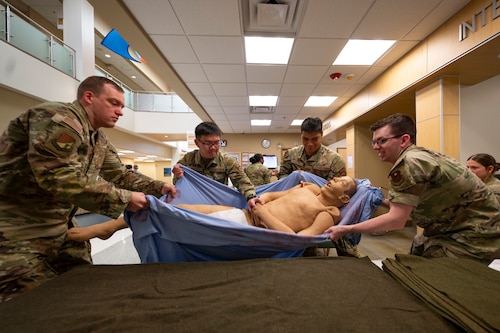
Airmen from the 49th Medical Group transfer a 200-pound training dummy from a gurney to an operating table during a Medic-X exercise at Holloman Air Force Base, New Mexico, July 16, 2025.
Airmen from the 49th Medical Group transfer a 200-pound training dummy from a gurney to an operating table during a Medic-X exercise at Holloman Air Force Base, N.M., July 16, 2025. This exercise allowed every member of the medical group to sharpen field skills they are not able to practice every day while providing critical clinical support to Team Holloman. (U.S. Air Force photo by Tech. Sgt. Victor J. Caputo)

“There’s going to be a bit of a shock factor for people working in a clinic, where even though we’re incredibly busy, a lot of it is just administrative work instead of intense, hands-on medical practice,” Pruitt said. “I’m trying to integrate some of the things that they did with us in a physical aspect at the Tier 3 training so that these Airmen have more experience and understand that if they have to do this in real life tomorrow, it’s not going to be easy. They’ll have to think about getting the patient out of the combat zone, treating their wounds, stopping the bleeding, loading them onto a helicopter, etc.”

The success of the first iteration of integrated field work with Medic-X has laid the groundwork for an ever-improving series of exercises to better prepare Team Holloman’s medics for unpredictable and challenging fights of future conflict.

“Today’s potential adversaries are better equipped and more prepared than any potential foe has ever been,” Estrada said. “For that reason, every uniform-wearing member of our military needs to understand that he/she is one bad day, one ill-guided decision, one perceived threatful action away from finding themselves, in support of our country, inside a combat environment where the old rules may not apply.”


Defense News in Brief: CNRC Launches “Top Doc” in Fort Lauderdale

Source: United States Navy

FORT LAUDERDALE, Fla. — Navy Recruiting Command launched its national initiative pilot program, “Top Doc,” showcasing Medical Corps capabilities and career paths at Nova Southeastern University’s Fort Lauderdale campus on Saturday, July 12.

“Top Doc,” is designed to draw in a wide variety of people in various stages of their medical career path. This includes medical students, residents, residency program leaders and staff, and attending physicians in any type of practice or specialty.

“The involvement of a scholarly team of professionals, enabled by Nova Southeastern University’s prestigious health sciences programs, is a cornerstone of our excitement for launching the ‘Top Doc,’ pilot in South Florida, where we’ve received unparalleled community support,” said Capt. Tara Mcginnis, medical officer programs officer, Navy Recruiting Command. “This event captivates Florida residents by showcasing Navy Medicine’s advanced emergency care techniques, directly relevant to the state’s veteran and active-duty communities. It offers local medical professionals and students the chance to explore rewarding careers in Navy Medicine, while residents take pride in the military-civilian partnerships fostered here.”

Mcginnis believes the “Top Doc” initiative prioritizes the Medical Corps by attracting top medical talent from medical schools, residencies, and direct accessions.

“The experience offers military medical trainees and staff the opportunity to collaborate with civilian healthcare programs, foster a mutual exchange of knowledge, innovation, and service,” said Navy Counselor (Recruiting) 1st Class Jason Catano, assigned to the Hometown Medical Recruiter pilot program with Medical Accessions, Navy Recruiting Command. “The whole intent with this is to bring that all to the table and also give an opportunity to have hands-on training with the different professionals that are here from different career fields.”

Navy Bureau of Medicine and Surgery (BUMED), the headquarters for Navy Medicine, was represented at “Top Doc,” by surgeons, an anesthesiologist, and a dermatologist. Tactical Combat Casualty Care (TCCC) instructors, Nurse Corps officers, and enlisted hospital corpsmen also lent their experience and expertise to the event.

Matthew Chenworth, senior director of military affairs for Nova Southeastern University and Marine Corps veteran, believes ensuring connecting the university’s students, faculty, and staff with the military is a top priority. Chenworth says NSU’s collaboration on “Top Doc,” and the long-standing relationship with NTAG Miami helps to achieve that goal.

“We’ve been coordinating a lot of scholarship opportunities specifically with our medical students who are looking to serve their country as a medical officer with the United States Navy upon their graduation,” said Chenworth. “We introduced [“Top Doc”] to our pre-medicine students, our nursing students, and to those who are currently within our health profession division that are going to be [Doctor of Osteopathic Medicine, Medical Doctors, and Physician Assistants]. We also extended the invite to our public safety office as well because those might be skills that our security officers here on campus may need.”

This joint effort brought in local medical professionals and community leaders, adding to the value of the event. Dr. Joshua Lenchus, former Florida Medical Association president, and Dr. Aeyal Oren, general surgeon in private practice, spent time working with simulation manikins and leading procedural demonstrations.

“It was a big role to step into, but I have prior experience doing simulation experience with my training down in Miami as well as dealing with the military because we ran trauma simulations there as well,” said Lenchus. “I think that the opportunities in the military are tremendous and there’s never enough gratitude that we can pay to the people who choose to put on the uniform and serve this country.”

Lenchus believes that while financial aid is extremely important, the leadership development gained through the military’s specialized training and coursework—often not available in the civilian sector—is equally vital.

Those in attendance gained insights from active-duty and reserve healthcare professionals working in the fleet.

Navy Medicine personnel presented specialized training capabilities on simulation tools, such as the TCCC Cut Suit, used to train medical personnel in treating battlefield traumas. Several presenters shared information sessions explaining the availability and requirements of medical officer programs and how they applied those programs in their careers.

Lt. Gahen Pendlebury, a full-time out-service medical officer and, emergency medicine resident, facilitated at the event.

“What I’ve realized through talking with civilian colleagues is that there are a lot of misconceptions [about military careers],” said Pendlebury. “Some people think that they’re too old, and they are no where near that. Some think that because they went to a Caribbean school, they can’t join as physicians. There are all sorts of entryways. These types of events really help not only expand Navy branding, but really help people understand that it’s not too late and that there are different pathways.”

Pendlebury believes there is a need for these kinds of events where interested people can obtain information about different career paths in Navy Medicine whether as active duty or reserve Sailors.

David Missel, a first-year optometry student at NSU and Navy medical officer applicant, said he attended “Top Doc,” to learn more about Navy Medicine and to celebrate his commitment to serve upon graduation.

“I decided to come here today because I’ve really had a passion for the Navy ever since I was a little kid,” said Missel. “I didn’t even know that I could be an optometrist in the Navy until very recently. Speaking to a recruiter and other people in the Navy, the more I learned about it the more I realize that this is such an amazing program and it’s a wonderful career opportunity. I’m just really looking forward to diving into this.”

Navy Medicine, represented by more than 44,000 highly trained military and civilian health care professionals, provides enduring expeditionary medical support to the warfighter any time, any place.

Missed the event but want to learn about Navy Medicine opportunities? Visit www.navy.com/navy-medicine or call 1-800-USA-NAVY for information.

NTAG Miami, has 38 recruiting locations throughout South Florida, Puerto Rico and the Virgin Islands, with the combined mission to recruit the highest caliber Sailors to meet the needs of the Fleet.

Navy Recruiting Command consists of a command headquarters, two Navy Recruiting Regions, Navy Recruiting Reserve Command, and 26 NTAGs that serve more than 970 recruiting stations around the world. Their mission is to attract the highest quality candidates to assure the ongoing success of America’s Navy.

Justice Department Supports Seattle’s Motion to Terminate Police Department Consent Decree

Source: United States Department of Justice Criminal Division

The Justice Department’s Civil Rights Division today announced that it has filed a response in support of the City of Seattle’s Motion to Terminate the Consent Decree in United States v. City of Seattle. The decree required reforms in the Seattle Police Department’s practices regarding use of force, crisis intervention, stops and detentions, supervision and accountability. With support from the Justice Department, the Seattle Police Department (SPD) achieved sustained substantial compliance.

The Justice Department brought this case pursuant to the Violent Crime Control and Law Enforcement Act of 1994 and the Omnibus Crime Control and Safe Streets Act of 1968. The U.S. Attorney’s Office’s Civil Division and the Special Litigation Section of the U.S. Department of Justice’s Civil Rights Division jointly investigated and found that the Seattle Police Department (SPD) had engaged in a pattern or practice of unnecessary or excessive force that violated the Constitution and federal law. The U.S. District Court for the Western District of Washington entered the consent decree in 2012.

“We congratulate the Seattle Police Department on its achievement of sustained substantial compliance with this thirteen-year-old consent decree,” said Assistant Attorney General Harmeet K. Dhillon of the Justice Department’s Civil Rights Division. “This Civil Rights Division will continue to work with police departments across the country to help make America’s communities safe again.”

“The U.S. Attorney’s Office, Western District of Washington, believes the district court should terminate the consent decree and monitorship, which have been in place for 13 years,” said Acting U.S. Attorney Teal Luthy Miller for the Western District of Washington. “Seattle has been held up as an example of successful police reform and has done recent work on its crowd control policies and accountability systems. We trust it will continue to lead the way on constitutional policing.”

New Jersey Construction Company Owner Sentenced for Tax Evasion

Source: United States Department of Justice Criminal Division

A New Jersey construction company owner was sentenced yesterday to 15 months in prison for evading employment tax penalties assessed against him.

The following is according to court documents and statements made in court: Joseph Caravella, of Randolph, owned several masonry companies in New Jersey. From 2008 to 2016, the IRS assessed approximately $650,000 in Trust Fund Recovery penalties against Caravella for causing three masonry businesses that he owned to not pay their federal employment taxes. The timely payment of federal employment taxes is critical to the functioning of the U.S. government because, for example, they are the primary source of funding for Social Security and Medicare. The federal income taxes that are withheld from employees’ wages also account for a significant portion of all federal income taxes collected each year. Congress empowered the IRS to impose a penalty equal to the amount of the unpaid taxes — called a Trust Fund Recovery Penalty — against any responsible individual who fails to ensure that these taxes are paid timely. Caravella pleaded guilty to attempting to evade these Trust Fund Recovery penalties.  

From around March 2008 through April 2019, Caravella sought to evade the payment of these penalties by placing companies that he controlled in the names of nominee owners and avoiding the use of a bank account in his own name to prevent the IRS from levying the funds. Also during that time, Caravella continued to cause his businesses not to pay employment taxes, resulting in an additional loss of $1.2 million to the IRS.

In total, Carvalla caused a tax loss to the IRS of $1,885,519.39.

Acting Deputy Assistant Attorney General Karen E. Kelly of the Justice Department’s Tax Division and U.S. Attorney Alina Habba for the District of New Jersey made the announcement.

IRS Criminal Investigation is investigating the case.

Trial Attorney Hayter L. Whitman of the Tax Division and Assistant U.S. Attorney Christopher Fell for the District of New Jersey are prosecuting the case.

Defense News in Brief: U.S.-Philippine Airmen strengthen ties during Cope Thunder 25-2

Source: United States Airforce

PACAF participated in Cope Thunder 25-2, a unique platform that integrates U.S. and Philippine Air Forces and enhances interoperability through bilateral fighter training, subject matter expert exchanges and key leadership engagements.

U.S. Pacific Air Forces and Philippine Air Force members participated in Cope Thunder 25-2, a bilateral training conducted across multiple locations in the Philippines. The exercise aimed to strengthen partnerships and support the Philippine Air Force’s modernization efforts, promoting regional and global stability.

Established in the Philippines in 1976, Cope Thunder provides a unique platform to integrate U.S. and Philippine Air Forces and enhance interoperability through bilateral fighter training, subject matter expert exchanges and key leadership engagements. Cope Thunder 25-2 also marked the first time a U.S. Air Force F-35A Lightning II squadron has deployed to the Philippines.

“It’s obvious that this isn’t a relationship that’s simply on paper,” said Lt. Col. Bryan Mussler, 421st Mission Generation Force Element commander. “We’ve been integrating with them for a long time, and their mentality and approach to operations is very similar to ours.”

Subject matter expert exchanges during the exercise enabled U.S. and Philippine Airmen in similar career fields to share best practices and effective techniques aimed at improving day-to-day operations for both forces. These exchanges included maintenance, firefighting, airfield operations, electromagnetic warfare and basic fighter manoeuvres with U.S. and Philippine pilots flying side by side.

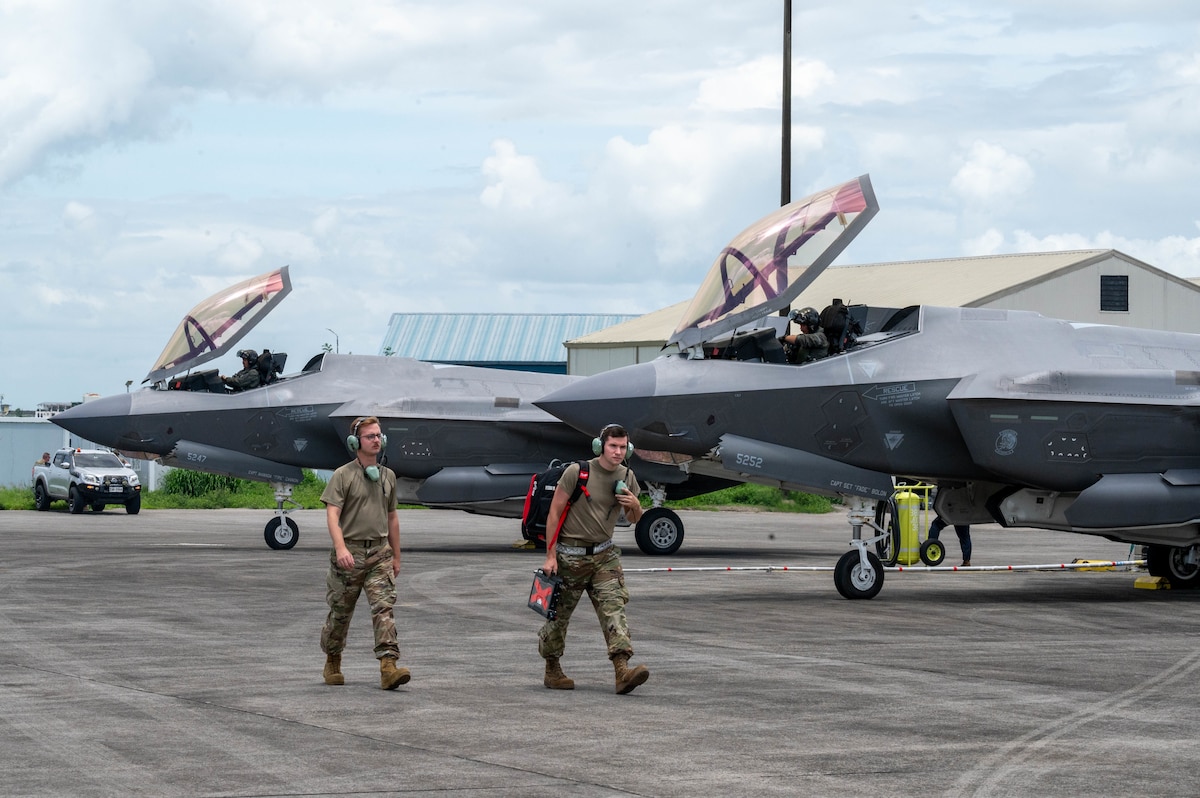
U.S. Air Force maintainers, assigned to the 421st Mission Generation Force Element, depart the flightline after conducting preflight operations on an F-35A Lightning II during Cope Thunder 25-2 at Clark Air Base, Philippines, July 7, 2025. The exercise enhances interoperability between the U.S. Air Force and the Philippine Air Force and supported the Armed Forces of the Philippines' modernization efforts. (U.S. Air Force photo by Airman 1st Class Aden Brown)
U.S. Air Force maintainers, assigned to the 421st Mission Generation Force Element, depart the flightline after conducting preflight operations on an F-35A Lightning II during Cope Thunder 25-2 at Clark Air Base, Philippines, July 7, 2025. The exercise enhances interoperability between the U.S. Air Force and the Philippine Air Force and supported the Armed Forces of the Philippines’ modernization efforts. (U.S. Air Force photo by Airman 1st Class Aden Brown)

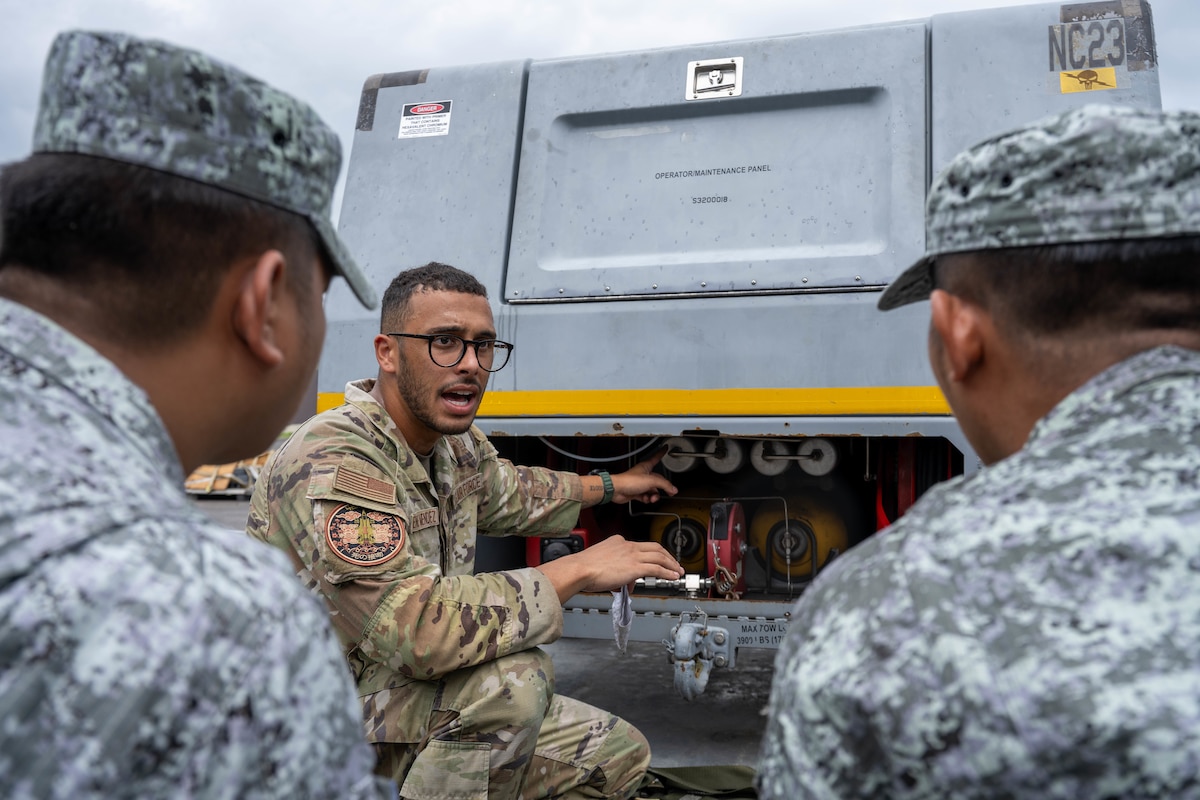
U.S. Air Force Staff Sgt. Arnaldo Puente Mendez, 421st Mission Generation Force Element aerospace ground equipment maintainer, briefs Philippine Air Force airmen on a self generating nitrogen servicing cart during Cope Thunder 25-2 at Clark Air Base, Philippines, July 9, 2025. During the subject matter expert exchange, U.S. Airmen provided valuable insight into equipment used for aircraft maintenance, supporting Armed Forces of the Philippines’ modernization efforts. (U.S. Air Force photo by Airman 1st Class Aden Brown)
U.S. Air Force Staff Sgt. Arnaldo Puente Mendez, 421st Mission Generation Force Element aerospace ground equipment maintainer, briefs Philippine Air Force airmen on a self-generating nitrogen servicing cart during Cope Thunder 25-2 at Clark Air Base, Philippines, July 9, 2025. During the subject matter expert exchange, U.S. Airmen provided valuable insight into equipment used for aircraft maintenance, supporting Armed Forces of the Philippines’ modernization efforts. (U.S. Air Force photo by Airman 1st Class Aden Brown)

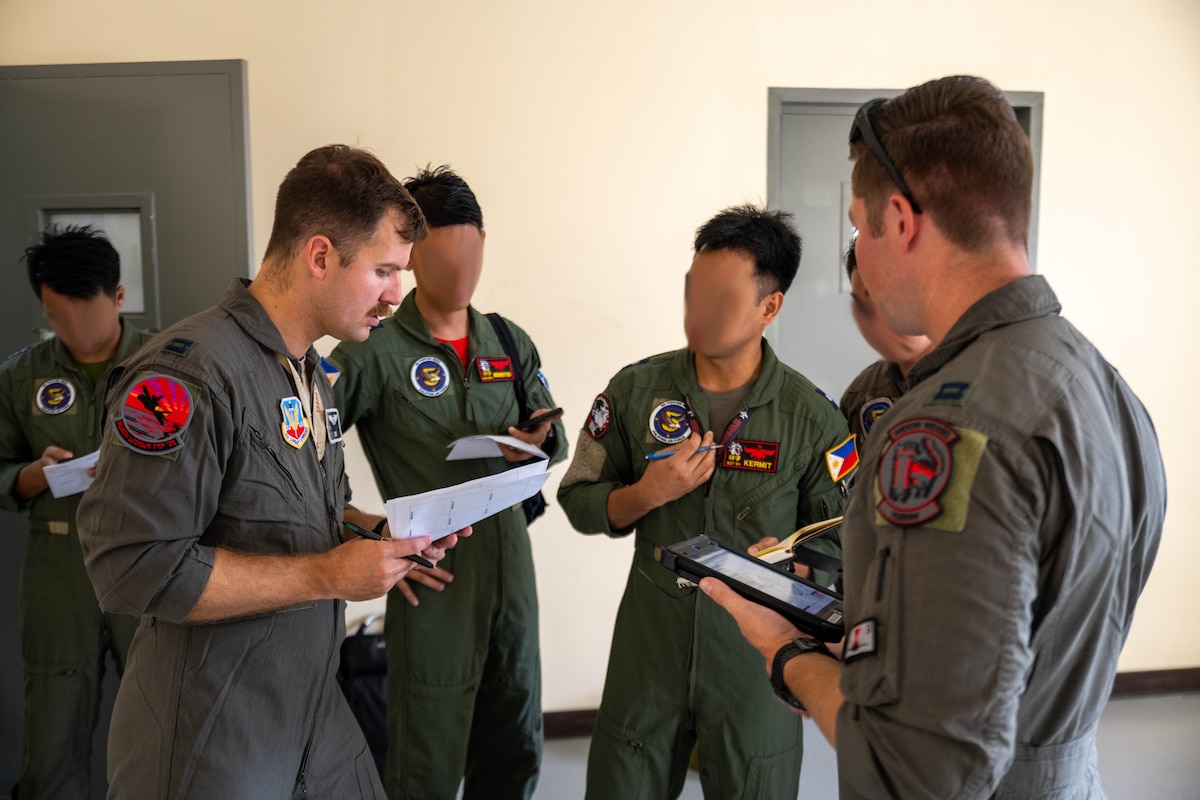
U.S. Air Force Capt. Tyler Rico (2nd left) and Capt. Toney Fisher (right), 421st Mission Generation Force Element F-35A pilots, coordinate flight plans with Philippine Air Force pilots during the Cope Thunder 25-2 exercise at Clark Air Base, Philippines, July 7, 2025. The training conducted between the U.S. and Philippine Air Force strengthens both the ability to respond together for potential future crises, contingencies and natural disasters. (U.S. Air Force photo by Airman 1st Class Aden Brown) (Image blurred for operational security)
U.S. Air Force Capt. Tyler Rico, second to the left, and Capt. Toney Fisher, right, 421st Mission Generation Force Element F-35A pilots, coordinate flight plans with Philippine Air Force pilots during the Cope Thunder 25-2 exercise at Clark Air Base, Philippines, July 7, 2025. The training conducted between the U.S. and Philippine Air Force strengthens both the ability to respond together for potential future crises, contingencies and natural disasters. (U.S. Air Force photo by Airman 1st Class Aden Brown) (Image blurred for operational security)

“We worked closely with the PAF pilots, and it was clear they are professional and highly capable aviators that employ their weapon systems with skill and precision,” said Capt. Tobey Fisher, 421st Mission Generation Force Element F-35A instructor pilot. “Additionally, this exercise afforded the 421st MGFE the opportunity to operate at a remote airfield with minimal support.”

The F-35A maintenance team supported Cope Thunder 25-2 with a lean, agile team, operating with roughly one-third of the personnel they typically have at their home station.

“It’s really cool to see such a small team come here and execute the mission,” said Maj. Clinton Bialcak, 421st Fighter Generation Squadron commander, referring to executing the F-35 maintenance mission. “I think everyone in the region, in the world and in the Department of Defense sees that we can do it and they can rely on us.”

The U.S. Air Force’s participation reflects ongoing efforts to strengthen coordination with regional allies and partners.


Defense News in Brief: Next-gen TOC-L systems announced to boost agile C2 capabilities

Source: United States Airforce

The DAF has announced the upgrade of the Tactical Operations Center-Light capability with its Major Release 2 prototype, designed to advance contributions to Combined Joint All-Domain Command and Control.

The Department of the Air Force recently announced the upgrade of the Tactical Operations Center-Light capability with its Major Release 2 prototype, July 22.

This rapid prototyping effort, developed with support from long-standing industry partners, will deliver more than 40 next-generation TOC-L systems designed to advance the DAF’s contribution to Combined Joint All-Domain Command and Control.

“This has been a major push from our team and industry partners to see the TOC-L MR2 prototype developed with all the lessons learned from MR1,” said Maj. Gen. Luke CropseyDAF’s Program Executive Officer for Command, Control, Communications and Battle Management. “This achievement truly embodies our agile acquisition approach, setting the stage for a phased deployment where we can rapidly field operationally relevant upgrades based on feedback from the field.”

U.S. Air Force photo by Staff Sgt. Noah Sudolcan
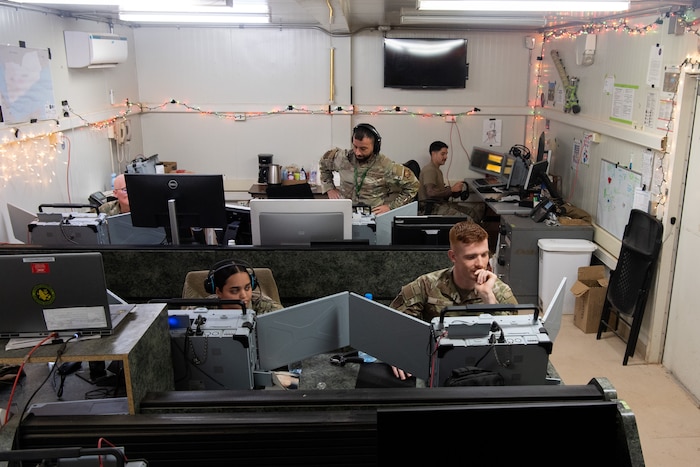
U.S. Air Force Airmen assigned to the 606th Air Control Squadron perform their daily tasks on the Tactical Operations Control – Light command and control system at Camp Lemonnier, Djibouti, Feb. 17, 2025. The 606th Air Control Squadron, callsign “Primo,” is a mobile command and control combat unit “Ready Now” to meet the nation’s call for exceptional tactical C2. (U.S. Air Force photo by Staff Sgt. Noah Sudolcan)

Managed by DAF PEO C3BM’s Advanced Battle Management System Division, the TOC-L integrates data from multiple sources to create a synchronized air picture. The MR2 prototype represents a crucial leap forward for the TOC-L. While 16 MR1 prototypes focused on minimizing the system’s physical footprint, MR2 also prioritizes enhanced integration capabilities.

“The MR2 aims to enhance portability, survivability, mobility and ease of use through reduced size, weight, power, while featuring improved usability and maintainability to reduce training time and improve operational readiness,” said Lt. Col. Micah Graber, ABMS Deployable Systems Branch materiel leader. “The system will also feature ABMS Digital Infrastructure and Cloud-Based Command and Control software capability for enhanced enterprise interoperability and expanded data access within the DAF BATTLE NETWORK.”  

This shift from maneuverability to integration leveraged insights gained from the MR1 prototype’s first operational deployment to Combined Joint Task Force-Horn of Africa, which provided real-world capability assessment. Along with data from prior experiments, recent participation in the U.S. Army’s Project Convergence Capstone 5 also played a vital role in directly informing MR2 requirements, focusing on the system’s integration with other key technologies.   

“The plan for the MR2 prototypes builds upon the lessons learned from the original 16,” said Stephen Ciulla, ABMS TOC-L program manager. “The potential use cases and operational possibilities have expanded over the last 18 months and MR2 development includes more rigorous testing and design validation to ensure that functional and operational requirements are met.”

The MR2 prototype will serve as the execution arm of the DAF BATTLE NETWORK by utilizing ABMS DI to communicate to various sensors and C2 systems, according to Ciulla. This bridges communication gaps between disparate systems, facilitating seamless cross-domain integration and interoperability. CBC2 functionality additionally employs advanced software and artificial intelligence to assist battle managers in prioritizing and executing actions, while advancing human-machine teaming.

“MR2’s integration advancements, enabled by ABMS DI and CBC2, will enable seamless information sharing and improved coordination among warfighters in contested environments, leading to a more cohesive and effective force,” Graber said. “This enhanced interoperability translates into tangible operational advancements by allowing for better-informed decisions and more decisive actions across all levels – tactical, operational and strategic.”

The TOC-L prototype is a critical component of the DAF BATTLE NETWORK, contributing to enhanced situational awareness and decision-making across the battlespace. The MR2 prototype underscores the Air Force’s commitment to delivering cutting-edge technology to the warfighter, ensuring decisive advantage in future conflicts.