Arizona Woman Sentenced for $17M Information Technology Worker Fraud Scheme that Generated Revenue for North Korea

Source: United States Department of Justice

An Arizona woman was sentenced today to 102 months in prison for her role in a fraudulent scheme that assisted North Korean Information Technology (IT) workers posing as U.S. citizens and residents with obtaining remote IT positions at more than 300 U.S. companies. The scheme generated more than $17 million in illicit revenue for Chapman and for the Democratic People’s Republic of Korea (DPRK or North Korea).

Christina Marie Chapman, 50, of Litchfield Park, Arizona, pleaded guilty on Feb. 11 in the District of Columbia to conspiracy to commit wire fraud, aggravated identity theft, and conspiracy to launder monetary instruments. In addition to the 102-month prison term, U.S. District Court Judge Randolph D. Moss ordered Chapman to serve three years of supervised release, to forfeit $284,555.92 that was to be paid to the North Koreans, and to pay a judgment of $176,850.

“Christina Chapman perpetrated a years’ long scheme that resulted in millions of dollars raised for the DPRK regime, exploited more than 300 American companies and government agencies, and stole dozens of identities of American citizens,” said Acting Assistant Attorney General Matthew R. Galeotti of the Justice Department’s Criminal Division. “Chapman made the wrong calculation: short term personal gains that inflict harm on our citizens and support a foreign adversary will have severe long term consequences.  I encourage companies to remain vigilant of these cyber threats, and warn individuals who may be tempted by similar schemes to take heed of today’s sentence.”

“North Korea is not just a threat to the homeland from afar. It is an enemy within. It is perpetrating fraud on American citizens, American companies, and American banks. It is a threat to Main Street in every sense of the word,” said U.S. Attorney Jeanine Ferris Pirro for the District of Columbia. “The call is coming from inside the house. If this happened to these big banks, to these Fortune 500, brand name, quintessential American companies, it can or is happening at your company. Corporations failing to verify virtual employees pose a security risk for all. You are the first line of defense against the North Korean threat.”

“The North Korean regime has generated millions of dollars for its nuclear weapons program by victimizing American citizens, businesses, and financial institutions,” said Assistant Director Rozhavsky of the FBI’s Counterintelligence Division. “However, even an adversary as sophisticated as the North Korean government can’t succeed without the assistance of willing U.S. citizens like Christina Chapman, who was sentenced today for her role in an elaborate scheme to defraud more than 300 American companies by helping North Korean IT workers gain virtual employment and launder the money they earned. Today’s sentencing demonstrates that the FBI will work tirelessly with our partners to defend the homeland and hold those accountable who aid our adversaries.”

“The sentencing today demonstrates the great lengths to which the North Korean government will go in its efforts and resources to fund its illicit activities. The FBI continues to pursue these threat actors to disrupt their network and hold those accountable wherever they may be,” said Special Agent in Charge Heith Janke of the FBI Phoenix Field Office.

“Today’s sentencing brings justice to the victims whose identities were stolen for this international fraud scheme,” said Special Agent in Charge Carissa Messick of the IRS Criminal Investigation (IRS-CI) Phoenix Field Office. “The scheme was elaborate. If this sentencing proves anything, it’s that no amount of obfuscation will prevent IRS-CI and our law enforcement partners from tracking down those that wish to steal the identities of U.S. nationals, launder money, or engage in criminality that jeopardizes national security.”

The case involved one of the largest North Korean IT worker fraud schemes charged by the Department of Justice, with 68 identities stolen from victims in the United States and 309 U.S. businesses and two international businesses defrauded.

According to court documents, North Korea has deployed thousands of highly skilled IT workers around the world, including to the United States, to obtain remote employment using false, stolen, or borrowed identities of U.S. persons. To circumvent controls employed by U.S. companies to prevent the hiring of illicit overseas IT workers, the North Korean IT workers obtain assistance from U.S.-based collaborators.

Chapman helped North Korean IT workers obtain jobs at 309 U.S. companies, including Fortune 500 corporations. The impacted companies included a top-five major television network, a Silicon Valley technology company, an aerospace manufacturer, an American car maker, a luxury retail store, and a U.S media and entertainment company. Some of the companies were targeted by the IT workers, who maintained a repository of postings for companies that they wanted to employ them. The IT workers also attempted to obtain employment at two different U.S. government agencies, although these efforts were generally unsuccessful.

Chapman operated a “laptop farm” where she received and hosted computers from the U.S. companies at her home, deceiving the companies into believing that the work was being performed in the United States. Chapman also shipped 49 laptops and other devices supplied by U.S. companies to locations overseas, including multiple shipments to a city in China on the border with North Korea. More than 90 laptops were seized from Chapman’s home following the execution of a search warrant in October 2023.

Christina Chapman organized and stored U.S. company laptops in her home, and included notes identifying the U.S. company and identity associated with each laptop.

Much of the millions of dollars in income generated by the scheme was falsely reported to the IRS and Social Security Administration in the names of actual U.S. individuals whose identities had been stolen or borrowed. Additionally, Chapman received and forged payroll checks in the names of the stolen identities used by the IT workers and received IT workers’ wages through direct deposit from U.S. companies into her U.S. financial accounts. Chapman further transferred the proceeds from the scheme to individuals overseas.

This case was investigated by the FBI Phoenix Field Office, and the IRS-CI Phoenix Field Office. Assistance was provided by the FBI Chicago Field Office.

Trial Attorney Ashley R. Pungello of the Criminal Division’s Computer Crime and Intellectual Property Section and Assistant U.S. Attorney Karen P. Seifert for the District of Columbia prosecuted the case, with assistance from Paralegal Specialist Jorge Casillas. Assistant U.S. Attorney Joshua Rothstein for the District of Columbia, the Victim Witness Unit, the U.S. Attorney’s Office for the District of Arizona, and the National Security Division’s National Security Cyber Section also provided assistance.

***

In a coordinated effort, FBI Phoenix also issued guidance for HR professionals on detecting North Korean IT workers, and the Department of State issued guidance on the North Korean IT worker threat.

Prior guidance was issued by the FBI, State Department, and the Department of the Treasury on this threat in a May 2022 advisory, and by the United States and the Republic of Korea (South Korea) in October 2023. The FBI issued updated guidance in May 2024 regarding the use of U.S. persons acting as facilitators by providing a U.S.-based location for U.S. companies to send devices and a U.S.-based internet connection for access to U.S. company networks and in January 2025 concerning the extortion and theft of sensitive company data by North Korean IT workers, along with recommended mitigations.

Security News: Arizona Woman Sentenced for $17M Information Technology Worker Fraud Scheme that Generated Revenue for North Korea

Source: United States Department of Justice

An Arizona woman was sentenced today to 102 months in prison for her role in a fraudulent scheme that assisted North Korean Information Technology (IT) workers posing as U.S. citizens and residents with obtaining remote IT positions at more than 300 U.S. companies. The scheme generated more than $17 million in illicit revenue for Chapman and for the Democratic People’s Republic of Korea (DPRK or North Korea).

Christina Marie Chapman, 50, of Litchfield Park, Arizona, pleaded guilty on Feb. 11 in the District of Columbia to conspiracy to commit wire fraud, aggravated identity theft, and conspiracy to launder monetary instruments. In addition to the 102-month prison term, U.S. District Court Judge Randolph D. Moss ordered Chapman to serve three years of supervised release, to forfeit $284,555.92 that was to be paid to the North Koreans, and to pay a judgment of $176,850.

“Christina Chapman perpetrated a years’ long scheme that resulted in millions of dollars raised for the DPRK regime, exploited more than 300 American companies and government agencies, and stole dozens of identities of American citizens,” said Acting Assistant Attorney General Matthew R. Galeotti of the Justice Department’s Criminal Division. “Chapman made the wrong calculation: short term personal gains that inflict harm on our citizens and support a foreign adversary will have severe long term consequences.  I encourage companies to remain vigilant of these cyber threats, and warn individuals who may be tempted by similar schemes to take heed of today’s sentence.”

“North Korea is not just a threat to the homeland from afar. It is an enemy within. It is perpetrating fraud on American citizens, American companies, and American banks. It is a threat to Main Street in every sense of the word,” said U.S. Attorney Jeanine Ferris Pirro for the District of Columbia. “The call is coming from inside the house. If this happened to these big banks, to these Fortune 500, brand name, quintessential American companies, it can or is happening at your company. Corporations failing to verify virtual employees pose a security risk for all. You are the first line of defense against the North Korean threat.”

“The North Korean regime has generated millions of dollars for its nuclear weapons program by victimizing American citizens, businesses, and financial institutions,” said Assistant Director Rozhavsky of the FBI’s Counterintelligence Division. “However, even an adversary as sophisticated as the North Korean government can’t succeed without the assistance of willing U.S. citizens like Christina Chapman, who was sentenced today for her role in an elaborate scheme to defraud more than 300 American companies by helping North Korean IT workers gain virtual employment and launder the money they earned. Today’s sentencing demonstrates that the FBI will work tirelessly with our partners to defend the homeland and hold those accountable who aid our adversaries.”

“The sentencing today demonstrates the great lengths to which the North Korean government will go in its efforts and resources to fund its illicit activities. The FBI continues to pursue these threat actors to disrupt their network and hold those accountable wherever they may be,” said Special Agent in Charge Heith Janke of the FBI Phoenix Field Office.

“Today’s sentencing brings justice to the victims whose identities were stolen for this international fraud scheme,” said Special Agent in Charge Carissa Messick of the IRS Criminal Investigation (IRS-CI) Phoenix Field Office. “The scheme was elaborate. If this sentencing proves anything, it’s that no amount of obfuscation will prevent IRS-CI and our law enforcement partners from tracking down those that wish to steal the identities of U.S. nationals, launder money, or engage in criminality that jeopardizes national security.”

The case involved one of the largest North Korean IT worker fraud schemes charged by the Department of Justice, with 68 identities stolen from victims in the United States and 309 U.S. businesses and two international businesses defrauded.

According to court documents, North Korea has deployed thousands of highly skilled IT workers around the world, including to the United States, to obtain remote employment using false, stolen, or borrowed identities of U.S. persons. To circumvent controls employed by U.S. companies to prevent the hiring of illicit overseas IT workers, the North Korean IT workers obtain assistance from U.S.-based collaborators.

Chapman helped North Korean IT workers obtain jobs at 309 U.S. companies, including Fortune 500 corporations. The impacted companies included a top-five major television network, a Silicon Valley technology company, an aerospace manufacturer, an American car maker, a luxury retail store, and a U.S media and entertainment company. Some of the companies were targeted by the IT workers, who maintained a repository of postings for companies that they wanted to employ them. The IT workers also attempted to obtain employment at two different U.S. government agencies, although these efforts were generally unsuccessful.

Chapman operated a “laptop farm” where she received and hosted computers from the U.S. companies at her home, deceiving the companies into believing that the work was being performed in the United States. Chapman also shipped 49 laptops and other devices supplied by U.S. companies to locations overseas, including multiple shipments to a city in China on the border with North Korea. More than 90 laptops were seized from Chapman’s home following the execution of a search warrant in October 2023.

Christina Chapman organized and stored U.S. company laptops in her home, and included notes identifying the U.S. company and identity associated with each laptop.

Much of the millions of dollars in income generated by the scheme was falsely reported to the IRS and Social Security Administration in the names of actual U.S. individuals whose identities had been stolen or borrowed. Additionally, Chapman received and forged payroll checks in the names of the stolen identities used by the IT workers and received IT workers’ wages through direct deposit from U.S. companies into her U.S. financial accounts. Chapman further transferred the proceeds from the scheme to individuals overseas.

This case was investigated by the FBI Phoenix Field Office, and the IRS-CI Phoenix Field Office. Assistance was provided by the FBI Chicago Field Office.

Trial Attorney Ashley R. Pungello of the Criminal Division’s Computer Crime and Intellectual Property Section and Assistant U.S. Attorney Karen P. Seifert for the District of Columbia prosecuted the case, with assistance from Paralegal Specialist Jorge Casillas. Assistant U.S. Attorney Joshua Rothstein for the District of Columbia, the Victim Witness Unit, the U.S. Attorney’s Office for the District of Arizona, and the National Security Division’s National Security Cyber Section also provided assistance.

***

In a coordinated effort, FBI Phoenix also issued guidance for HR professionals on detecting North Korean IT workers, and the Department of State issued guidance on the North Korean IT worker threat.

Prior guidance was issued by the FBI, State Department, and the Department of the Treasury on this threat in a May 2022 advisory, and by the United States and the Republic of Korea (South Korea) in October 2023. The FBI issued updated guidance in May 2024 regarding the use of U.S. persons acting as facilitators by providing a U.S.-based location for U.S. companies to send devices and a U.S.-based internet connection for access to U.S. company networks and in January 2025 concerning the extortion and theft of sensitive company data by North Korean IT workers, along with recommended mitigations.
Justice Department Sues New York City Over Sanctuary Policies

Source: United States Department of Justice

WASHINGTON – Today, the Justice Department filed a lawsuit against New York City, Mayor Eric Adams, and several other city officials to challenge New York’s sanctuary city laws.

As detailed in the complaint, New York’s sanctuary policies have allowed dangerous criminals to roam the streets and commit heinous crimes within the community. These policies reflect an intentional effort to obstruct federal law enforcement and thus are preempted under the Supremacy Clause of the U.S. Constitution.

“New York City has released thousands of criminals on the streets to commit violent crimes against law-abiding citizens due to sanctuary city policies,” said Attorney General Pamela Bondi. “If New York City won’t stand up for the safety of its citizens, we will.”

“For too long, New York City has been at the vanguard of interfering with enforcing our immigration laws,” said Assistant Attorney General Brett Shumate. “Its efforts to thwart federal immigration enforcement end now.”

The case, filed in the Eastern District of New York, is the latest action from the Justice Department fighting back against unlawful obstruction of enforcement of federal immigration laws. In the past three months, the Department has filed lawsuits against Los Angeles, New York State, Colorado, Illinois, the city of Rochester, New York, and several New Jersey cities to invalidate unconstitutional sanctuary policies. Recently, the Mayor of Louisville revoked the city’s sanctuary policy after the Justice Department threatened legal action.

Read the full complaint here.

Former Missionary Charged with Sexually Abusing Minors Abroad

Source: United States Department of Justice

A former missionary was arrested today in Pittsburgh, Pennsylvania, for sexually abusing minors abroad. William James Purdy, 28, of West Valley, Utah, was indicted by a federal grand jury on July 16 on charges related to the exploitation of minors outside the United States.

“The defendant in this case chose to travel abroad under the guise of good intentions and then sexually exploited and abused children who had been trusted to his care,” said Acting Assistant Attorney General Matthew Galeotti of the Justice Department’s Criminal Division. “When foreign authorities sought to hold him accountable, he fled back to the United States. The United States will not export child exploitation. The Justice Department is committed to securing justice for children exploited overseas when these heinous acts are committed by Americans.”

“William James Purdy’s actions represent a profound betrayal of trust and have caused immeasurable harm to the young lives he was supposed to protect and nurture,” said Special Agent in Charge Edward V. Owens of Homeland Security Investigations (HSI) Philadelphia. “HSI’s global reach and partnerships are crucial in our relentless fight against child predators, ensuring that those who exploit and abuse children, no matter where they are, are brought to justice. We remain steadfast in our commitment to protecting the most vulnerable members of our society and will continue to work tirelessly to prevent such heinous crimes.”

“This is a perfect illustration of the DSS global reach and our ability to partner with U.S. and foreign law enforcement agencies on international cases,” said Acting Assistant Director of Domestic Operations Adrian Diaz of the U.S. Department of State’s Diplomatic Security Service (DSS). “DSS and our counterparts are conducting investigations like these on a daily basis around the world.”

According to court documents, Purdy, a U.S. Citizen, traveled to Tonga in 2017 for his mission with The Church of Jesus Christ of Latter-day Saints. While there, he allegedly sexually abused multiple minor boys. Purdy returned to Tonga in late 2019 to teach at a school in Nuku’alofa, Tonga. For years, Purdy allegedly groomed and sexually abused numerous male students, some of whom lived with him. Purdy allegedly provided gifts, including electronic devices and access to the internet, food, toys, and money, in exchange for the performance of sexual acts. Purdy is also alleged to have surreptitiously recorded minor males in his bathroom at his various Tonga apartments.

Purdy was arrested by Tonga police in October 2022, when an eight‑year‑old boy disclosed that Purdy sexually assaulted him during their tutoring sessions. When Purdy was released from jail, he allegedly continued to sexually abuse children. In March 2023, just prior to his scheduled trial, Purdy fled Tonga using an assumed identity and returned to Utah. The investigation thus far has identified 14 minor victims throughout Tonga.

Homeland Security Investigations (HSI) and the Diplomatic Security Service (DSS) are investigating the case, with the substantial assistance of the Tonga Police and the Tongan Department of Public Prosecutions.

Trial Attorney Rachel L. Rothberg of the Criminal Division’s Child Exploitation and Obscenity Section (CEOS) and Assistant U.S. Joey L. Blanch for the District of Utah are prosecuting the case.

This case was brought as part of Project Safe Childhood, a nationwide initiative launched in May 2006 by the Department of Justice to combat the epidemic of child sexual exploitation and abuse. Led by U.S. Attorneys’ Offices and CEOS, Project Safe Childhood marshals federal, state, and local resources to better locate, apprehend, and prosecute individuals who exploit children via the internet, as well as to identify and rescue victims. For more information about Project Safe Childhood, visit www.justice.gov/psc.

California Certified Public Accountant Indicted for Filing False Tax Returns and Mail Fraud Scheme

Source: United States Department of Justice Criminal Division

A federal grand jury in San Francisco returned a superseding indictment yesterday charging a California man with filing false tax returns, mail fraud, and money laundering. Gilbert was previously charged with filing false tax returns earlier this year.

The following is according to the superseding indictment: Michael M. Gilbert, of San Rafael, filed false tax returns for himself and two business entities he controlled. Gilbert, a certified public accountant since 1985, allegedly underreported the total income his accounting and tax return preparation business, M.M. Gilbert & Company Inc., received during the years 2017 through 2020.

The superseding indictment further alleges that Gilbert solicited payments from clients of M.M. Gilbert for “tax strategies” and “donations,” among other things, which the clients paid to White Mountain Properties Inc., another entity Gilbert controlled. Gilbert allegedly did not report these payments as income on the company’s 2017 through 2021 business tax returns. These payments to White Mountain were allegedly proceeds from Gilbert’s scheme to defraud his clients through the promise of some tax benefit. In fact, the White Mountain funds did not create a tax benefit for Gilbert’s clients, and Gilbert allegedly instead diverted the payments for his own personal enrichment. In 2020-2021, Gilbert is alleged to have transferred more than $5 million from White Mountain to himself and then failed to report that income on his individual tax returns.

If convicted, Gilbert faces a maximum penalty of 20 years in prison for each count of mail fraud, a maximum penalty of 10 years in prison for each count money laundering, and a maximum penalty of three years in prison for each count of filing a false tax return. A federal district court judge will determine any sentence after considering the U.S. Sentencing Guidelines and other statutory factors.

Acting Deputy Assistant Attorney General Karen Kelly of the Justice Department’s Tax Division and U.S. Attorney Craig H. Missakian for the Northern District of California made the announcement.

IRS Criminal Investigation is investigating the case.

Trial Attorneys Julia M. Rugg and Patrick Burns of the Tax Division and Assistant U.S. Attorney Sara E. Henderson for the Northern District of California are prosecuting the case.

An indictment is merely an allegation. All defendants are presumed innocent until proven guilty beyond a reasonable doubt in a court of law.

Louisiana Nurse Practitioner Convicted of $12M Medicare Fraud Scheme

Source: United States Department of Justice Criminal Division

A federal jury convicted a Louisiana nurse practitioner today for her role in an over $12.1 million health care fraud scheme to defraud Medicare by ordering medically unnecessary cancer genetic tests for hundreds of patients she never met or examined.

According to court documents and evidence presented at trial, Scharmaine Lawson Baker, 58, of Richmond, Texas, served as a nurse practitioner and was an enrolled Medicare provider. She held herself out as an expert in Medicare regulations – authoring publications on medical necessity and patient-provider relationships – while actively violating those very standards.

“Scharmaine Lawson Baker shamelessly exploited her medical license and the trust of vulnerable patients to enrich herself through a multimillion-dollar genetic testing fraud,” said Acting Assistant Attorney General Matthew R. Galeotti of the Justice Department’s Criminal Division. “The defendant peddled false promises of free cancer screenings while pocketing kickbacks for medically unnecessary tests. The Criminal Division remains relentless in uncovering and prosecuting fraud against government programs and those who prey on victims for personal gain.”

“This conviction signals the end of a challenging and labor-intensive prosecution,” said Acting U.S. Attorney Michael M. Simpson for the Eastern District of Louisiana. “Medicare fraud schemes such as these, profoundly impact our society, not only because of the monetary loss sustained by our Medicare program, and the damages suffered by those who were victimized by the fraud, but also by the erosion of public trust in our institutions. The successful prosecution of this case exemplifies our commitment to seek justice for all victims of fraud as well as to preserve taxpayer confidence in our nation’s medical institutions as a whole.”

“This defendant brazenly exploited the federal health care system for personal profit. Her scheme to peddle millions of dollars of medically unnecessary genetic tests was not a mistake — it was a calculated crime. She preyed on vulnerable patients, siphoned taxpayer dollars, and turned health care into a tool for fraud. Her actions represent a deliberate betrayal of public trust and a flagrant abuse of those she was entrusted to serve,” said Deputy Inspector General for Investigations Christian J. Schrank of the U.S. Department of Health and Human Services Office of Inspector General (HHS-OIG). “HHS-OIG, in coordination with our federal and state partners, will continue to apply every available resource to detect and disrupt fraud schemes that seek to abuse the Medicare program and enrollees.”

From 2018 to 2019, Lawson Baker worked as an independent contractor for a company that claimed to provide telehealth services. In her role, the defendant signed hundreds of orders for medically unnecessary cancer genetic testing after brief phone calls – typically lasting less than 60 seconds – and without conducting any physical exams of patients. Lawson Baker falsely diagnosed patients to justify the unnecessary tests, such as diagnosing male patients with cervical cancer that they did not have. Lawson Baker never reviewed any of the test results, including when the results showed that patients actually had variants predisposing them to certain cancers.

In furtherance of the scheme, Lawson Baker participated in phone calls misleading patients into believing they were being screened for cancer at no cost, despite the tests ordered not actually diagnosing patients with existing cancer. In doing so, she exploited the trust placed in licensed health care professionals and manipulated vulnerable patients.

In total, Lawson Baker caused over $12.1 million in fraudulent Medicare claims and the labs involved in the scheme received over $1.5 million in reimbursements for unnecessary testing. In exchange for signing these orders, Lawson Baker accepted kickbacks and bribes from the telehealth company – payments she later failed to disclose in her bankruptcy petition.

Lawson Baker was convicted of six counts of health care fraud. She is scheduled to be sentenced on Nov. 19 and faces a maximum penalty of 10 years in prison on each count. A federal district court judge will determine any sentence after considering the U.S. Sentencing Guidelines and other statutory factors.

HHS-OIG and FBI investigated the case.

Trial Attorneys Samantha Usher and Gary A. Crosby II of the Criminal Division’s Fraud Section and Assistant U.S. Attorney Nicholas D. Moses for the Eastern District of Louisiana are prosecuting the case. Trial Attorney Kelly Z. Walters of the Criminal Division’s Fraud Section assisted in the prosecution.

The Fraud Section leads the Criminal Division’s efforts to combat health care fraud through the Health Care Fraud Strike Force Program. Since March 2007, this program, currently comprised of 9 strike forces operating in 27 federal districts, has charged more than 5,800 defendants who collectively have billed federal health care programs and private insurers more than $30 billion. In addition, the Centers for Medicare & Medicaid Services, working in conjunction with HHS-OIG, are taking steps to hold providers accountable for their involvement in health care fraud schemes. More information can be found at www.justice.gov/criminal-fraud/health-care-fraud-unit.

Patio Furniture Company Grosfillex Inc. to Pay $4.9 Million to Resolve Allegations it Evaded Duties on Extruded Aluminum from the PRC

Source: United States Department of Justice Criminal Division

The Justice Department announced today that Grosfillex Inc. (Grosfillex), a patio furniture company located in Pennsylvania, has agreed to pay $4.9 million to resolve allegations that it violated the False Claims Act and other statutes by evading antidumping and countervailing duties (AD/CVD) on items made of extruded aluminum originating from the People’s Republic of China (PRC).

The Department of Commerce assesses, and U.S. Customs and Border Protection (CBP) collects, antidumping and countervailing duties (AD/CVD) to level the playing field for domestic producers. Antidumping duties protect against foreign companies “dumping” products on U.S. markets at prices below cost, while countervailing duties offset foreign government subsidies. The settlement announced today resolves allegations that Grosfillex knowingly submitted, and caused to be submitted, false customs forms to CBP claiming that certain furniture parts made of extruded aluminum were not subject to AD/CVD. For a subset of such parts, the United States alleged that Grosfillex attempted to camouflage the aluminum extrusions by packaging the parts as sham furniture “kits.” In addition, for a different subset of such parts, Grosfillex knowingly failed to correct customs forms it had submitted previously, even after learning that the forms falsely stated to CBP that certain extruded aluminum parts were not subject to AD/CVD.

“Antidumping and countervailing duties protect American companies from unfair subsidies and trade practices that harm domestic industries,” said Assistant Attorney General Brett Shumate of the Justice Department’s Civil Division. “Today’s settlement demonstrates that the Justice Department will continue to actively pursue those who knowingly fail to pay customs duties.”

“This settlement should serve as a warning that the United States Attorney’s Office for the Eastern District of Pennsylvania will use every tool available to combat fraud in international trade,” said U.S. Attorney David Metcalf for the Eastern District of Pennsylvania. “We will pursue those who seek an unfair advantage in U.S. markets by attempting to evade paying the customs, duties, or tariffs on foreign imports meant to level the playing field for U.S. manufacturers.”

“The investigation into Grosfillex Inc. highlights our relentless dedication to enforcing our nation’s trade laws and protecting the integrity of our economy. By uncovering and dismantling intricate schemes to defraud the government, we ensure that all businesses operate on a fair and level playing field,” said Special Agent in Charge Edward V. Owens of Homeland Security Investigations (HSI) at the Philadelphia office of U.S. Immigration and Customs Enforcement. “The successful settlement of this case is a testament to the outstanding collaboration between HSI, CBP and the U.S. Department of Justice. We remain vigilant in our efforts to identify and hold accountable those who attempt to exploit our trade system for their benefit.”

The allegations resolved by this settlement arose from a whistleblower lawsuit filed under the False Claims Act by Edward Wisner, a former employee of Grosfillex. Under the False Claims Act, private citizens can sue on behalf of the government and share in any recovery. Wisner will receive a $962,662.74 share of today’s settlement.

The settlement was the result of a coordinated effort between the Civil Division’s Commercial Litigation Branch, Fraud Section, and the U.S. Attorney’s Office for the Eastern District of Pennsylvania, with assistance from CBP.

Trial Attorney Nelson Wagner in the Civil Division’s Commercial Litigation Branch, Fraud Section, and Assistant U.S. Attorney Mark Sherer for the Eastern District of Pennsylvania handled the matter.

The pursuit of this matter illustrates the government’s emphasis on combating fraud, waste, and abuse. One of the most powerful tools in this effort is the False Claims Act. Tips and complaints from all sources about potential customs fraud can be reported to CBP at www.help.cbp.gov/s/tip.

The claims resolved by the settlement are allegations only and there has been no determination of liability. 

Utah Man Sentenced for Wire Fraud Schemes

Source: United States Department of Justice Criminal Division

Defendant Impersonated Federal Agent, Attorney, and Others to Perpetrate $3.5M Fraud

A Utah man was sentenced yesterday to 108 months in prison for wire fraud, impersonating a federal officer, aggravated identity theft, and making a false statement.

The following is according to court documents and statements made in court: from 2018 through 2020, Santiago Garcia Gutierrez (Garcia), of Salt Lake City, defrauded a single victim out of more than $2.8 million by falsely representing that he was a confidential informant with the Department of Homeland Security. He also falsely represented that he could acquire, at discounted prices, exotic cars, planes, and vessels that had been seized by the U.S. government through forfeiture. Garcia falsely induced the victim to use him as an intermediary to receive the money that the victim believed was then being used to purchase what turned out to be non-existent luxury assets. To convince his victim the scheme was legitimate, Garcia contacted the victim on numerous occasions via text message from multiple phone numbers, falsely claiming to be a confidential government informant, federal agent and, at times, Garcia’s own attorney.

In addition, from 2019 through 2024, Garcia  defrauded eight additional victims across the country. To execute these other frauds, Garcia falsely induced victims to invest money into federal oil wells in which he had an ownership interest, promising large returns on investment. The victims never realized any profits, however, because Garcia diverted the investment funds for his own benefit. To effectuate these schemes and lend them legitimacy, Garcia again assumed the identity of his attorney. In total, Garcia defrauded these victims of more than $900,000.

Finally, Garcia did not pay royalties to the federal government on the sale of oil extracted from the wells, despite knowing that he had a duty to do so.

In addition to the term of imprisonment, U.S. District Judge Howard C. Nielson Jr. for the District of Utah ordered Garcia to pay $3,795,930.60 in restitution to the victims of his crimes, and to forfeit $2,853,789.27.

Acting Deputy Assistant Attorney General Karen E. Kelly of the Justice Department’s Tax Division, Acting U.S. Attorney Felice John Viti for the District of Utah, and Special Agent in Charge Carissa Messick of IRS Criminal Investigation’s Phoenix Field Office made the announcement.

IRS Criminal Investigation’s Phoenix Field Office and the EPA investigated the case.

Senior Litigation Counsel Richard M. Rolwing and former Trial Attorney Erika Suhr of the Tax Division prosecuted the case.

Defense News in Brief: Holloman medics enhance fitness and expeditionary capabilities in Medic-X exercise

Source: United States Airforce

By incorporating field tactics and wartime medical practice in a Medic-X exercise, the 49th Medical Group added a new layer of depth to their monthly training day.

The medics of the 49th Medical Group added a new layer of depth to their monthly training day by incorporating field tactics and wartime medical practice in a Medic-X exercise on July 16, 2025.

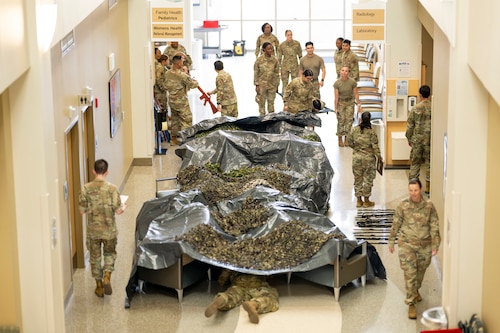
The training consisted of 16 stations and substations that ranged from spinal immobilization to infection control to post-mortem protocol, all scenarios that are critically important for a medic to know but unlikely to experience in a clinical setting such as the clinic at Holloman Air Force Base.

“Gone are the days when a medic would only be expected to perform duties within their specific specialty – our medics need to be versatile and better equipped to provide speedy and effective support to the warfighter,” said U.S. Air Force Chief Master Sgt. Jason Estrada, 49th MDG senior enlisted leader. “That versatile mindset is what our medical group education and training team has used to shape our Medic-X and other hands-on training.”

U.S. Air Force Airman 1st Class Da’Ja Thomas, 49th Healthcare Operations Squadron mental technician, low-crawls through an obstacle course during a Medic-X exercise at Holloman Air Force Base, New Mexico, July 16, 2025.
U.S. Air Force Airman 1st Class Da’Ja Thomas, 49th Healthcare Operations Squadron mental technician, low-crawls through an obstacle course during a Medic-X exercise at Holloman Air Force Base, N.M., July 16, 2025. This iteration of Medic-X integrated field exercises for medics who typically perform clinical and administrative duties, allowing them to sharpen their tactical skills while supporting lethal warfighters downrange. (U.S. Air Force photo by Tech. Sgt. Victor J. Caputo)

The Air Force is one of the most lethal parts of the Department of Defense, and the flipside of lethality is the medical skill needed to keep the warfighters in the fight downrange. This more hands-on approach to training was brought about after an education and training member went through the intense two-week Tactical Combat Casualty Care Tier 3 course and realized how important it would be to bring lessons learned to the entire medical group.

“We’re focusing on operating in an austere environment where it’s not going to be calm, it’s not going to be like day-to-day clinic operations,” said U.S. Air Force Capt. Natasha Lindbloom, 49th MDG education and training flight commander. “You could tell somebody to recite the alphabet, but if it’s stressful, they’re going to mess it up. We want our people to be able to do this until they can perform these simple tasks under pressure.”

Although we cannot mirror a battlefield environment, we can put our medics in situations where critical thinking and a sense of urgency fuels their training to ‘kick in.’Chief Master Sgt. Jason Estrada, 49th MDG senior enlisted leader

Coupled with the chance to exercise underutilized but combat-effective skills, the exercise served to underscore the importance of medics who are fit to fight and capable of doing what’s needed when it’s needed in a stressful and possibly deadly environment. A low-crawl obstacle course was put together using furniture and gear inside the clinic, streamlining the flow of training and simulating a more realistic urban environment.

Airmen from the 49th Medical Group rotate between stations during a Medic-X exercise at Holloman Air Force Base, New Mexico, July 16, 2025.
Airmen from the 49th Medical Group rotate between stations during a Medic-X exercise at Holloman Air Force Base, N.M., July 16, 2025. This exercise allowed every member of the medical group to sharpen field skills they are not able to practice every day while providing critical clinical support to Team Holloman. (U.S. Air Force photo by Tech. Sgt. Victor J. Caputo)

“Although we cannot mirror a battlefield environment, we can put our medics in situations where critical thinking and a sense of urgency fuels their training to ‘kick in,’” Estrada said. “Since so few of our current medics possess the real-world experience, it’s our training team that brings these scenarios to life with realism and pressure-induced decision making, which results in the desired sets & reps our teams need to build muscle memory.

Constant Improvement

Medic-X training exercises are not a new concept for medical personnel; in fact, Medic-X was rolled out across the enterprise two years ago and has provided quarterly training objectives to all Defense Health Agency members. The ever-changing global environment and nature of future warfare were other driving factors in the 49th MDG collectively getting ahead of the curve and practicing these critical wartime skills on top of staying adept at their daily clinical duties.

“I’m hoping this gives people the mindset of ‘Hey, I know I’m in this job right now and I’m comfortable, but I’m not always going to be comfortable if we’re put in these situations in real life,’” said U.S. Air Force Senior Airman Claire Pruitt, 49th MDG education and training program manager.

All Airmen take TCCC Tier-1 training that covers the basics of what was formerly known as self-aid and buddy care, while all medics are required to take Tier-2 training to gain more expertise in the ability to treat wounds sustained in combat. Tier-3 training is optional but available for all medics and provides a realistic, grueling experience of austere field conditions and the physical limits that medics can be pushed to in wartime.

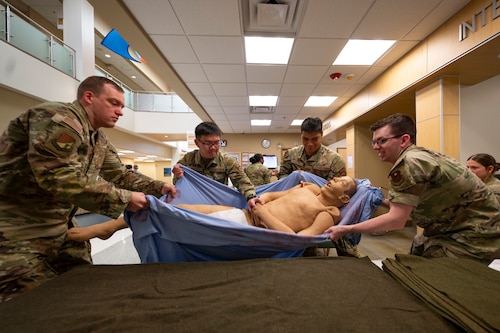
Airmen from the 49th Medical Group transfer a 200-pound training dummy from a gurney to an operating table during a Medic-X exercise at Holloman Air Force Base, New Mexico, July 16, 2025.
Airmen from the 49th Medical Group transfer a 200-pound training dummy from a gurney to an operating table during a Medic-X exercise at Holloman Air Force Base, N.M., July 16, 2025. This exercise allowed every member of the medical group to sharpen field skills they are not able to practice every day while providing critical clinical support to Team Holloman. (U.S. Air Force photo by Tech. Sgt. Victor J. Caputo)

“There’s going to be a bit of a shock factor for people working in a clinic, where even though we’re incredibly busy, a lot of it is just administrative work instead of intense, hands-on medical practice,” Pruitt said. “I’m trying to integrate some of the things that they did with us in a physical aspect at the Tier 3 training so that these Airmen have more experience and understand that if they have to do this in real life tomorrow, it’s not going to be easy. They’ll have to think about getting the patient out of the combat zone, treating their wounds, stopping the bleeding, loading them onto a helicopter, etc.”

The success of the first iteration of integrated field work with Medic-X has laid the groundwork for an ever-improving series of exercises to better prepare Team Holloman’s medics for unpredictable and challenging fights of future conflict.

“Today’s potential adversaries are better equipped and more prepared than any potential foe has ever been,” Estrada said. “For that reason, every uniform-wearing member of our military needs to understand that he/she is one bad day, one ill-guided decision, one perceived threatful action away from finding themselves, in support of our country, inside a combat environment where the old rules may not apply.”


Defense News in Brief: Surging airpower in the Pacific: Lamontagne observes allied mobility in action

Source: United States Airforce

The commander of AMC visited the 515th AMOW squadrons during the U.S. Air Force Department-Level Exercise, to see how the Pacific-oriented AMC wing conducts an operational surge.

Gen. Johnny Lamontagne, Air Mobility Command commander, visited the 515th Air Mobility Operations Wing during a recent stop in the Indo-Pacific theater to observe the U.S. Air Force’s 2025 Department-Level Exercise series — this first-in-a-generation exercise series is designed to test the service’s ability to rapidly deploy at speed and scale and sustain global operations.

The 515th AMOW, headquartered in Hawai’i, plays a pivotal role in enabling air mobility across the Indo-Pacific region. Lamontagne’s visit focused on how air mobility squadrons operate during surge conditions and how they integrate with Allies and partners to move critical capabilities where they are most needed.

“Hosting Gen. Lamontagne was a great chance to show how our Airmen rise to the challenge,” said Col. Jens Lyndrup, 515th AMOW commander. “They surge, adapt and deliver — with our allies by their side — and they do it with incredible precision and pride.”

Lamontagne echoed that sentiment, praising the dedication and resilience of Airmen across the theater.

“The Airmen are what impress me, period,” Lamontagne said. “The Airmen of the air mobility squadrons are fully executing the mission in tough environments during a very challenging exercise, helping the Department of the Air Force come together in a big way.”

With contested logistics becoming a central theme in defense planning, Lamontagne emphasized the 515th AMOW’s unique role in scaling operations and reinforcing key nodes in support of U.S. and Allied objectives.

“We couldn’t execute this large-scale exercise without the AMOW out here in the Pacific,” he said. “There’s no way we could project power at this scale without the 515th AMOW. They do an indispensable job surging capability where it’s needed, delivering greater throughput, capacity and operational reach.”

Close coordination with international partners was also a key focus of the visit. Lamontagne highlighted the strong relationship between the 730th AMS, based at Yokota Air Base, Japan, and the Japan Air Self-Defense Force.

“The 730th AMS has a great relationship with their Japanese counterparts, and we had the opportunity to meet with a couple of their three-stars who run their Air Defense Command and Air Support Command,” Lamontagne said. “They help us present forces at the tactical level and enable success at the operational and strategic levels very effectively each and every day.”

As competitors challenge U.S. military advantage in the region, Lamontagne emphasized the scale, speed and effectiveness of American airpower.

“No other air force can do it at the scale and on the timeline that our Air Force can,” he said. “Operating as one big Air Force to do what our nation needs us to do is really where it’s at.”

From enabling deterrence to sustaining operations at the tactical edge, the 515th AMOW and its network of mobility Airmen remain a critical part of the United States’ ability to project power — anytime, anywhere.