Justice Department Sues Montgomery County, MD for Violating Supreme Court’s Wolford Decision

Source: United States Department of Justice Criminal Division

Today, the Justice Department filed suit against Montgomery County, Maryland (County). The complaint alleges that the County’s newly enacted Bill 23-26 violates the Second Amendment by prohibiting law-abiding citizens from possessing firearms in daily life. Bill 23-26 prohibits carrying firearms at thousands of locations, and also creates an arbitrary 100-yard exclusion zone around each location. The law applies even if the person carrying a firearm is duly licensed and has the express consent of the property owner. 

“The Second Amendment does not allow local governments to ban law-abiding citizens from carrying firearms in public places as they go about their daily lives,” said Assistant Attorney General Harmeet K. Dhillon of the Justice Department’s Civil Rights Division. “Montgomery County makes it almost impossible for a law-abiding citizen with a valid carry license to walk down the street and avoid these exclusion zones. The Civil Rights Division will not stand idle while Montgomery County tramples the rights guaranteed to law-abiding citizens by the Second Amendment.”

The breadth of Bill 23-26’s prohibition, including the 100-yard exclusion zone, makes it practically impossible for individuals in the County to go about their daily business while lawfully carrying a firearm. Therefore, the ordinance violates the Supreme Court’s recent decision in Wolford v. Lopez, where the Court held a law that bans citizens from carrying firearms into, “places that people routinely visit in the course of their daily routines . . . hobbles what the Second Amendment protects: the right of Americans to carry arms for self-defense as they go about their daily lives.”

The Civil Rights Division’s Second Amendment Section enforces the Second Amendment, the Police Pattern or Practice Act (34 U.S.C. § 12601), and Executive Order 14206. If you are a current or prospective gun owner and believe that a state or local government has infringed your right to keep or bear arms, please submit a complaint through https://www.justice.gov/crt/second-amendment-section.

Defense News in Brief: Not Theoretical but Personal: Naval Leaders Celebrate ONR at Anniversary Event

Source: United States Navy

ARLINGTON, Va.—Looking back on his career as a U.S. Navy diver and explosive ordnance disposal officer, Acting Secretary of the Navy Hung Cao shared a personal perspective on the scientific and technological legacy of the Office of Naval Research (ONR).

“While many of ONR’s discoveries shaped the wider world, other less well-known breakthroughs transformed the daily lives of our Sailors and Marines on the front lines,” he said. “Having served in Iraq, Afghanistan and Somalia, my perspective is that what ONR does isn’t theoretical — it’s personal. It’s what saved our lives over there.

“For eight decades, ONR has stood at the vanguard of naval power,” Cao continued. “You’re the operational engine that transforms science fiction into tactical reality on the high seas.”

Cao gave his remarks during a special celebration honoring ONR’s 80th anniversary. Held on July 31 in the Pentagon Auditorium, the event highlighted eight decades of critical scientific and technological innovation for the U.S. Navy and Marine Corps.

In addition to commemorating historical achievements, the celebration discussed the future of integrated naval power and technological dominance — and featured more than 20 ONR technology displays on the second-floor Apex of the Pentagon’s 9th and 10th corridors.

Chief of Naval Research Dr. Rachel Riley talked about ONR’s newly released 2026 Science and Technology Strategy, which calls for a fundamental transformation of how the command prioritizes, develops and deploys technology to the Navy and Marine Corps.

Riley also introduced the CNR Fellows program. Launching this year, the fellowship brings newly tenured academic professors to ONR for a one-year term to learn about naval priorities, and provide technical oversight and state-of-the-art expertise.

“Every time I come to the Pentagon, I think about a poster here that has a George Washington quote from 1780,” said Riley. “It says, ‘There’s nothing so likely to produce peace as to be well prepared to meet an enemy.’ It speaks to the broader importance of ONR’s mission — to ensure that every U.S. Sailor and Marine, every platform within the Joint Force, is equipped with the latest and greatest technology.”

In addition to Cao, ONR’s anniversary celebration featured other prominent guest speakers:

  • Adm. James Kilby, Vice Chief of Naval Operations
  • Dr. Joseph S. Jewell, Assistant Secretary of War for Science and Technology
  • Dr. Peter W. Singer, noted author, strategist and futurist

“For 80 years, the Office of Naval has shaped the way we fight,” said Kilby. “Long before a ship is commissioned or a capability reaches the fleet, someone had to imagine that was possible. For 80 years, that has been ONR’s mission — to look beyond today’s requirements and prepare for tomorrow’s fight.”

Jewell recalled his time as a university professor and awardee of ONR’s Young Investigator Program — and expressed gratitude for the command’s sustained support of his academic research in hypersonics.

“The innovations taking place through ONR are truly mission-driven, and support the warfighters of today and tomorrow,” he said. “The mission of ONR is paramount to our nation’s economic and national security.”

During his presentation, Singer outlined five technological areas — what he called “lineages” — in which he believes ONR has been particularly effective since its establishment in 1946:

  • Unmanned systems, robotics and autonomy
  • Sensor improvement and integration
  • PNT, C5ISR and battlespace awareness
  • Ocean science, acoustics and undersea warfare
  • Troop protection, materials and human performance

“In 1946, ONR started with six basic branches, including physics, fluid mechanics, aviation and physiology,” said Singer. “From that structure, ONR has taken into areas that now extend from cyber to autonomy to directed energy. Entire departments are named after words that didn’t even exist in 1946. That shows an organization evolving and changing the very lexicon of human scientific and military capability.”

Warren Duffie Jr. is a contractor for ONR Corporate Strategic Communications.

About the Office of Naval Research

The Department of the Navy’s Office of Naval Research provides the science and technology necessary to maintain the Navy and Marine Corps’ technological advantage. Through its affiliates, ONR is a leader in science and technology with engagement in 50 states, 55 countries, 634 institutions of higher learning and nonprofit institutions, and more than 960 industry partners. ONR, through its commands, including headquarters, ONR Global and the Naval Research Laboratory in Washington, D.C., employs more than 3,800 people, comprising uniformed, civilian and contract personnel.

Defense News in Brief: Navy to Reclassify Virginia Payload Module-equipped SSNs to SSGNs, Unleashing Next-Generation Strike Power

Source: United States Navy

“This reclassification is a clear acknowledgment of the increased lethality VPM brings to the undersea fight,” said Vice Adm. Rob Gaucher, Director, Submarine Programs. “These VPM-equipped SSGNs will ensure the Navy continues to dominate the undersea domain for decades to come. By integrating this additional payload capacity, we will have the ability to surge strike power to assure our allies, deter aggression, outmatch any adversary, and give our Fleet commanders an incredibly versatile, hard-hitting instrument of national power.”

This decision highlights the formidable capabilities of the Navy’s newest undersea assets. Encompassing Virginia Class Blocks V and VI, these platforms will deliver with the integrated VPM—a hull modification that significantly increases length, boosts munition capacity, and provides unprecedented payload flexibility. By putting high-volume, long-range precision strike capabilities directly into the hands of the Fleet, these SSGNs will serve as a vital cornerstone for Distributed Maritime Operations and high-end warfighting. While carrying the new SSGN designation, they will remain an integral part of the storied Virginia Class program.

“Reclassifying Virginia Payload Module-equipped submarines as SSGNs accurately reflects the extraordinary strike capacity, operational flexibility, and global reach these platforms bring to the Fleet,” said the Chief of Naval Operations, Adm. Daryl Caudle. “This transition comes at an important moment as USS Georgia, one of the Navy’s four Ohio-class guided-missile submarines, begins the inactivation process after more than four decades of exceptional service. Georgia and her sister ships proved the enduring value of combining undersea stealth with unmatched clandestine strike capability. The next generation of Virginia-class SSGNs builds on that legacy with greater survivability, adaptability, and sustained combat power. These submarines will provide our Nation with a powerful and persistent deterrent, expand options for our combatant commanders, and ensure the Navy remains ready to fight and win whenever and wherever called upon.”

The first VPM platform (SSGN 803) is estimated to deliver in FY 2029, with deliveries scheduled through FY 2038. Once operational, these highly survivable platforms will be dynamically employed across crucial global theaters—providing persistent forward presence, reinforcing robust alliance deterrence, and standing ready to project decisive combat power at a moment’s notice.

“The Submarine Force is defined by our ability to operate undetected and strike without warning,” said Vice Adm. Rick Seif, Commander, Submarine Forces. “By integrating high-volume precision strike capabilities into these stealth platforms, these SSGNs serve as the ultimate enabler for Distributed Maritime Operations, giving our warfighters the overwhelming, flexible firepower required to win decisively in any theater.”

Virginia Class submarines are built to dominate a broad spectrum of open-ocean and littoral missions, including anti-submarine warfare, anti-surface warfare, precision strike, intelligence collection, irregular warfare, and mine warfare. Armed with state-of-the-art sensors, unmatched stealth, and advanced automation, these reclassified SSGNs will operate with impunity in contested waters, ensuring the United States Navy maintains absolute undersea supremacy.


Defense News in Brief: 24th Marine Expeditionary Unit and USS San Antonio Transit Panama Canal

Source: United States Navy

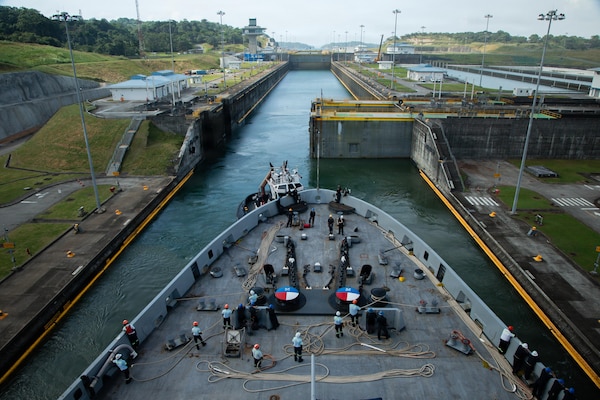
PANAMA CANAL — On August 1, 2026, the 24th Marine Expeditionary Unit (MEU) — operating as Littoral Combat Force-24 (LCF-24) — aboard the amphibious transport dock ship USS San Antonio (LPD 17), completed a transit through the Panama Canal while operating under United States Southern Command.


Marking the first time a Marine Expeditionary Unit has navigated the canal since 2008, this large-scale maneuver is a demonstration of the Marine Corps’ capacity for rapid global mobility, maritime dominance, and seamless power projection.

Since its completion, the Panama Canal has served as a vital strategic pathway for the United States and its allies. The canal allows naval vessels to rapidly shift between the Atlantic and Pacific theaters, saving weeks of travel around South America. Navigating this critical maritime shortcut ensures the U.S. military can maintain a flexible, responsive posture — surging ships and troops to meet emerging crises across hemispheres without delay.

“This historic transit is a powerful testament to the flexibility and readiness of Littoral Combat Force-24,” said Col. Ryan Lynch, the commanding officer of LCF-24. “Our ability to seamlessly navigate this critical waterway alongside our Navy partners aboard the USS San Antonio demonstrates our capability to rapidly project power and respond to crises anywhere in the Southern Command area of responsibility. We are ready to operate straight from the sea, at a moment’s notice.”

The transit serves as a validation of the Littoral Combat Force concept and the modern Marine Air-Ground Task Force. It proves LCF-24’s ability to navigate narrow waterways and project assets ashore without relying on established military basing, underscoring the Marine Corps’ enduring role as the nation’s premier force-in-readiness, perfectly calibrated for contested littoral regions.

The foundation of this capability is the unbreakable teamwork between the Navy and the Marine Corps. The interoperability displayed by the Marines of LCF-24 and the Sailors of the USS San Antonio highlights a fully integrated naval force supporting Combatant Commander objectives.

By moving fluidly through the canal, the Blue-Green team proves its unrestricted access to the U.S. Southern Command area of responsibility, which spans Central and South America, and the Caribbean. Whether tasked with humanitarian disaster relief, bolstering regional partnerships, or deterring aggression, this force can reach anywhere in the region to deliver tailored, decisive effects.

The 24th MEU’s transit of the Panama Canal proves that the Navy-Marine Corps team remains prepared to respond as America’s 9-1-1 force in any clime and place.

Defense News in Brief: Pacific Partnership 2026 Concludes Second Mission Stop in Sibolga, Indonesia

Source: United States Navy

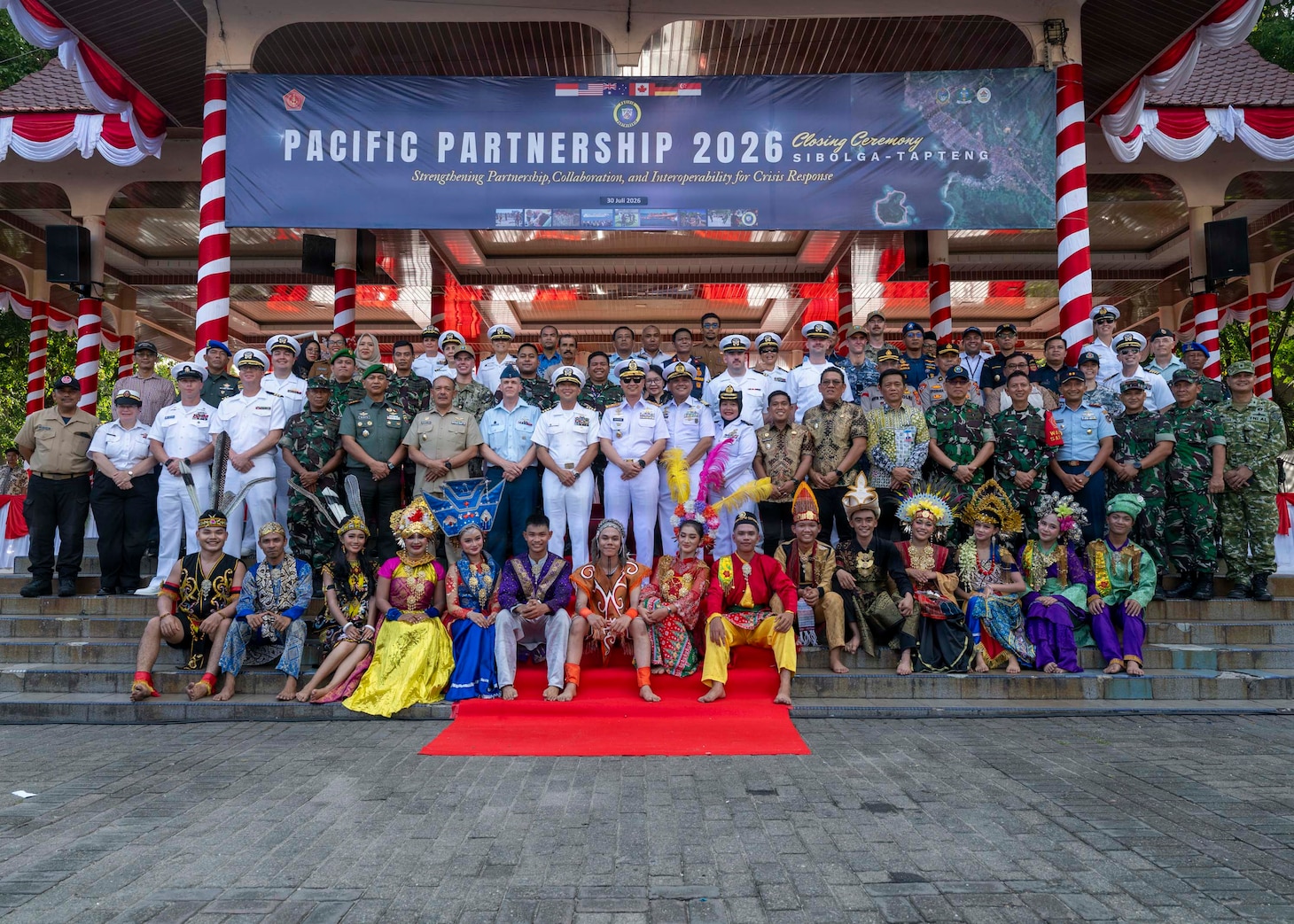
SIBOLGA, Indonesia – Pacific Partnership 2026 (PP26) concluded its second mission stop in Sibolga and the surrounding Central Tapanuli regency, Indonesia, with a closing ceremony at Simare-Mare Field, July 30, 2026.

Pacific Partnership 2026 Concludes Second Mission Stop in Sibolga, Indonesia

Leaders of Pacific Partnership 2026 (PP26) and Indonesian National Armed Forces (Tentara Nasional Indonesia) pose for a group photo during the PP26 Indonesia mission stop closing ceremony at Simare-Mare Field in Sibolga, Indonesia, July 30, 2026. Now in its 22nd iteration, the Pacific Partnership series is the largest annual multinational humanitarian assistance and disaster management preparedness mission conducted in the region. Pacific Partnership works collaboratively with host and partner nations to enhance regional interoperability and disaster response capabilities, increase security in the region, and foster new and enduring friendships in the Indo-Pacific. (U.S. Navy photo by Mass Communication Specialist 2nd Class Anthony Robledo)


Over the course of the two-week mission stop, the U.S. Navy’s largest annual multinational humanitarian and disaster preparedness mission in the Indo-Pacific enabled PP26 personnel composed of approximately 150 U.S. service members, together with Australian Defence Force, Canadian Armed Force, German Armed Force, and Singapore Armed Force service members, to work alongside the Indonesian National Armed Forces (Tentara Nasional Indonesia), Indonesian experts and civilians across four lines of effort: engineering, disaster management, host nation outreach, and medical.

“This mission has been about more than training and engagements; it has been about people,” said U.S. Navy Lt. Macswayne Muralt, the officer in charge of the Indonesia Pacific Partnership 2026 mission stop. “As an American of Indonesian-Chinese heritage, it has been a privilege to work alongside our TNI and Indonesian partners, strengthening the relationships that help our communities prepare for future challenges together.”

While in Indonesia, the U.S. Navy Seabees, assigned to Naval Mobile Construction Battalion 5 and Amphibious Construction Battalion 1, U.S. Army soldiers assigned to the Hawaii National Guard’s 230th Engineer Company, and TNI engineers conducted new construction of a two-classroom building at National Elementary School #158309 and classroom renovations at National Elementary School #158490. Their combined efforts improved public infrastructure, directly increasing students’ learning capabilities.

“Executing these new construction and renovation projects alongside our Army National Guard and TNI partners highlights our ability to seamlessly integrate diverse technical capabilities,” said U.S. Navy Lt. Cmdr. Michael Hamilton, mission engineer for PP26. “From the first block laid to the final coat of paint applied, this mission represented a unified, team effort. Missions like this reflect the core of why we serve, leaving a lasting, positive impact on a community while strengthening our operational bonds.”

The disaster management team conducted a five-day urban search and rescue vertical lane rescue and patient evacuation training on Sibolga Naval Base, held a two-day disaster response planning at the Sibolga mayor’s office, and a two-day culminating field training exercise at Pandan General Hospital. The culminating exercise simulated a hospital fire and a ship collision designed to improve international interoperability and rehearse critical coordination between military forces and civilians. The hands-on, practical exercise consisted of a simulated building collapse, mass casualty drill, water rescue, and on-scene treatment and evacuation of casualties.

“It was a great experience to work with our TNI counterparts and Indonesia’s national-level first responders,” said U.S. Army Capt. Nathanael Wrye, PP26 disaster management line of effort (LOE) lead for the Indonesia mission stop. “These evolutions allowed us all to explore the individual capabilities of TNI and first responders to react to specific scenarios that can occur during disasters and increase our collective ability to develop plans and strategic outlook.”

Beyond technical and tactical exchanges, the mission stop featured host nation outreach events focused on community engagement and youth education. The Pacific Partnership Band performed a series of public concerts at local venues and school grounds, bringing together hundreds of residents through music.

“Music connects people instantly. It cuts across language and culture in a way nothing else does. The students were the highlight of this mission stop, hands down,” said U.S. Navy Lt. Joel Thiesfeldt, Pacific Partnership band master. “When kids who don’t speak your language are singing and dancing along with you, that’s cultural outreach doing exactly what it’s supposed to do: bringing our nations closer together.”

The medical team conducted a total of 79 engagements, consisting of seven veterinary exchanges, seven community health engagements, and 65 subject matter expert exchanges across the disciplines of nursing, dental, midwifery, general surgery, emergency medicine, internal medicine, and ophthalmology. PP26 medical personnel engaged with local professionals to enhance mutual medical capabilities and strengthen long-term capacity.

“We had great collaborative engagements with our host and partner nations in subject matter exchanges and side-by-sides,” said U.S. Navy Lt. Cmdr. Matthew Squires, PP26 medical LOE lead for the Indonesia mission stop. “The opportunity to share and exchange knowledge from our specialists to the community of health professionals is a truly rewarding experience. I realized working here that health is a universal language. No matter what culture, religion, language, or place we come from, our shared experiences broke down barriers and we found common ground in finding different solutions for similar challenges.”

Following the ceremony, Pacific Partnership personnel prepared to embark aboard the Royal Australian Navy Bay-class landing ship dock HMAS Choules (LSD 100) to continue the mission of strengthening regional security, enhancing cooperation, and improving disaster preparedness across the Indo-Pacific.

Now in its 22nd iteration, the Pacific Partnership series is the largest annual multinational humanitarian assistance and disaster management preparedness mission conducted in the Indo-Pacific. Pacific Partnership works collaboratively with host and partner nations to enhance regional interoperability and disaster response capabilities, increase security and stability in the region, and foster new and enduring friendships in the Indo-Pacific.

For updates and multimedia from Pacific Partnership 2026, follow #PacificPartnership, #PP26, and #PacificPartnership26 on social media or visit: DVIDS’s Pacific Partnership.
Defense News in Brief: U.S. Naval War College students and faculty discuss uses, potential of artificial intelligence

Source: United States Navy

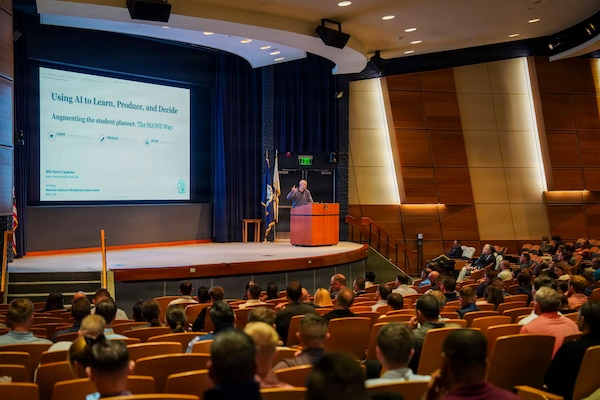
The U.S. Naval War College (NWC) held a series of lectures and workshops on artificial intelligence (AI) for incoming students and for faculty members on July 30 and 31, 2026, respectively.


“The Naval War College is a place where military leaders can learn how to use AI to optimize their effectiveness as warfighters,” said NWC President Rear Adm. Darryl Walker. “AI can provide crystal clear battlespace awareness and lightning-fast calculations to assist operational and tactical commanders so they can move faster and more decisively. The forces who master AI will be the most successful in conflict deep into the future.”

Dr. Amanda Rosen, professor of teaching and learning at the NWC’s Teaching Excellence Center, said the July 31 conference started conceptually as a small gathering of faculty to share best practices amongst themselves. But after she sent out a request to determine interest among colleagues, she received 15 volunteers to present and many more – from not only the Naval War College, but from other U.S. professional military institutions – to attend. “Interest just kept growing and growing and now we have 265 (registered to take part),” she said.

Rosen – who is organizing the July 31 conference alongside Dr. Curtis Bell of NWC’s International Programs Department, Dr. Chris Demchak of the Cyber and Innovation Policy Institute (CIPI) and Teaching Excellence Center Director Dr. Kimberly Moreland – said AI can be tasked with coding, role-play simulations, research, and translation, in addition to the more basic editing and schedule management.

“For initial users, a lot of it is about efficiency and offloading menial tasks,” she said. “But it goes beyond that. It also allows us to do things we were never able to before.”

Rosen said Bell pointed out that before AI, anyone could come up with a good idea, but putting those good ideas into practice would often require so much labor or specialized expertise that those innovations would never get past the drawing board.

“We are moving from a period where AI is increasing our efficiency to a place where it’s increasing what is even possible,” she said.

During the faculty conference, sessions were held on AI in adaptive learning, class discussion preparation, design and execution of academic courses, security and multiple talks on the technology’s role in wargaming.

On day earlier, during the student workshops on July 30, talks were held on cybersecurity and law as they pertain to AI, among other topics.

Facilitated by U.S. Navy Cmdr. Jonathan Durham of the Joint Military Operations Department, speakers for the student sessions included representatives of the war college’s Maritime Advanced Warfighting School (MAWS), the military’s Chief Digital and Artificial Intelligence Office, the Office of the Judge Advocate General and others.

Established in 1884, NWC informs today’s decision-makers and educates tomorrow’s leaders by providing educational experiences and learning opportunities that develop their ability to hedge aggressively, innovate continuously, fight distributively, delegate confidently, and command with clarity within complex battlespaces.

Justice Department Files Record 25 Denaturalization Cases Against Naturalized Criminals Including Attempted Murderers, Spousal Abusers, and Child Sex Offenders

Source: United States Department of Justice

25 complaints filed since July 20, 2026, mark largest denaturalization effort ever

The Department of Justice announced today that it filed denaturalization actions in various U.S. district courts against 25 individuals accused of serious offenses — including attempted first-degree murder and assault with a deadly weapon with intent to kill, assault and battery of a high and aggravated nature, and aggravated sexual assault of a child.

Under the Immigration and Nationality Act, a naturalized U.S. citizen’s citizenship may be revoked, and certificate of naturalization canceled, if the naturalization was illegally procured or procured by concealment of a material fact or by willful misrepresentation. The complaints were filed between July 20 and Aug. 3, 2026. Since Jan. 20, 2025, the Justice Department has filed 123 civil denaturalization complaints, the most in recorded history.

“U.S. citizenship is one of our nation’s highest privileges, and it must be obtained lawfully and honestly,” said Acting Attorney General Todd Blanche. “The complaints announced today allege that these individuals secured naturalization through fraud, concealment, or other unlawful conduct — including by concealing violent crimes, sexual offenses against children, fraudulent identities, and other disqualifying facts. Today’s filings represent the largest coordinated denaturalization effort in Department history, but they are only the beginning. The Justice Department will continue to use every tool available to protect the integrity of the naturalization process and the safety of the American people.”

“Today marks the largest denaturalization surge in recorded history,” said Assistant Attorney General Brett A. Shumate of the Justice Department’s Civil Division. “Every one of these individuals committed crimes incompatible with U.S. citizenship. We are moving at record speed to denaturalize those who sought to deceive the federal government and abuse the naturalization process.”

  1. Zia Murad Bhatti (Pakistan/Age 59): On July 24, the Department of Justice filed a case in the Eastern District of Arkansas seeking the denaturalization of Zia Murad Bhatti, also known as Raza Moorad, a resident of Conway, Arkansas, because he committed immigration fraud in his naturalization proceedings. Bhatti illegally entered the United States in 1992 using the name Raza Moorad. He was ordered removed, but he did not depart the United States. Instead, he married a United States citizen and sought permanent resident status, based on the marriage, using the name Zia Murad Bhatti. In naturalization proceedings, he concealed the fact that he used another identity and was ordered removed. The United States alleges that the court should issue an order revoking Bhatti’s naturalization because he committed fraud in seeking permanent resident status, provided false testimony and committed unlawful acts when he lied under penalty of perjury in naturalization proceedings, and procured his naturalization by concealment of material facts and willful misrepresentations. (Eastern District of Arkansas).
  2. Tatiana Power (Moldova/Age 46): On July 22, the Department of Justice filed a case in the Southern District of Florida seeking the denaturalization of Tatiana Power, a resident of Weston, Florida, because she committed crimes involving the sexual abuse of children before she became a U.S. citizen. Power entered the United States in 2005 and naturalized in 2010. In 2021, she was charged with several counts related to her participation in a business selling images and videos depicting the sexual abuse of children on numerous websites. In criminal proceedings she admitted that she became involved in the illegal enterprise before she became a citizen. In 2022, she was convicted of conspiracy to commit money laundering, in violation of 18 U.S.C. § 1956(h), for her efforts in concealing proceeds from the unlawful activity. The United States alleges that the court should issue an order revoking Power’s naturalization because her criminal acts and her false testimony in naturalization proceedings rendered her unable to demonstrate the required good moral character for naturalization and because she procured her naturalization by concealment of material facts and willful misrepresentations. (Southern District of Florida).
  3. Narinder Singh (India/Age 65): On July 20, the Department of Justice filed a case in the District of Delaware seeking the denaturalization of Narinder Singh for using a fraudulent identity to gain admission to the United States. Singh used two identities to gain admission to the U.S. beginning in 1996 and naturalized as a U.S. citizen on May 1, 2008. The complaint alleges seven counts for his numerous misrepresentations and unlawful acts that adversely reflect his moral character. (District of Delaware).
  4. Emigdio Sanchez (Mexico/Age 62): On July 22, the United States filed a case in the District of South Carolina seeking the denaturalization of Emigdio Sanchez, who, beat and choked his wife, was arrested for such conduct, and they lied about it to immigration authorities. On Aug. 16, 1998, Mr. Sanchez beat his wife so severely, she was hospitalized. He was arrested for this violent assault the following day, and later pled guilty to assault and battery of a high and aggravated nature. Yet on Sept. 17, 1998, when Mr. Sanchez filled out paperwork related to his naturalization application, and was specifically asked whether he had been arrested or engaged in any criminal conduct since he first submitted his naturalization application, Mr. Sanchez lied, and wrote “no.” Mr. Sanchez’s violent assault upon his wife rendered him ineligible to naturalize, and had he disclosed his criminal conduct, that bar would have been apparent. The United States filed a three-count complaint against Mr. Sanchez seeking his denaturalization, including claims that he lacked the good moral character to naturalize and made material misrepresentations to immigration authorities. (District of South Carolina).
  5. Louisa Fernandez Ordonez (Colombia/Age 54): On July 20, the Department of Justice filed an action in the Northern District of Georgia seeking the denaturalization of Luisa Fernanda Ordonez because she failed to disclose in her naturalization proceedings that she obtained her permanent residence as a result of marriage fraud and that she was married to two men simultaneously. In 2000, Ms. Ordonez paid a U.S. citizen to marry her so that she could procure her permanent residence. Ms. Ordonez had no intention of establishing a marital relationship with this man, nor did she. Instead, in 2003, she married another man, without first divorcing her first husband. At no point during her naturalization proceedings did Mr. Ordonez disclose that her marriage to her first husband was entered into solely to obtain an immigration benefit. Neither did she disclose that she had married someone else. The United States seeks the denaturalization of Ms. Ordonez in a five-count complaint alleging she illegally procured her naturalization because she was not lawfully admitted for permanent residence, she was statutorily ineligible to apply for naturalization when she did, and because she made various false statements and misrepresentations in her immigration proceedings. (Northern District of Georgia).
  6. Jonathan Omorogieva Obasohan (Nigeria/Age 56): On July 21, the United States filed a case in the District of Massachusetts seeking the denaturalization of Jonathan Omorogieva Obasohan because he obtained his citizenship under a fake identify, after he was already subject to an order of deportation under his true identify. Before Mr. Obasohan, a native of Nigeria, became a permanent resident and later naturalized as a U.S. citizen under the name Jonathan Omorogieva Obasohan, he was previously ordered to be deported from the United States under the name Tinosa Joe Aigbedion. At no point during his naturalization proceedings did Mr. Obasohan disclose that he previously used the name Tinosa Joe Aigbedion or that he had a current order of deportation pending against him. The United States has filed a five-count complaint against Mr. Obasohan seeking his denaturalization on the grounds that he was statutorily ineligible to naturalize, never lawfully obtained his permanent residence, and made numerous material misstatements to immigration officials. (District of Massachusetts).
  7. Enos Fong Korti (Liberia/Age 51): On July 29, the Department of Justice filed a case in the District of Minnesota seeking the denaturalization of Enos Fong Korti, a native of Liberia.  Mr. Korti immigrated to the United States as the unmarried child of a U.S. citizen. However, Korti was married and ineligible to immigrate under that status, so Mr. Korti lied about his marital status to immigration officials during the visa process to hide his ineligibility. When it came time to naturalize, Korti falsely claimed that he had never lied to U.S. officials. As a result, Mr. Korti was naturalized. The United States is seeking to revoke Mr. Korti’s citizenship because he was not lawfully admitted for permanent residence, because he procured his naturalization by concealment of material facts and willful misrepresentations, and because he lacked the good moral character necessary to naturalize. (District of Minnesota).
  8. Yetunde Folake Olaniyi (Nigeria/Age 56): On July 31, the Department of Justice filed a case in the District of Maryland seeking the denaturalization of Yetunde Folake Olaniyi, also known as Folake Rosemary Thomas, a native of Nigeria. Olaniyi was ordered removed from the United States and rather than report for her scheduled removal flight, she adopted the identity of Folake Rosemary Thomas and entered into a sham marriage with a U.S. citizen, notwithstanding that she was already married to another Nigerian citizen. Through this sham marriage and by concealing her true identity, Olaniyi was granted a green card through her spouse. Three years later, Olaniyi naturalized as Folake Rosemary Thomas. In 2014, Olaniyi (as Thomas) was convicted in federal court for passport fraud after fingerprint checks revealed her true identity to be Olaniyi. The seven-count civil Complaint alleges Olaniyi was ineligible for a spousal green card and naturalization through her spouse because her marriage to the U.S. citizen was both a sham and legally invalid, that Olaniyi obtained her naturalization through a litany of willful misrepresentations of material facts, and that Olaniyi lacked the requisite good moral character required for naturalization. (District of Maryland).
  9. Mohd Wasif, also known as Mohammad Khanwasif (Pakistan/Age 56 or 58): On August 3, the U.S. Department of Justice filed a case in the Eastern District of Texas seeking to revoke the multiple naturalizations that Mohd Wasif, also known as Mohammad Khanwasif obtained under multiple identities. As Mohd Wasif, this individual obtained permanent residence in the U.S. by lying about his eligibility for that benefit. Then, while waiting for approval of that application, this individual applied for permanent residence under the different identity of Mohammad Khanwasif. Then, during his naturalization proceedings as Mohd Wasif, he lied about having provided false information to immigration officials to obtain permanent resident status and concealed his use of a second identity as Mohammad Khanwasif. During his naturalization proceedings as Mohammad Khanwasif, he similarly concealed his fraud and use of other identities. Because this individual did not obtain either of his naturalizations lawfully, but procured them instead by repeatedly lying, the United States now seeks to revoke both of those naturalizations. (Eastern District of Texas)
  10. Esther Quayle (Ghana/Age 50): On July 29, the Department of Justice filed a case in the Middle District of Tennessee seeking the denaturalization of Esther Quayle. Quayle, a native of Ghana, acquired a green card in the United States through her spouse, who had stolen the identity of a United States citizen. As a result of her husband’s identity theft and Quayle’s nondisclosure of her husband’s true identity and citizenship, Quayle was granted naturalization. Because Quayle was not married to a real U.S. citizen, she was ineligible for citizenship because she was not lawfully admitted to permanent residence. Further, because Quayle misrepresented her spouse’s true name and citizenship status in her naturalization proceedings, she obtained naturalization through a concealment or willful misrepresentation of a material fact, provided false testimony disqualifying her from citizenship, and lacked the good moral character necessary to naturalize. (Middle District of Tennessee).
  11. Dwyane Robinson (Jamaica/Age 44): On July 21, the Department of Justice filed a case in the Eastern District of North Carolina against Dwyane Robinson, who shot and attempted to murder another man, leading to his conviction for attempted first degree murder and assault with a deadly weapon with intent to kill inflicting serious injury. On Dec. 31, 2013, while awaiting trial, Defendant was discharged from the U.S. Army. Defendant had earlier obtained his U.S. citizenship on the basis of his military service, but because he was discharged under other than honorable conditions prior to serving honorably in the military for a total of five years, he is subject to denaturalization. (Eastern District of North Carolina).
  12. Yi Lee (Taiwan/Age 46): On July 22, the Department of Justice filed a case in the District of New Mexico seeking the denaturalization of Yi Lee because he masterminded a marriage fraud ring prior to naturalizing. From January 2016 to on or about May 2017, Lee conspired with exploit U.S. immigration laws by uniting U.S. citizens with alien beneficiaries in sham marriages. Lee coordinated a payment schedule to the U.S. citizen conspirators and coached participants through the application process, including preparing them for immigration interviews. In 2017, Lee pled guilty to conspiracy to commit marriage fraud. Lee illegally procured his naturalization as a U.S. citizen because his crime precluded the required good moral character to naturalize. Also, Lee falsely testified under oath and misrepresented and concealed facts that were material to determining his naturalization eligibility. (District of New Mexico).
  13. Eddie Jones Appah (Ghana/Age 66 or 67): On July 30, the Department of Justice filed a case in the District of New Jersey seeking the denaturalization of Mr. Eddie Jones Appah because he failed to disclose in his naturalization proceedings that he had already entered and been deported under a prior identity. He is charged with illegal procurement of naturalization by providing false testimony during his proceedings and for procuring his U.S. citizenship after misrepresenting and concealing material facts. (District of New Jersey).
  14. Jose Luis Martinez-Zavala (Mexico/Age 80): On July 27, the Department of Justice filed a case in the Western District of Texas seeking the denaturalization of Jose Luis Martinez-Zavala, who failed to disclose in his naturalization proceedings that he had previously sexually assaulted a minor.  Martinez-Zavala naturalized in 2014 by hiding from the Government that in 2010 he had committed Aggravated Sexual Assault of a Child, in violation of Texas Penal Code Ann. § 22.021(a)(2)(B), a first-degree felony. In 2020, he pleaded guilty to and was convicted of that offense in Travis County, Texas. The complaint charges Martinez-Zavala with being ineligible to naturalize because, during the statutory period when he was required to show he had good moral character, he committed that crime and the additional offenses of making false statements, of falsely swearing in an immigration matter, and of perjuring himself when he submitted his Naturalization Application and again during his Naturalization Interview when he falsely stated and swore that he had not committed any crime for which he had not been arrested. The complaint further claims Martinez-Zavala was ineligible to naturalize because he provided false testimony during the same statutory period. Finally, the complaint alleges that Martinez-Zavala procured his naturalization by concealment of a material fact or by willful misrepresentations about his criminal history. (Western District of Texas).
  15. Vivian Chike Obichere (Nigeria/Age 72): On July 30, the Department of Justice filed a denaturalization action in the Northern District of California seeking the denaturalization of Vivian Chike Obichere. Ms. Obichere is a native of Nigeria who naturalized as a United States citizen in 2013, and represented throughout her naturalization proceedings that she had never committed crimes for which she was not arrested, had used only one alias while in the United States, had not taken trips outside of the United States during the relevant period, and had never given misleading information to any United States official. However, she later pled guilty to False Application and Use of a Passport, and admitted the falsity of all of those attestations. Specifically, Ms. Obichere admitted that she had concealed, during her naturalization proceedings, that she had previously applied for and used a passport with the name and identifying information of another person, who was a United States citizen. Accordingly, the Department of Justice is pursuing revocation of Ms. Obichere’s naturalization on three counts related to her statutory ineligibility for denaturalization as a person barred from establishing good moral character, and one count of illegal procurement of naturalization by concealment of a material fact or by willful misrepresentation. (Northern District of California).
  16. Jose Francisco Cruz (Honduras/Age 72):  On July 31, the Department of Justice filed a denaturalization action in the Southern District of Florida seeking the denaturalization of Jose Francisco Cruz. On or between December 28, 1995 and June 6, 1998, Cruz sexually abused his minor stepdaughter, while he was in a position of familial or custodial authority over her. Cruz naturalized as a U.S. citizen on Feb. 20, 1996. On or about Feb. 22, 1999, Cruz pled guilty in the Circuit Court of the Fifteenth Judicial District, Palm Beach County, Florida, to three counts of Sexual Activity with a Child in violation of section 794.011(8)(b), Florida Statutes, in full satisfaction of the Third Amended Information. On or about Feb. 22, 1999,Cruz was sentenced to a 16-year term of imprisonment. Cruz was also required to register as a sex offender. Cruz illegally procured his naturalization as a United States citizen because his crime precluded the required good moral character to naturalize. Also, during the naturalization process, Cruz willfully misrepresented and concealed his involvement in unlawful sexual acts with his minor stepdaughter. (Southern District of Florida).
  17. Francois Nguessi Dame (Cameroon/Age 65): On July 30, the Department of Justice filed a suit in the District of Maryland seeking the denaturalization of Francois Nguessi Dame because he illegally procured his naturalization and obtained his naturalization by concealment of a material fact or by willful misrepresentation. From December 2008 to March 2015, Mr. Dame sexually abused his minor stepdaughter from the time she was ten until she was sixteen. After Mr. Dame naturalized in August 2014, he was convicted for multiple counts of sexual abuse of a minor in May 2017. He never disclosed the conduct underlying those convictions during the naturalization process. Accordingly, OIL seeks to pursue denaturalization of Mr. Dame for both illegal procurement (failure to show good moral character due to unlawful acts and false testimony) and concealment of material facts or willful misrepresentations relating to that conduct. (District of Maryland).
  18. Haitham A. Mustafa (Jordan/Age 58): On July 29, the Department of Justice filed a denaturalization action in the Southern District of Florida seeking the denaturalization of Haitham A. Mustafa, alleging that he failed to disclose in his naturalization proceedings that he engaged in credit card fraud using false names. Beginning in November 1999 and continuing until after his May 2001 naturalization, Mustafa engaged in credit card fraud using fraudulently obtained credit cards using at least one false name. This fraud scheme also coincided with a bank fraud scheme that occurred after his naturalization. Following his guilty plea, in May 2006, Mustafa was found guilty of one count of credit card fraud and one count of bank fraud, in violation of 15 U.S.C. § 1644(a) and 18 U.S.C. § 1344. He was sentenced to a term of twenty-five months’ imprisonment to be served concurrently and ordered to pay restitution in the amount of $146,646.43 to all victims of his fraud scheme. Mustafa illegally obtained his naturalization as a United States citizen because credit card fraud is a crime that adversely reflects on his moral character. Moreover, Mustafa misrepresented and concealed material facts to obtain his naturalization. (Southern District of Florida).
  19. Jairo Javier Pedron Tellez (Cuba/Age 29): On July 31, the Department of Justice filed a denaturalization action in the Southern District of Florida, seeking denaturalization of Jairo Javier Pedron Tellez because he failed to disclose in his naturalization proceedings that he conspired to commit bank fraud and engaged in aggravated identity theft prior to naturalizing.  Beginning in April 2015, and continuing through September 2017, Mr. Pedron conspired with others to defraud financial institutions by illegally obtaining envelopes and parcels from United States Post Office collection boxes with the intent to obtain, alter, and cash or deposit checks contained in those envelopes and parcels. In total, Mr. Pedron and his coconspirators illegally obtained nearly $175,000 through this scheme. The Department seeks Mr. Pedron’s denaturalization because he illegally obtained his naturalization due to his unlawful acts and because he provided false testimony during his naturalization. The Department also seeks Mr. Pedron’s denaturalization because he obtained his naturalization through willful misrepresentation or concealment of material facts during his naturalization. (Southern District of Florida).
  20. Carlos Ernesto Giron (El Salvador/Age 65): On July 29, the Department of Justice filed a civil denaturalization complaint in the United States District Court for the District of Maryland against Carloe Ernesto Giron. In 2019, Mr. Giron pled guilty and was convicted of sexual abuse of a minor for criminal acts he committed against two minors between 2005 and 2010. Mr. Giron lied about his criminal conduct in connection with his application to become a naturalized United States citizen. The United States has filed a three-count complaint against Mr. Giron seeking his denaturalization because he allegedly obtained that status through willful misrepresentation of material facts, false testimony, and because his criminal acts against minors precluded him from demonstrating good moral character. (District of Maryland).
  21. Juan Camilo Montoya (Colombia/Age 34): On July 31, the Department of Justice filed a case in the District of Maryland seeking the denaturalization of Juan Camilo Montoya because he was dishonorably discharged from the Marine Corps before accruing the necessary period of honorable conduct after naturalizing, and because he lied in order to naturalize. Montoya naturalized via military service, which requires a five-year period of honorable conduct. But Montoya pleaded guilty via court-martial to possession and distribution of child pornography before that period had passed, which tainted his entire service and left him open to denaturalization. Further, Montoya swore under oath during his naturalization process that he had never been arrested, detained, or cited by law enforcement, but he had been cited by Maryland police for a prior drug-related offense. The denaturalization complaint, containing the above allegations, charges Montoya with being ineligible to naturalize because, during the statutory period when he was required to show he had good moral character, he gave false testimony to procure an immigration benefit. The complaint further charges Montoya as being amenable to denaturalization for being a naturalized citizen who was dishonorably discharged from the Marine Corps without accruing five years of honorable service. (District of Maryland).
  22. Cantave Previlon (Haiti/Age 63): On July 31, the Department of Justice filed a case in the Southern District of Florida, seeking to revoke the naturalization of Cantave Previlon. In July 2007, Previlon, began having sexual intercourse with his minor biological child, against the child’s will, and he concealed this crime during his naturalization proceedings.  After naturalizing, Previlon provided a sworn statement admitting to the offense and was convicted in Florida of sexual battery, victim over twelve years old but less than eighteen years old, while in a position of familial or custodial authority over the victim, and sexual battery, victim over twelve years old but less than eighteen years old, without consent. The denaturalization complaint filed against Previlon alleges that he is subject to denaturalization because, during the period in which he was statutorily required to demonstrate good moral character, he committed crimes involving moral turpitude, committed unlawful acts that adversely reflected on his moral character, and provided false testimony about his crime. Additionally, Previlon willfully mispresented the material fact of his crime during his naturalization proceedings. (Southern District of Florida).
  23. Syed Tanweer Ahmad, also known as Timothy Syed Andersson, also known as Tanweer Ahmad Syed (Sweden/Age 82): On July 31, the Department of Justice filed a case in the Northern District of California seeking the denaturalization of Syed Tanweer Ahmad, who failed to disclose in his naturalization proceedings that he had committed grand theft against multiple victims and falsely represented for years — both to the public and to his victims — that he was a medical practitioner. In 2011, Ahmad pleaded guilty to these offenses, and the California Superior Court, County of San Francisco, convicted Ahmad of 64 separate criminal violations, including 30 counts of Practicing Medicine without a License; 30 counts of Grand Theft; one count of Perjury, and three counts of Forgery. As a result of these crimes, the court sentenced Ahmad to six years in state prison. The four-count denaturalization complaint alleges that Ahmad illegally procured his citizenship because he lacked the good moral character required for naturalization given his crime of moral turpitude, unlawful acts, and false testimony under oath during the naturalization process; and because he procured U.S. citizenship through the concealment of material facts and willful misrepresentations. (Northern District of California).
  24. Miguel Eduardo Romero (El Salvador/Age 67):  On July 31, the U.S. Department of Justice and the U.S. Attorney for the District of Maryland filed a civil denaturalization complaint in the United States District Court in Baltimore, Maryland, against Miguel Eduardo Romero, a native of El Salvador. Before he became a U.S. citizen, Mr. Romero, over the course of several years, repeatedly sexually abused a minor, his granddaughter, while she was in his care.  He concealed and lied about this behavior during his naturalization proceedings. The United States has brought three claims against Mr. Romero seeking his denaturalization, including claims that he lacked the good moral character to become a U.S. citizen and that he knowingly lied to immigration authorities. (District of Maryland).
  25. Manuel Antonio La Rosa-Lopez (Age 68/Peru): On July 22, 2026, the United States brought a denaturalization action against Manuel Antonio La Rosa-Lopez.  La Rosa-Lopez, who lived in the Houston, Texas area, received his naturalization based on his representation in his application that he had never committed a crime for which he had not been arrested. In fact, prior to his naturalization application, La Rosa-Lopez had committed acts constituting indecency with a child under the Texas penal code. La Rosa-Lopez was charged after his naturalization, pled guilty to two felony counts, and is currently serving a 10-year prison sentence. The United States filed a complaint seeking to denaturalize La Rosa-Lopez because the material misrepresentation on his naturalization application made him ineligible to become a United States citizen.  

The claims made in the complaints are allegations only, and there has been no determination of liability.

Note: This release has been updated from a previous version.

U.S. Attorney Ryan Raybould meets with Dyess AFB leadership and Taylor County Sheriff to strengthen strategic partnerships and reaffirm support for the Abilene community

Source: United States Department of Justice Criminal Division

United States Attorney for the Northern District of Texas, Ryan Raybould, recently visited Dyess Air Force Base and Taylor County Sheriff’s Office to reaffirm the collaborative mission between the U.S. Attorney’s Office, Dyess leadership and local community partners. During the visits, he engaged in strategic discussions on national security, community safety, and support for military families.