Defense News in Brief: Holloman AFB medics enhance fitness and expeditionary capabilities in Medic-X exercise

Source: United States Airforce

The medics of the 49th Medical Group added a new layer of depth to their monthly training day by incorporating field tactics and wartime medical practice in a Medic-X exercise on July 16, 2025.

The training consisted of 16 stations and substations that ranged from spinal immobilization to infection control to post-mortem protocol, all scenarios that are critically important for a medic to know but unlikely to experience in a clinical setting such as the clinic at Holloman Air Force Base.

“Gone are the days when a medic would only be expected to perform duties within their specific specialty – our medics need to be versatile and better equipped to provide speedy and effective support to the warfighter,” said U.S. Air Force Chief Master Sgt. Jason Estrada, 49th MDG senior enlisted leader. “That versatile mindset is what our medical group education and training team has used to shape our Medic-X and other hands-on training.”
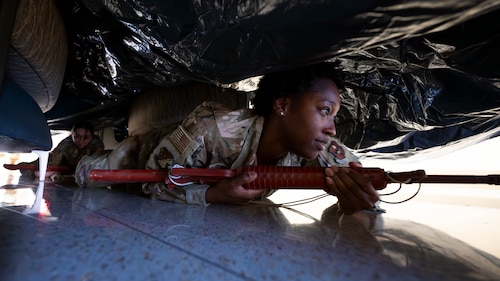
U.S. Air Force Airman 1st Class Da’Ja Thomas, 49th Healthcare Operations Squadron mental technician, low-crawls through an obstacle course during a Medic-X exercise at Holloman Air Force Base, New Mexico, July 16, 2025.
U.S. Air Force Airman 1st Class Da’Ja Thomas, 49th Healthcare Operations Squadron mental technician, low-crawls through an obstacle course during a Medic-X exercise at Holloman Air Force Base, N.M., July 16, 2025. This iteration of Medic-X integrated field exercises for medics who typically perform clinical and administrative duties, allowing them to sharpen their tactical skills while supporting lethal warfighters downrange. (U.S. Air Force photo by Tech. Sgt. Victor J. Caputo)

The Air Force is one of the most lethal parts of the Department of Defense, and the flipside of lethality is the medical skill needed to keep the warfighters in the fight downrange. This more hands-on approach to training was brought about after an education and training member went through the intense two-week Tactical Combat Casualty Care Tier 3 course and realized how important it would be to bring lessons learned to the entire medical group.

“We’re focusing on operating in an austere environment where it’s not going to be calm, it’s not going to be like day-to-day clinic operations,” said U.S. Air Force Capt. Natasha Lindbloom, 49th MDG education and training flight commander. “You could tell somebody to recite the alphabet, but if it’s stressful, they’re going to mess it up. We want our people to be able to do this until they can perform these simple tasks under pressure.”

Although we cannot mirror a battlefield environment, we can put our medics in situations where critical thinking and a sense of urgency fuels their training to ‘kick in.’Chief Master Sgt. Jason Estrada, 49th MDG senior enlisted leader

Coupled with the chance to exercise underutilized but combat-effective skills, the exercise served to underscore the importance of medics who are fit to fight and capable of doing what’s needed when it’s needed in a stressful and possibly deadly environment. A low-crawl obstacle course was put together using furniture and gear inside the clinic, streamlining the flow of training and simulating a more realistic urban environment.
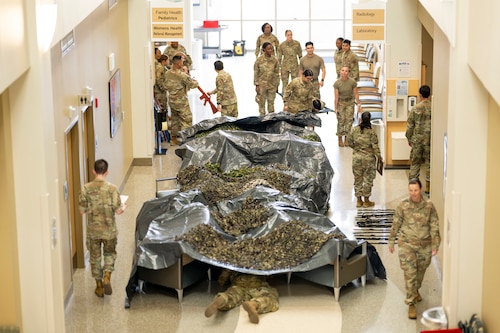
Airmen from the 49th Medical Group rotate between stations during a Medic-X exercise at Holloman Air Force Base, New Mexico, July 16, 2025.
Airmen from the 49th Medical Group rotate between stations during a Medic-X exercise at Holloman Air Force Base, N.M., July 16, 2025. This exercise allowed every member of the medical group to sharpen field skills they are not able to practice every day while providing critical clinical support to Team Holloman. (U.S. Air Force photo by Tech. Sgt. Victor J. Caputo)

“Although we cannot mirror a battlefield environment, we can put our medics in situations where critical thinking and a sense of urgency fuels their training to ‘kick in,’” Estrada said. “Since so few of our current medics possess the real-world experience, it’s our training team that brings these scenarios to life with realism and pressure-induced decision making, which results in the desired sets & reps our teams need to build muscle memory.

Constant Improvement

Medic-X training exercises are not a new concept for medical personnel; in fact, Medic-X was rolled out across the enterprise two years ago and has provided quarterly training objectives to all Defense Health Agency members. The ever-changing global environment and nature of future warfare were other driving factors in the 49th MDG collectively getting ahead of the curve and practicing these critical wartime skills on top of staying adept at their daily clinical duties.

“I’m hoping this gives people the mindset of ‘Hey, I know I’m in this job right now and I’m comfortable, but I’m not always going to be comfortable if we’re put in these situations in real life,’” said U.S. Air Force Senior Airman Claire Pruitt, 49th MDG education and training program manager.

All Airmen take TCCC Tier-1 training that covers the basics of what was formerly known as self-aid and buddy care, while all medics are required to take Tier-2 training to gain more expertise in the ability to treat wounds sustained in combat. Tier-3 training is optional but available for all medics and provides a realistic, grueling experience of austere field conditions and the physical limits that medics can be pushed to in wartime.
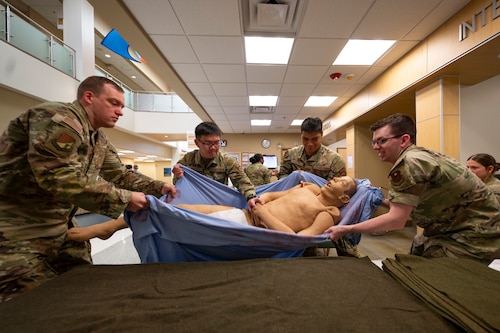
Airmen from the 49th Medical Group transfer a 200-pound training dummy from a gurney to an operating table during a Medic-X exercise at Holloman Air Force Base, New Mexico, July 16, 2025.
Airmen from the 49th Medical Group transfer a 200-pound training dummy from a gurney to an operating table during a Medic-X exercise at Holloman Air Force Base, N.M., July 16, 2025. This exercise allowed every member of the medical group to sharpen field skills they are not able to practice every day while providing critical clinical support to Team Holloman. (U.S. Air Force photo by Tech. Sgt. Victor J. Caputo)

“There’s going to be a bit of a shock factor for people working in a clinic, where even though we’re incredibly busy, a lot of it is just administrative work instead of intense, hands-on medical practice,” Pruitt said. “I’m trying to integrate some of the things that they did with us in a physical aspect at the Tier 3 training so that these Airmen have more experience and understand that if they have to do this in real life tomorrow, it’s not going to be easy. They’ll have to think about getting the patient out of the combat zone, treating their wounds, stopping the bleeding, loading them onto a helicopter, etc.”

The success of the first iteration of integrated field work with Medic-X has laid the groundwork for an ever-improving series of exercises to better prepare Team Holloman’s medics for unpredictable and challenging fights of future conflict.

“Today’s potential adversaries are better equipped and more prepared than any potential foe has ever been,” Estrada said. “For that reason, every uniform-wearing member of our military needs to understand that he/she is one bad day, one ill-guided decision, one perceived threatful action away from finding themselves, in support of our country, inside a combat environment where the old rules may not apply.”
 

Defense News in Brief: Next-gen TOC-L systems announced to boost agile C2 capabilities

Source: United States Airforce

The DAF has announced the upgrade of the Tactical Operations Center-Light capability with its Major Release 2 prototype, designed to advance contributions to Combined Joint All-Domain Command and Control.

The Department of the Air Force recently announced the upgrade of the Tactical Operations Center-Light capability with its Major Release 2 prototype, July 22.

This rapid prototyping effort, developed with support from long-standing industry partners, will deliver more than 40 next-generation TOC-L systems designed to advance the DAF’s contribution to Combined Joint All-Domain Command and Control.

“This has been a major push from our team and industry partners to see the TOC-L MR2 prototype developed with all the lessons learned from MR1,” said Maj. Gen. Luke CropseyDAF’s Program Executive Officer for Command, Control, Communications and Battle Management. “This achievement truly embodies our agile acquisition approach, setting the stage for a phased deployment where we can rapidly field operationally relevant upgrades based on feedback from the field.”

U.S. Air Force photo by Staff Sgt. Noah Sudolcan
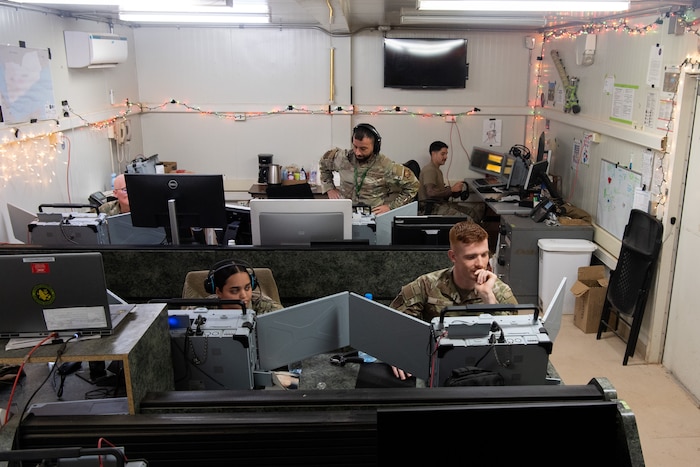
U.S. Air Force Airmen assigned to the 606th Air Control Squadron perform their daily tasks on the Tactical Operations Control – Light command and control system at Camp Lemonnier, Djibouti, Feb. 17, 2025. The 606th Air Control Squadron, callsign “Primo,” is a mobile command and control combat unit “Ready Now” to meet the nation’s call for exceptional tactical C2. (U.S. Air Force photo by Staff Sgt. Noah Sudolcan)

Managed by DAF PEO C3BM’s Advanced Battle Management System Division, the TOC-L integrates data from multiple sources to create a synchronized air picture. The MR2 prototype represents a crucial leap forward for the TOC-L. While 16 MR1 prototypes focused on minimizing the system’s physical footprint, MR2 also prioritizes enhanced integration capabilities.

“The MR2 aims to enhance portability, survivability, mobility and ease of use through reduced size, weight, power, while featuring improved usability and maintainability to reduce training time and improve operational readiness,” said Lt. Col. Micah Graber, ABMS Deployable Systems Branch materiel leader. “The system will also feature ABMS Digital Infrastructure and Cloud-Based Command and Control software capability for enhanced enterprise interoperability and expanded data access within the DAF BATTLE NETWORK.”  

This shift from maneuverability to integration leveraged insights gained from the MR1 prototype’s first operational deployment to Combined Joint Task Force-Horn of Africa, which provided real-world capability assessment. Along with data from prior experiments, recent participation in the U.S. Army’s Project Convergence Capstone 5 also played a vital role in directly informing MR2 requirements, focusing on the system’s integration with other key technologies.   

“The plan for the MR2 prototypes builds upon the lessons learned from the original 16,” said Stephen Ciulla, ABMS TOC-L program manager. “The potential use cases and operational possibilities have expanded over the last 18 months and MR2 development includes more rigorous testing and design validation to ensure that functional and operational requirements are met.”

The MR2 prototype will serve as the execution arm of the DAF BATTLE NETWORK by utilizing ABMS DI to communicate to various sensors and C2 systems, according to Ciulla. This bridges communication gaps between disparate systems, facilitating seamless cross-domain integration and interoperability. CBC2 functionality additionally employs advanced software and artificial intelligence to assist battle managers in prioritizing and executing actions, while advancing human-machine teaming.

“MR2’s integration advancements, enabled by ABMS DI and CBC2, will enable seamless information sharing and improved coordination among warfighters in contested environments, leading to a more cohesive and effective force,” Graber said. “This enhanced interoperability translates into tangible operational advancements by allowing for better-informed decisions and more decisive actions across all levels – tactical, operational and strategic.”

The TOC-L prototype is a critical component of the DAF BATTLE NETWORK, contributing to enhanced situational awareness and decision-making across the battlespace. The MR2 prototype underscores the Air Force’s commitment to delivering cutting-edge technology to the warfighter, ensuring decisive advantage in future conflicts.


Defense News in Brief: U.S.-Philippine Airmen strengthen ties during Cope Thunder 25-2

Source: United States Airforce

PACAF participated in Cope Thunder 25-2, a unique platform that integrates U.S. and Philippine Air Forces and enhances interoperability through bilateral fighter training, subject matter expert exchanges and key leadership engagements.

U.S. Pacific Air Forces and Philippine Air Force members participated in Cope Thunder 25-2, a bilateral training conducted across multiple locations in the Philippines. The exercise aimed to strengthen partnerships and support the Philippine Air Force’s modernization efforts, promoting regional and global stability.

Established in the Philippines in 1976, Cope Thunder provides a unique platform to integrate U.S. and Philippine Air Forces and enhance interoperability through bilateral fighter training, subject matter expert exchanges and key leadership engagements. Cope Thunder 25-2 also marked the first time a U.S. Air Force F-35A Lightning II squadron has deployed to the Philippines.

“It’s obvious that this isn’t a relationship that’s simply on paper,” said Lt. Col. Bryan Mussler, 421st Mission Generation Force Element commander. “We’ve been integrating with them for a long time, and their mentality and approach to operations is very similar to ours.”

Subject matter expert exchanges during the exercise enabled U.S. and Philippine Airmen in similar career fields to share best practices and effective techniques aimed at improving day-to-day operations for both forces. These exchanges included maintenance, firefighting, airfield operations, electromagnetic warfare and basic fighter manoeuvres with U.S. and Philippine pilots flying side by side.

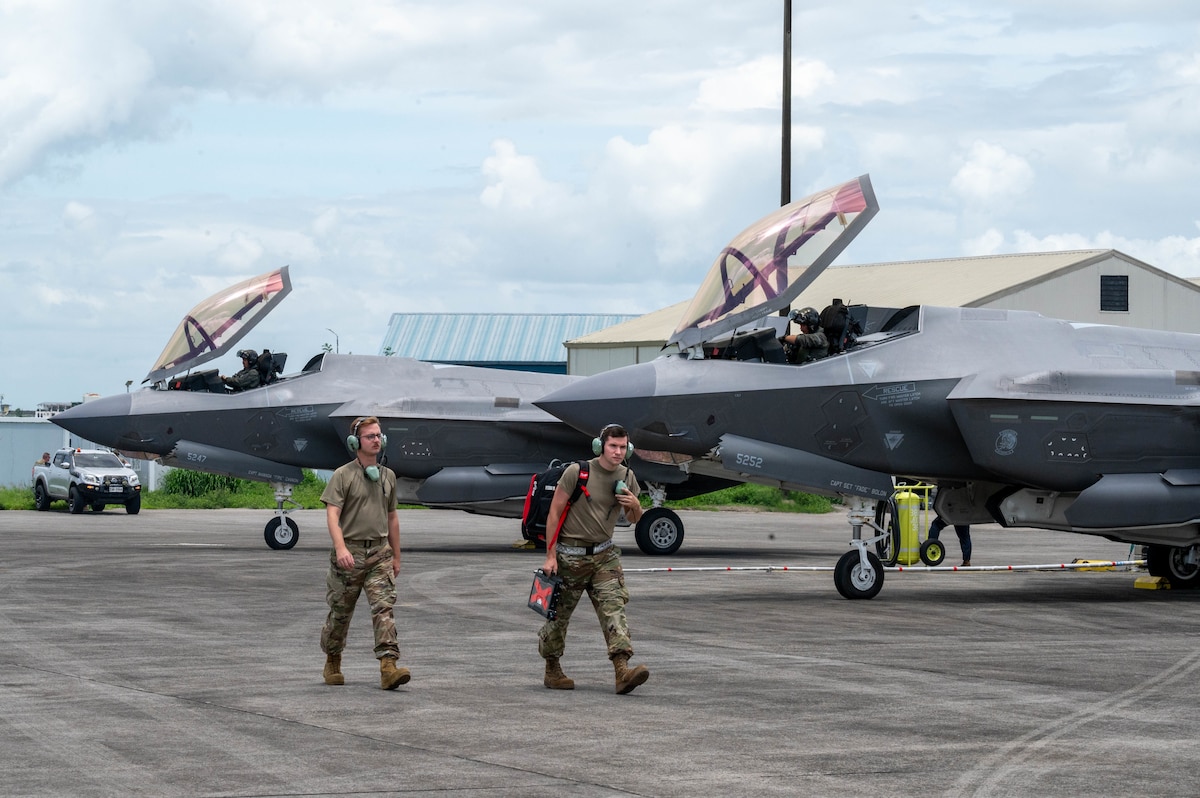
U.S. Air Force maintainers, assigned to the 421st Mission Generation Force Element, depart the flightline after conducting preflight operations on an F-35A Lightning II during Cope Thunder 25-2 at Clark Air Base, Philippines, July 7, 2025. The exercise enhances interoperability between the U.S. Air Force and the Philippine Air Force and supported the Armed Forces of the Philippines' modernization efforts. (U.S. Air Force photo by Airman 1st Class Aden Brown)
U.S. Air Force maintainers, assigned to the 421st Mission Generation Force Element, depart the flightline after conducting preflight operations on an F-35A Lightning II during Cope Thunder 25-2 at Clark Air Base, Philippines, July 7, 2025. The exercise enhances interoperability between the U.S. Air Force and the Philippine Air Force and supported the Armed Forces of the Philippines’ modernization efforts. (U.S. Air Force photo by Airman 1st Class Aden Brown)

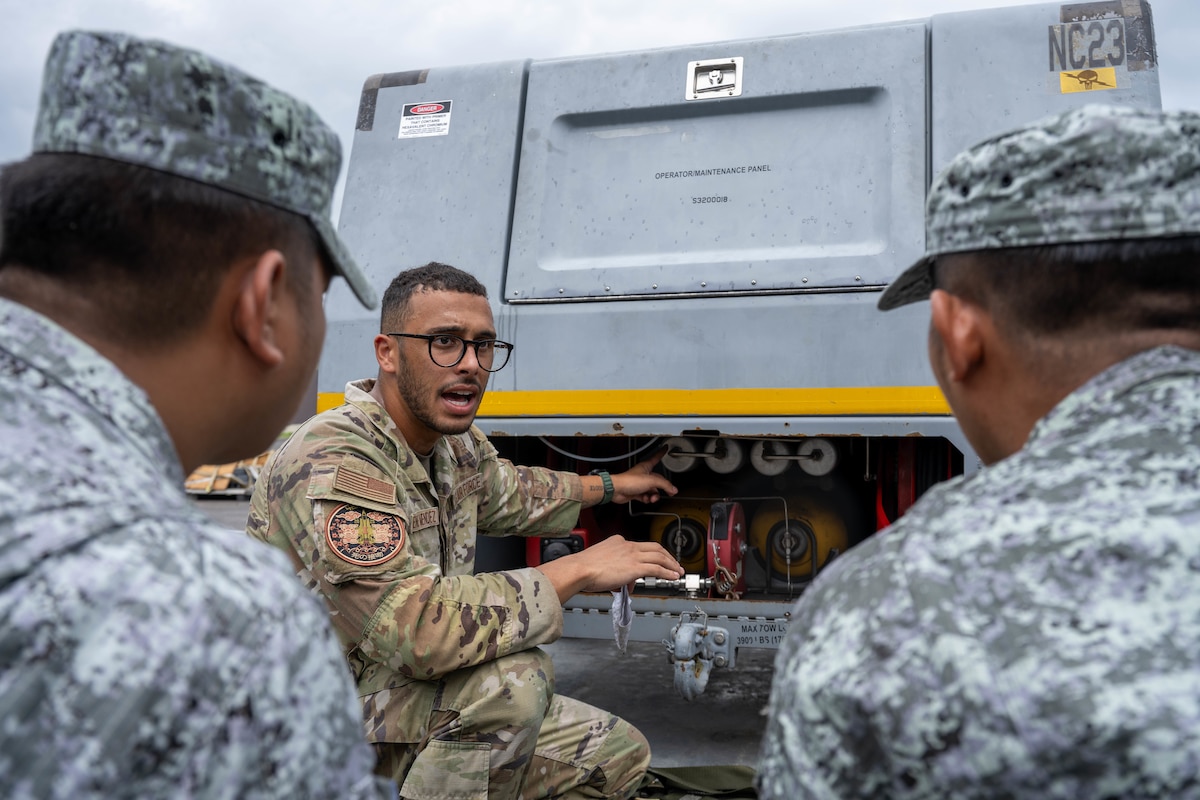
U.S. Air Force Staff Sgt. Arnaldo Puente Mendez, 421st Mission Generation Force Element aerospace ground equipment maintainer, briefs Philippine Air Force airmen on a self generating nitrogen servicing cart during Cope Thunder 25-2 at Clark Air Base, Philippines, July 9, 2025. During the subject matter expert exchange, U.S. Airmen provided valuable insight into equipment used for aircraft maintenance, supporting Armed Forces of the Philippines’ modernization efforts. (U.S. Air Force photo by Airman 1st Class Aden Brown)
U.S. Air Force Staff Sgt. Arnaldo Puente Mendez, 421st Mission Generation Force Element aerospace ground equipment maintainer, briefs Philippine Air Force airmen on a self-generating nitrogen servicing cart during Cope Thunder 25-2 at Clark Air Base, Philippines, July 9, 2025. During the subject matter expert exchange, U.S. Airmen provided valuable insight into equipment used for aircraft maintenance, supporting Armed Forces of the Philippines’ modernization efforts. (U.S. Air Force photo by Airman 1st Class Aden Brown)

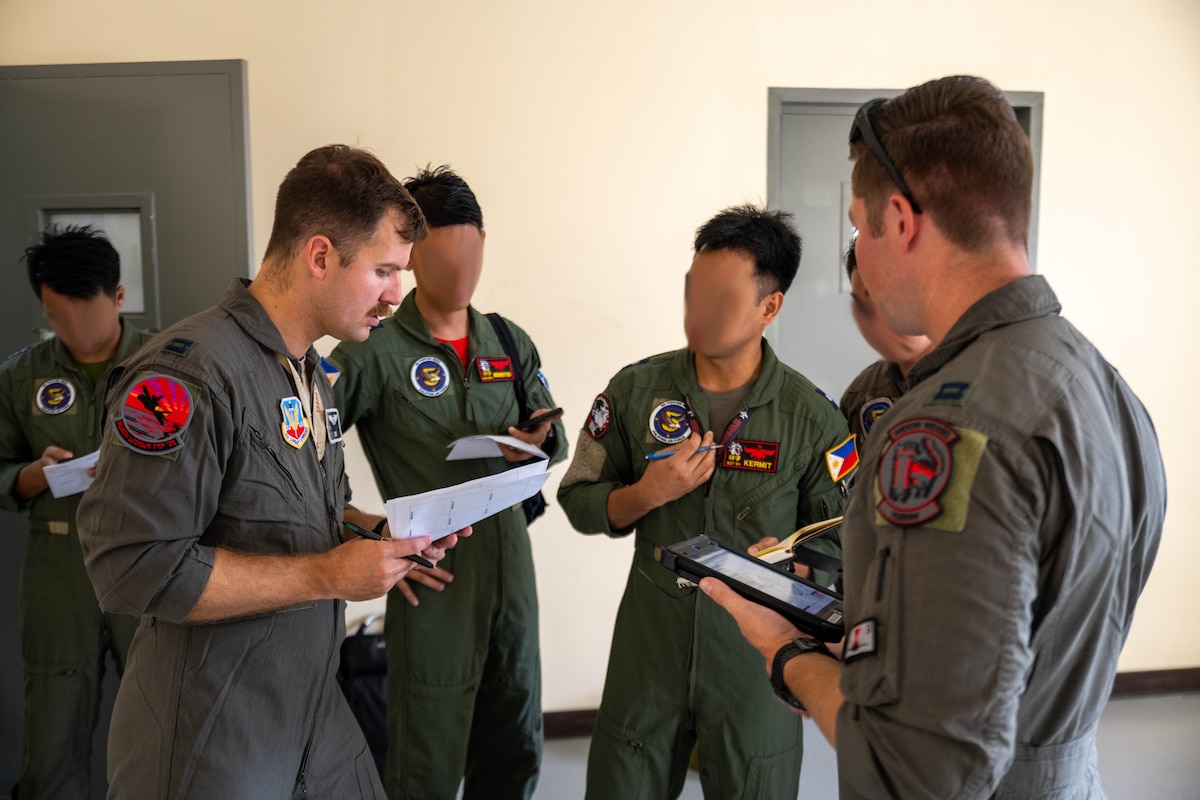
U.S. Air Force Capt. Tyler Rico (2nd left) and Capt. Toney Fisher (right), 421st Mission Generation Force Element F-35A pilots, coordinate flight plans with Philippine Air Force pilots during the Cope Thunder 25-2 exercise at Clark Air Base, Philippines, July 7, 2025. The training conducted between the U.S. and Philippine Air Force strengthens both the ability to respond together for potential future crises, contingencies and natural disasters. (U.S. Air Force photo by Airman 1st Class Aden Brown) (Image blurred for operational security)
U.S. Air Force Capt. Tyler Rico, second to the left, and Capt. Toney Fisher, right, 421st Mission Generation Force Element F-35A pilots, coordinate flight plans with Philippine Air Force pilots during the Cope Thunder 25-2 exercise at Clark Air Base, Philippines, July 7, 2025. The training conducted between the U.S. and Philippine Air Force strengthens both the ability to respond together for potential future crises, contingencies and natural disasters. (U.S. Air Force photo by Airman 1st Class Aden Brown) (Image blurred for operational security)

“We worked closely with the PAF pilots, and it was clear they are professional and highly capable aviators that employ their weapon systems with skill and precision,” said Capt. Tobey Fisher, 421st Mission Generation Force Element F-35A instructor pilot. “Additionally, this exercise afforded the 421st MGFE the opportunity to operate at a remote airfield with minimal support.”

The F-35A maintenance team supported Cope Thunder 25-2 with a lean, agile team, operating with roughly one-third of the personnel they typically have at their home station.

“It’s really cool to see such a small team come here and execute the mission,” said Maj. Clinton Bialcak, 421st Fighter Generation Squadron commander, referring to executing the F-35 maintenance mission. “I think everyone in the region, in the world and in the Department of Defense sees that we can do it and they can rely on us.”

The U.S. Air Force’s participation reflects ongoing efforts to strengthen coordination with regional allies and partners.


Defense News in Brief: CMSAF Flosi highlights Airmen’s agility, readiness during East Africa tour

Source: United States Airforce

CMSAF Flosi met with Airmen during a recent multi-base visit, where he observed how small, agile teams are delivering results in one of the most strategically significant and operationally complex regions in the world.

From low-resource expeditionary hubs to forward operating locations facing real threats, Airmen are staying mission-focused, supporting one another and delivering results in demanding conditions.The visit began at Camp Lemonnier, where Flosi received mission briefings from 449th Air Expeditionary Group leadership and visited squadron work centers. Operating in a constrained environment, Airmen there continue to deliver essential capabilities with flexibility and focus. They are leveraging available technologies to counter a growing small unmanned aerial system threat in the region, an evolving operational concern requiring agile solutions at the tactical edge.

Chief Master Sgt. of the Air Force David Flosi answers questions
Chief Master Sgt. of the Air Force David Flosi answers questions from Airmen assigned to the 475th Expeditionary Air Base Squadron during a Q&A session at Manda Bay, Kenya, July 12, 2025. The visit gave Flosi the opportunity to engage directly with Airmen across East Africa, address their concerns and recognize their contributions to regional security. (U.S. Air Force photo by Tech. Sgt. Timothy Hayden)

“The AFRICOM AOR is a challenging environment,” Flosi said. “You continue to operate in a low-resource setting, executing the mission with focus and flexibility to counter threats in the region.”

The senior leader then traveled to Camp Simba, Manda Bay, Kenya, where the deployed team is embodying the “Mission Ready” mindset. Airmen are stepping outside their core Air Force Specialty Codes to fill mission gaps, support each other and sustain forward operations, often in joint and host-nation integrated environments.

Chief Master Sgt. Ben Weavers, senior enlisted leader of the 475th Expeditionary Air Base Squadron, said the visit highlighted the growing strategic relevance of Manda Bay.

“It was great to highlight the strong partnership we share at Manda Bay with our host nation Kenyans, sister services and tenant units,” Weavers said. “They were impressed with what our Airmen are doing in support of our nation.”

Weavers said the visit helped reframe the narrative of Manda Bay from a site that was formerly attacked by enemy combatants to a vital node of partner engagement and operational readiness.

“We’ve moved beyond the legacy of the 2020 attack to a stronger security posture that allows us to focus on partnership building,” he explained. “We’ve conducted weekly knowledge exchanges with our Kenyan partners across disciplines like medical, maintenance, air transportation, civil engineering, and more.”

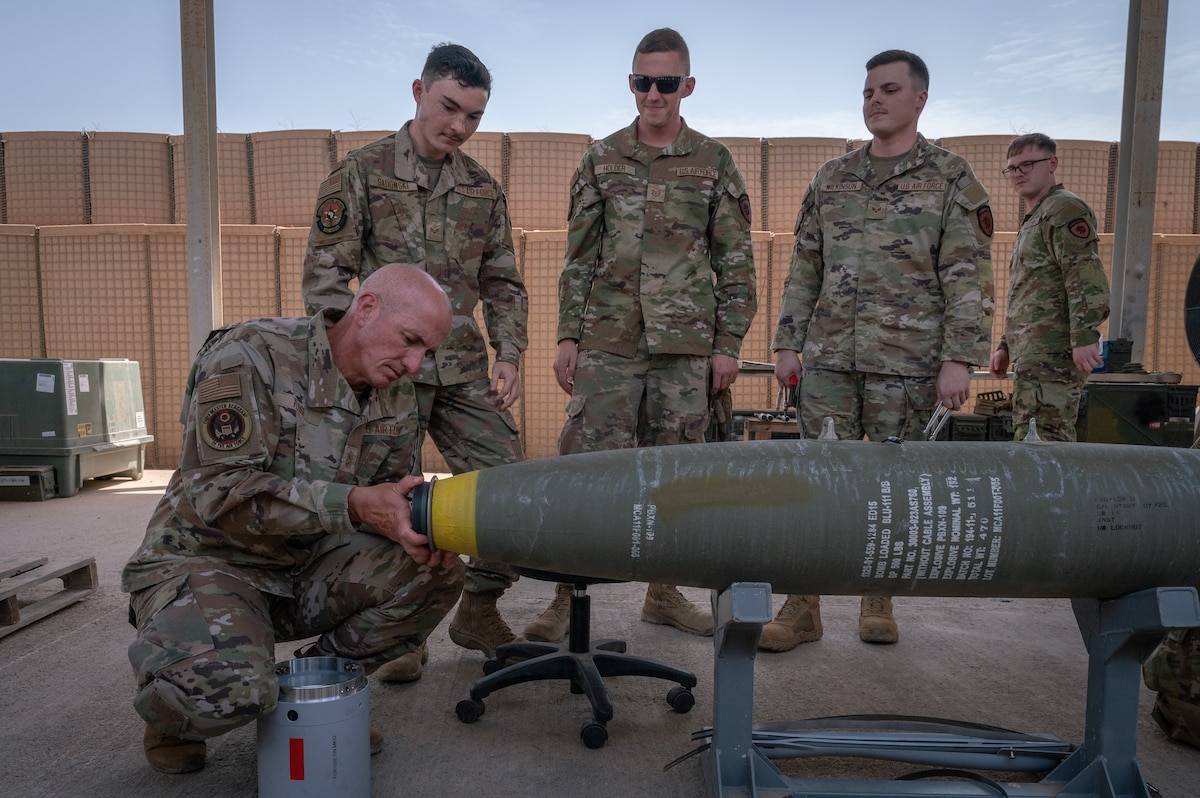
Chief Master Sgt. of the Air Force David Flosi assists munitions Airmen
Chief Master Sgt. of the Air Force David Flosi assists munitions Airmen assigned to the 776th Expeditionary Air Base Squadron with assembling a precision-guided munition at Chabelley Airfield, July 13, 2025. Flosi visited deployed Airmen across East Africa to engage with them directly, gain insight into their mission capabilities, and recognize their contributions to regional security. (U.S. Air Force photo by Tech. Sgt. Timothy Hayden)
Chief Master Sgt. of the Air Force David Flosi poses for a photo
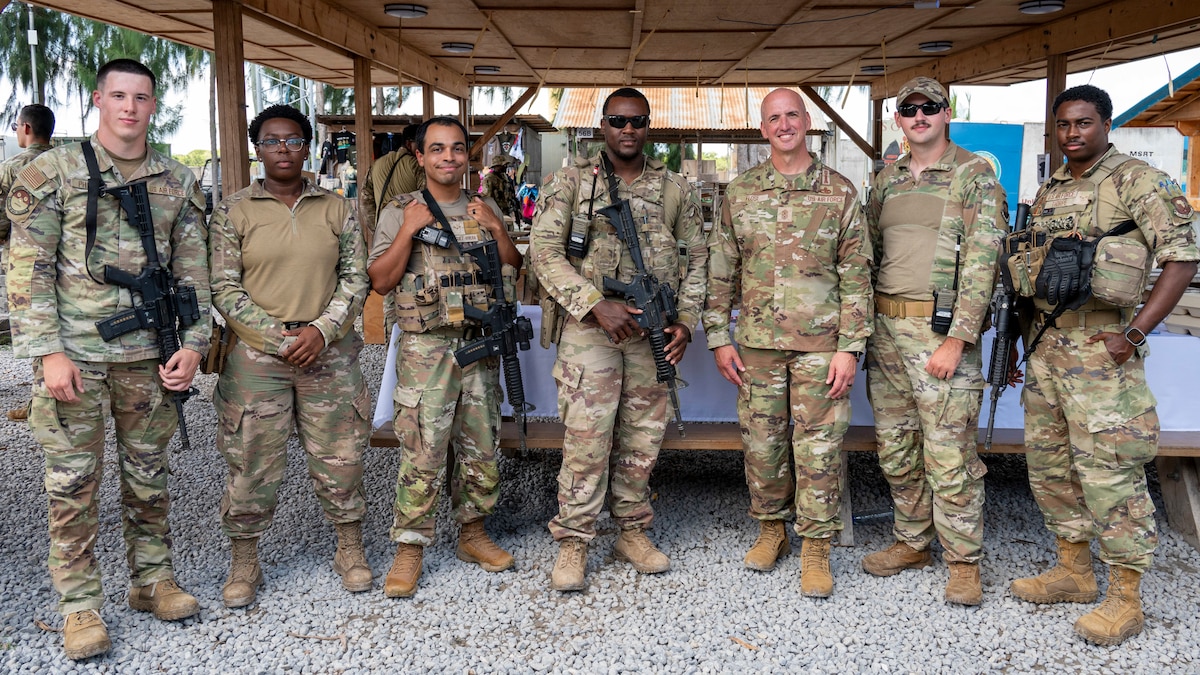
Chief Master Sgt. of the Air Force David Flosi, third from right, poses for a photo with 475th Expeditionary Air Base Squadron Airmen following the conclusion of his Q&A panel as part of a visit to Manda Bay, Kenya, July 12, 2025. The visit allowed the senior leader to engage directly with Airmen across East Africa, addressing their concerns and recognizing their contributions to regional security. (U.S. Air National Guard photo by Staff Sgt. Kevin Ray J. Salvador)
CMSAF and Sgt launch done
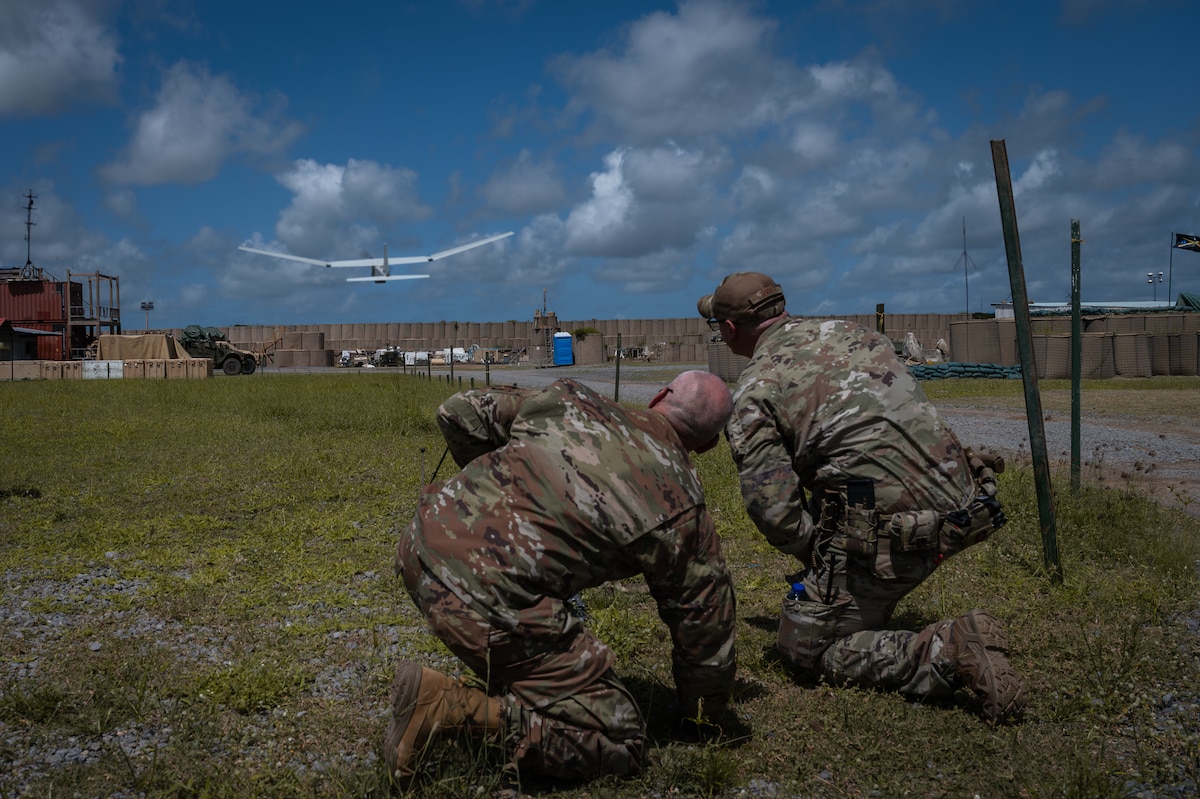
Chief Master Sgt. of the Air Force David Flosi assists U.S. Air Force Staff Sgt. Logan Terrell, a Small Unmanned Aircraft System program manager assigned to the 475th Expeditionary Air Base Squadron, with launching a Puma drone during a visit to Manda Bay, Kenya, July 12, 2025. The visit allowed Flosi to connect with Airmen across East Africa, hear their concerns, and recognize their contributions to regional security. (U.S. Air Force photo by Tech. Sgt. Timothy Hayden)

Lt. Col. Michael S. Ryan, commander of the 475th EABS, described the visit as a success, noting the valuable engagement between deployed personnel and senior leadership.

“CMSAF was able to interact with our deployed Airmen. The question-and-answer session allowed for two-way communication between Department of the Air Force leadership and our Airmen accomplishing the mission,” Ryan said. “We provided CMSAF the importance of Manda Bay and the mission here,” he added.

“We showcased our Airmen and the uniqueness of this deployment. Everything we do here is by, through and with the Kenyans.”

He also noted the positive response from his team.

“Multiple Airmen thanked local leadership for the opportunity to interact with CMSAF,” Ryan said. “This allowed them the opportunity to speak what is on their minds to our highest level of leadership.”

On the final day of the tour, Flosi visited Chabelley Airfield, where Airmen support critical intelligence, surveillance and reconnaissance operations. Here, he helped build a laser-guided bomb and observed how Airmen and Soldiers are detecting and deterring UAS threats with advanced counter-sUAS systems.

These missions play out just miles from the People’s Liberation Army Support Base in Djibouti, a visible reminder of the region’s strategic weight and the importance of maintaining a consistent, capable U.S. presence.

A consistent theme across locations was the deployment of small Unit Type Codes rather than fully aligned teams. Leaders noted that aligning future rotations with the Air Force’s Unit of Action concept, sending cohesive, trained teams that arrive and operate together from day one, may help improve readiness and continuity in the region.

“The missions you support are vital to regional security,” Flosi said. “You’re holding the line, and your work underscores the strategic significance of this region and the importance of a consistent and capable U.S. presence.”


Defense News in Brief: Living Namesake Rides First Set of Sea Trials for DDG 124

Source: United States Navy

In a rare moment of living history, ship namesake and Medal of Honor recipient, Col. Harvey “Barney” Barnum Jr. joined members of future USS Harvey C. Barnum Jr.’s (DDG 124) crew, the Navy programmatic team, and industry partners onboard the ship’s first set of sea trials, departing from General Dynamics Bath Iron Works, July 15.

Defense News in Brief: 510th Buzzards, a history of excellence

Source: United States Airforce

Nine pilots from the 510th Expeditionary Fighter Squadron at Aviano Air Base earned Single-Event Air Medals, and two were simultaneously awarded the Distinguished Flying cross, after returning from a deployment to the Central Command area of responsibility. During the deployment, they flew various defensive counter air sorties to protect U.S. Naval assets traveling through the Bab el Mandeb Strait, breaking records along the way.

“As the new Buzzard Commander, I am honored and humbled to lead such an accomplished team,” said Lt. Col. Brent Smith, the newly appointed commander of the 510th EFS. “The legacy of excellence, dedication and professionalism is inspiring and motivating. It’s a privilege to step into this role and work alongside some of the most talented and mission-focused individuals in the Air Force.”

During the deployment, the Buzzards flew 8,800 hours and 1,400 total sorties.

“The Buzzards supported a variety of missions, including Inherent Resolve’s fight against ISIS, Operation Prosperity Guardian’s protection of coalition partners and civilian vessels in the Red Sea, Operation Spartan Shield’s defense of US interests in the Arabian Gulf, and many other force protection and deterrence missions,” Smith said.

The 510th EFS has a long history of excellence, beginning in 1943 as the 625th Bombardment Squadron until being re-designated the 510th Fighter-Bomber Squadron later that same year.

After being stationed at various locations across the globe and experiencing multiple periods of activation and inactivation, the 510th EFS was permanently reactivated in 1994, establishing its current home at Aviano AB, Italy.

The 510th EFS has been the highest flown PSAB fighter unit since 2019, highest flown Aviano deployed unit since 2010, and the highest flown rotation fighter unit in the area of responsibility.

The Buzzards have flown combat missions during World War II, the Vietnam War, Operation Desert Storm, Operation Provide Comfort, Operation Deny Flight and many more. During their most recent deployment to support Operation Prosperity Guardian, the squadron exuded excellence while protecting American assets overseas.

“Each decoration represents not only a specific event, but also the precision, teamwork and unwavering commitment to the mission required to successfully execute in combat,” Smith said. “They represent countless hours of preparation, sacrifice and high intensity training by the whole Buzzard operations and maintenance team. They are proof of a culture that demands and delivers high performance every single day.”