New Britain Man Sentenced to Seven Years in Federal Prison for Trafficking Cocaine While on Supervised Release

Source: US FBI

Marc H. Silverman, Acting United States Attorney for the District of Connecticut, announced that AKEEM MANOO, 34, of New Britain, was sentenced today by U.S. District Judge Vernon D. Oliver in Hartford to 84 months of imprisonment, followed by four years of supervised release, for possessing with intent to distribute cocaine, and for committing the offense while on supervised release from a prior federal conviction.

According to court documents and statements made in court, on March 26, 2016, Manoo was sentenced in New Haven federal court to 120 months of imprisonment and five years of supervised release for his participation in a gang-related narcotics trafficking conspiracy.  He was released from federal prison in November 2022.  On May 11, 2023, Manoo was arrested after Hartford Police stopped his vehicle and found him in possession of nearly a half-kilogram of cocaine.

Manoo pleaded guilty on October 30, 2024.

Judge Oliver sentenced Manoo to 68 months of imprisonment for the cocaine distribution offense, and an additional 16 months of imprisonment for violating the conditions of his supervised release.

This investigation was conducted by the FBI’s Northern Connecticut Gang Task Force and the Hartford Police Department.  The case was prosecuted by Assistant U.S. Attorney Brendan J. Keefe.

Wethersfield Woman Admits Role in Scheme That Defrauded Connecticut’s Medicaid Program of More Than $1.8 Million

Source: US FBI

Marc H. Silverman, Acting United States Attorney for the District of Connecticut, announced that SUHAIL APONTE, 38, of Wethersfield, waived her right to be indicted and pleaded guilty today before U.S. District Judge Stefan R. Underhill in Bridgeport to a health care fraud offense related to a Medicaid fraud scheme.

The Connecticut Medical Assistance Program (CTMAP) is a Connecticut Department of Social Services-administered program that provides medical assistance to low income persons.  CTMAP’s benefit packages, referred to as “HUSKY” or “Connecticut Medicaid,” are jointly funded by the State of Connecticut and the federal government.

According to court documents and statements made in court, Aponte was the sole principal and registered agent of Minds Cornerstone LLC, dba Minds Cornerstone Behavior Therapy Services (“Minds Cornerstone”), an Autism Specialist Group, which was registered with the State of Connecticut in June 2021.  Beginning in approximately November 2021, Aponte, who is not a licensed provider, was involved in a scheme in which she and a co-conspirator used Minds Cornerstone to defraud the Connecticut Medicaid Program by submitting fraudulent claims for applied behavior analysis (“ABA”) services to children diagnosed with Autism Spectrum Disorder (“ASD”).  The scheme involved billing for Medicaid for services purportedly rendered to patients when company payroll records indicate employees were not compensated for the associated services; direct supervision services purportedly provided by a Board Certified Behavior Analyst (“BCBA”) of a behavioral technician, when the corresponding procedure code for behavioral technician services was not billed; services purportedly rendered to patients who were actually in an inpatient hospital; and services purportedly rendered when parents of patients and former employees of Minds Cornerstone confirmed those services did not occur.

Between November 2021 and January 2025, Aponte and her co-conspirator submitted or caused to be submitted to Medicaid fraudulent claims that resulted in a loss of approximately $1,876,617 to the Connecticut Department of Social Services.

From approximately May 2022 until November 2024, Aponte was also employed by the State of Connecticut in the Office of Policy and Management.

Aponte pleaded guilty to conspiracy to commit health care fraud, which carries a maximum term of imprisonment of 10 years.

As part of her plea, Aponte has agreed to the forfeiture of approximately $459,000 in funds seized from various bank accounts she controlled, as well as her interest in additional bank accounts and two parcels of land in Hartford.

Judge Underhill scheduled sentencing for July 30.

Aponte has been released on a $100,000 bond since her arrest on January 16, 2025.

This investigation is being conducted by the Federal Bureau of Investigation, the U.S. Department of Health and Human Services, Office of the Inspector General (HHS-OIG), and the Medicaid Fraud Control Unit of the Connecticut Chief State’s Attorney’s Office, with the assistance of the Connecticut Department of Social Services.  The case is being prosecuted by Assistant U.S. Attorney David T. Huang.

Three Charged with Trafficking Narcotics in the Naugatuck Valley

Source: US FBI

Marc H. Silverman, Acting United States Attorney for the District of Connecticut, Anish Shukla, Acting Special Agent in Charge of the New Haven Division of the Federal Bureau of Investigation, Stephen P. Belleau, Acting Special Agent in Charge of the Drug Enforcement Administration for New England, today announced that a federal grand jury in Hartford returned a 10-count indictment today charging KEYSHON ZIMMERMAN, also known as “AJ,” “Ace,” and “Slick,” 39, of Stratford; ROBERT SMITH, also known as “Mookie,” 43, of Ansonia; and MAHOGANY PETTWAY-STOKES, 45, of Ansonia with offenses related to the trafficking of fentanyl and cocaine in the Naugatuck Valley.

As alleged in court documents and statements made in court, an investigation by the FBI New Haven Transnational Organized Crime Task Force and the DEA New Haven District Office (NHDO) Task Force determined that Zimmerman and Smith were distributing fentanyl, cocaine, and prescription opioids in Connecticut’s Lower Naugatuck Valley.  Zimmerman and Smith shared a phone used to coordinate drug transactions.  Zimmerman typically used the phone in the morning and early afternoon and Smith used the phone in the late afternoon into the evening. Between July 2024 and April 2025, investigators made multiple controlled purchase of narcotics from Zimmerman, Smith, and Pettway-Stokes.

Zimmerman, Smith, and Pettway-Stokes were arrested on April 23, 2025.  It is alleged that as investigators entered Zimmerman’s residence on Main Street in Stratford, they located Zimmerman in a bathroom attempting to flush fentanyl in a toilet.  In association with the arrests, a search of Zimmerman’s residence revealed a large quantity of unpackaged fentanyl and cocaine, drug processing and packaging materials, and approximately $21,000 in cash.  Searches of two cars parked in Stratford and Ansonia used by Zimmerman revealed additional quantities of fentanyl and cocaine, narcotic pills, a .40 caliber semi-automatic pistol with an obliterated serial number, and a 9mm caliber semi-automatic pistol with an extended magazine.  A search of a residence shared by Smith and Pettway-Stokes on Wakelee Avenue in Ansonia revealed two handguns, and a search of an apartment on Olivia Street in Derby revealed narcotics processing and packaging materials, including a kilogram press.

The indictment charges Zimmerman, Smith, and Pettway-Stokes with one count of conspiracy to distribute, and to possess with intent to distribute, fentanyl and cocaine.  As to this charge, based on the type and quantity of drug attributed to each defendant, Zimmerman faces a mandatory minimum term of imprisonment of 10 years and a maximum term of imprisonment of life, and Smith and Pettway-Stokes each faces a maximum term of imprisonment of 20 years.

The indictment also charges Zimmerman, Smith, and Pettway-Stokes with multiple substantive counts related to the possession and distribution of controlled substances.  Zimmerman is also charged with two counts of possession of a firearm in furtherance of a drug trafficking crime, an offense that carries a mandatory consecutive term of imprisonment of at least five years on each count.

Zimmerman and Smith are currently detained and Pettway-Stokes is released on a $75,000 bond.

Acting U.S. Attorney Silverman stressed that an indictment is not evidence of guilt.  Charges are only allegations, and each defendant is presumed innocent unless and until proven guilty beyond a reasonable doubt.

This matter is being investigated by the FBI New Haven Transnational Organized Crime Task Force and the DEA New Haven District Office (NHDO) Task Force.  The FBI Task Force includes participants from the Connecticut State Police and the North Haven, New Haven, East Haven, Milford, and Brookfield Police Departments, and the DEA Task Force includes participants from the U.S. Marshals Service, Internal Revenue Service – Criminal Investigation Division, Connecticut State Police and the New Haven, Waterbury, East Haven, Branford, West Haven, Ansonia, Meriden, Naugatuck, and Shelton Police Departments.  The case is being prosecuted by Assistant U.S. Attorney Geoffrey M. Stone.

This case is part of Operation Take Back America, a nationwide initiative that marshals the full resources of the Department of Justice to repel the invasion of illegal immigration, achieve the total elimination of cartels and transnational criminal organizations (TCOs), and protect our communities from the perpetrators of violent crime.  Operation Take Back America streamlines efforts and resources from the Department’s Organized Crime Drug Enforcement Task Forces (OCDETF) and Project Safe Neighborhood (PSN).

Greenwich Investment Group Operator Pleads Guilty to Fraud, Money Laundering Offenses

Source: US FBI

Marc H. Silverman, Acting United States Attorney for the District of Connecticut, today announced that JUSTIN C. MURPHY, 50, of Stamford, pleaded guilty yesterday before U.S. District Judge Victor A. Bolden in New Haven to offenses stemming from an investment fraud scheme.

According to court documents and statements made in court, Murphy owned and operated Greenwich-based Mara Investment Group, LLC, also known as Mara Investment Management LP and Mara Investments Global Management LLC (“Mara”), which Murphy purported to be a hedge fund that solicited and accepted investments and used a quantitative strategy that balanced long and short positions in securities.  Between approximately 2016 and September 2022, Murphy defrauded investors by pursuing a much riskier investment strategy than he told investors; diverting substantial investor funds for his own personal use and benefit; representing to investors that their invested funds were performing more favorably than was, in fact, the case, including providing investors with account statements that falsely representing their account balances; and providing investors with federal tax forms that falsely reported business income upon which investors would be required to pay tax.

Murphy stole approximately $3,465,812 in investor funds through this scheme and used the funds to pay for personal expenses and to purchase a personal stake in his relative’s startup company.

Murphy pleaded guilty to one count of wire fraud, which carries a maximum term of imprisonment of 20 years, and one count of money laundering, which carries a maximum term of imprisonment of 10 years.  A sentencing date is not scheduled.

Murphy was arrested in Brazil on December 6, 2023, and was detained for nearly 11 months while awaiting extradition to the U.S.  He has been released on a $250,000 bond since November 1, 2024.

This investigation has been conducted by the Federal Bureau of Investigation and the Internal Revenue Service – Criminal Investigation Division.  The Justice Department’s Office of International Affairs and Brazilian authorities provided assistance.

The case is being prosecuted by Assistant U.S. Attorney David E. Novick.

Illinois Man Admits Trying to Arrange Florida Murder

Source: US FBI

CAPE GIRARDEAU – A man from Illinois on Wednesday admitted trying to have a business associate in Florida murdered.

Ben Patrick Mullavey, 66, of Mechanicsburg, in Sangamon County, pleaded guilty in U.S. District Court in Cape Girardeau to one felony count of use of interstate commerce facilities in the commission of attempted murder-for-hire. As part of his plea, Mullavey admitted offering cash to a former employee to commit the murder.

On Jan. 3, 2024, Mullavey picked up the former employee in Missouri and took him to a McDonald’s restaurant. There, Mullavey flashed a stack of cash and said he wanted his business partner killed. On Jan.11, 2024, the employee drove to Mullavey’s house. During the next three days, the employee helped Mullavey with construction work as they discussed the murder. Mullavey said he had been planning the murder for months, had conducted surveillance of the victim in Florida and had stolen a Florida license plate in preparation for the murder. Mullavey suggested the best time and place to commit the murder and how to avoid being identified on surveillance cameras. He also discussed several possible ways of disposing of the victim’s body, including using lime to dissolve it. Many of the conversations were audio and video recorded.

On Jan. 13, 2024, the employee left Mullavey’s home with orders to kill the victim. Mullavey also gave him a crossbow, arrows, the stolen Florida license plate, handwritten directions to a restaurant located next door to the victim’s business and $2,100 in cash, Mullavey’s plea agreement says.

Mullavey is scheduled to be sentenced July 22. The attempted murder-for-hire charge is punishable by up to 10 years in prison, a $250,000 fine or both.

The FBI investigated the case. Assistant U.S. Attorney Christopher Shelton is prosecuting the case.

‘Keeping America Left-of-Boom Safe’

Source: US FBI

The FBI is the lead federal agency for responding to WMD threats. The Bureau’s program has existed since 1995, but in 2006 it shifted to a more operational posture as the Weapons of Mass Destruction Directorate inside the Bureau’s National Security Branch. The directorate, located at FBI Headquarters, develops the overall policy, guidance, and countermeasures for operators in the field. In FBI field offices across the U.S., WMD coordinators put it all into action.

“We’re the boots on the ground,” said Caviggiola.

Their primary roles include training first responders, partners, and even fellow agents and task force officers on the different modalities of WMD investigations—chemical, biological, radiological, nuclear, and explosive, often referred to as CBRNE. They are subject matter experts who coordinate the tactical responses when WMDs are suspected.

In the Vermont case, for example, WMD coordinator Tom Stewart led all the responding agencies through the FBI’s Threat Credibility Evaluation (TCE) to determine the gravity of the threat and develop a plan of action. While the TCE process follows strict guidelines established by national policy for interagency responses, the FBI also developed a 14-point checklist—available on an FBI phone application—that helps WMD coordinators and first responders evaluate and process scenes that may not rise to the level of Headquarters involvement.

“We’re constantly in a state of being an investigator and being an educator,” Stewart said. Indeed, many WMD coordinators wear multiple hats: the full cadre includes SWAT operators, special agent bomb technicians, and members of evidence response teams (ERT) and hazardous evidence response teams (HERT). Like each of those disciplines, WMD coordinators receive extensive training and certifications before stepping into the uniquely dangerous role.

National Police Week

Source: US FBI

“To our FBI Family, to our federal, state, local, and Tribal law enforcement partners, and to our law enforcement partners around the world,” Director Wray said, “please know you have my gratitude for all you have done—and all you continue to do—to protect our communities.”

At the National Law Enforcement Officers Memorial in Washington, D.C., the names of 282 officers killed in the line of duty were added this year to two curving, 304-foot-long limestone walls containing the names of more than 24,000 fallen law enforcement personnel. The memorial, which rests on three acres of federal park land, was dedicated in 1991 and contains names dating back to the first known death in 1786.

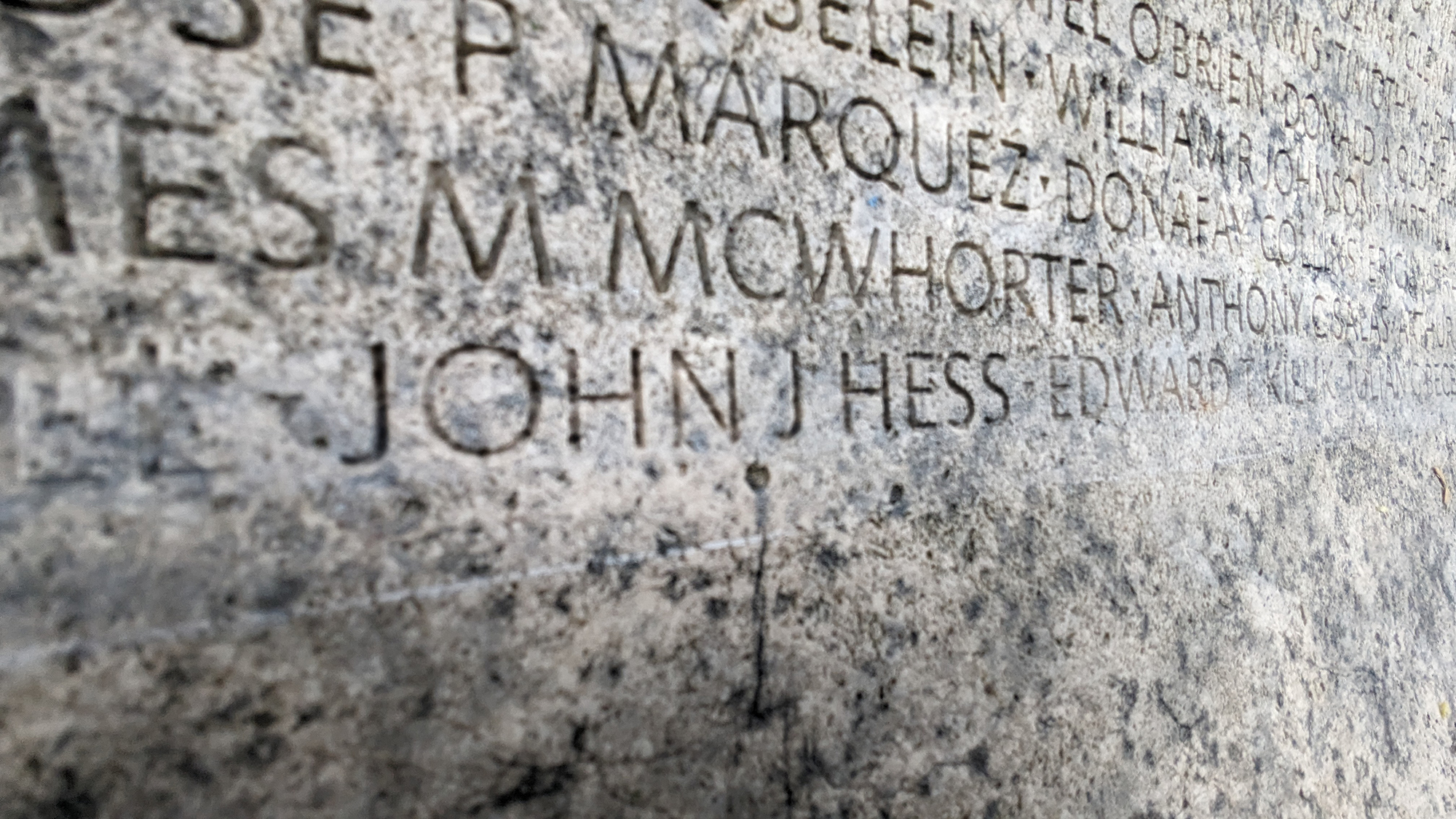
Among the new names etched into the stone memorial is that of retired FBI Special Agent John “Jack” Hess, who died last August of cancer he developed from toxic debris he encountered at the Pentagon on 9/11. Five years ago, Hess was among a cadre of vocal advocates pressing special agents and other 9/11 first responders to get check-ups and register for health benefits through the September 11th Victim Compensation Fund.  

John “Jack” Hess’ name was added this year to the National Law Enforcement Officers Memorial.

“Don’t be afraid to go out and get screened and find that something’s wrong with you, whether it’s related to 9/11 or not,” Hess said in 2019. “You can still get sick from this. If you had exposure back at 9/11 or the days after, then please register for the World Trade Center benefit screening program.” Hess is among those being added this year to the FBI’s Wall of Honor.

Hopi Special Agent Returns Home to Seek Justice for Tribal Communities

Source: US FBI

Preserving Hopi Heritage

Himel is proud of his heritage and the Hopis who helped pave the way for him, including the Hopi Code Talkers, who developed a code language used to assist U.S. military efforts during World War II.

“Everyone knows about the Navajo Code Talkers, but there were code talkers from a lot of Tribes throughout the United States, including Hopi,” Himel said. “Some were my extended family and relatives.”

Beyond his investigative duties, Himel remains committed to preserving Native heritage and language. As a member of the FBI’s American Indian and Alaska Native Advisory Committee, he advocates for initiatives promoting cultural sensitivity and inclusivity within the Bureau.

It is about acknowledging the importance of language and understanding, Himel explained. Words matter, especially when it comes to fostering stronger relationships with Native communities.

Reflecting on his journey, Himel’s pride in his community and heritage is apparent. “Becoming an FBI agent is something I’m proudest of,” he said. “There’s no one from my community of more than 20,000 that is an FBI agent—I’m the only one.”

But he doesn’t want it to stay that way, explaining it takes more people and resources to make an impact.

“I didn’t think my path would lead me here,” said Himel. “But it’s doable—and showing people in Indian country that this is something you can be and something you can accomplish is important.”

Elder Fraud, in Focus

Source: US FBI

Elder fraud complaints to the FBI’s Internet Crime Complaint Center (or IC3) increased by 14% in 2023, and associated losses increased by about 11%, according to IC3’s 2023 Elder Fraud Report, released April 30.  

This annual publication provides statistics about incidents of elder fraud—or fraud that explicitly targets older Americans’ money or cryptocurrency—that are reported to IC3. The report aims to raise the public’s awareness of this issue and to prevent future and repeat incidents. 

“Combatting the financial exploitation of those over 60 years of age continues to be a priority of the FBI,” wrote FBI Assistant Director Michael D. Nordwall, who leads the Bureau’s Criminal Investigative Division, in the report. “Along with our partners, we continually work to aid victims and to identify and investigate the individuals and criminal organizations that perpetrate these schemes and target the elderly.” 

And elder fraud is probably a more insidious threat than the report shows. Many of these crimes likely go unreported, and, as the report states, “only about half” of the fraud scam complaints submitted to IC3 in 2023 included victims’ ages.

Here are five key takeaways from the 2023 report

1. Elder fraud is an expensive crime. Scams targeting individuals aged 60 and older caused over $3.4 billion in losses in 2023—an increase of approximately 11% from the year prior. The average victim of elder fraud lost $33,915 due to these crimes in 2023. 

2. Older Americans seem to be disproportionately impacted by scams and fraud. Over 101,000 victims aged 60 and over reported this kind of crime to IC3 in 2023. On the flip side, victims under the age of 20 years old seemed to be the least-impacted demographic, with about 18,000 victims in this demographic reporting suspected scams or frauds to IC3 last year. 

3. Tech support scams were the most widely reported kind of elder fraud in 2023. Nearly 18,000 victims aged 60 and over reported such scams to IC3. Personal data breaches, confidence and romance scams, non-payment or non-delivery scams, and investment scams rounded out the top five most common types of elder fraud reported to IC3 last year.  

Investigating Environmental Crimes: The Huntington Oil Spill

Source: US FBI

In January 2021, the Los Angeles Port, one of the country’s largest and busiest shipping hubs, had effectively become a parking lot. COVID-19 had significantly slowed shipping rates globally, and dozens of 150,000-ton cargo ships were backed up and anchored in tight proximity to one another, creating a dangerous situation with little room for error. One or more of these ships was suspected to have damaged the pipeline. But the FBI would need to collect more data to narrow the list of which ships it could have potentially been.

In addition to assisting in the sample collection, USERT also worked to map the impact site. At 100 feet down with little natural light and murky ocean environments, the human eye could not effectively observe the surrounding area.

To address this, the FBI used sidescan sonar. Deployed from a remotely operated vehicle, the sonar would be pinged repeatedly. The intent was to divide the area into grids and use multiple sidescan sonar launches to fill in the grids. Dozens of missions over time would yield data for the entire area.

There are several things one can infer from sonar data, including the time it takes the sound to return gives depth. And the strength of the return can tell you what kind of material the sound is reflecting off of. A weak signal indicates muddy, sedimentary ocean floor. Stronger signals can indicate rocky bottom or foreign objects such as metal and concrete.

Summers turned the raw sonar data into a picture of the ocean floor around the break site that showed a few key details. First, the pipeline indeed was out of alignment from where it should have been, another indication it had been dragged. Second, in the soft ocean floor were furrows—scars left by an anchor that had dragged across the ocean floor and ultimately had snagged on the San Pedro pipeline.

The FBI used sidescan sonar, seen here, to help provide data to map the ocean floor surrounding the break.

A sample of the sonar data provided back. The long horizontal rows show the path of the sidescan sonar. Each section was laid side-by-side to produce a larger image of the ocean floor at the break site.